



- Uganda's workforce of 22.8 million is growing rapidly, with recruitment agencies recording a 4x increase in job listings year-on-year in H1 2025, making it an increasingly active market for international hiring and EOR services.
- EOR costs in Uganda range from $199 to $599 per employee per month. Gloroots offers a strong balance of compliance coverage and cost predictability at $199 per month, backed by a 4.8 out of 5 G2 rating.
- Uganda payroll requires monthly UGX processing with employer NSSF contributions of 10% and progressive PAYE withholding up to 40% managed through URA filings. Selecting an EOR with direct Employment Act 2006 compliance expertise is essential to avoid statutory penalties.
Uganda's workforce stands at 22.8 million with 81% labor participation, and recruitment agencies recorded a 4x increase in job listings year-on-year in H1 2025, signaling rapid expansion in formal employment demand.
This guide delivers an expert-backed comparison of the top EOR providers operating in Uganda, covering compliance capabilities, pricing structures, and country coverage to help you make a well-informed hiring decision for your business.
Our evaluation approach includes:
- Customer and buyer interviews
- Review site analysis
- Hands-on platform testing
Gloroots is included in this comparison as one of the providers reviewed. This listing does not reflect paid placements. Rankings and evaluations are based on objective criteria, with no commercial influence on provider positioning.
Use this guide to choose confidently.
What Is an EOR in Uganda?
An Employer of Record in Uganda is a third-party legal employer that manages payroll, taxes, and compliance obligations under the Employment Act 2006, NSSF pension framework, and URA tax requirements on your behalf.
An EOR enables companies to hire in Uganda without establishing a local legal entity, handling all employment contracts, payroll administration, and statutory benefits management.
EOR responsibilities in Uganda include:
- Managing payroll in UGX
- Handling PAYE and URA taxes
- Drafting employment contracts
- Administering statutory benefits
- Managing NSSF compliance reporting
Startups, scaleups, and enterprises use EOR services to build and manage teams in Uganda without the overhead of setting up a local corporate subsidiary.
Detailed Comparison of Best EOR Service Providers in Uganda 2026
Who Are the Best EOR Service Providers in Uganda?
1. Gloroots
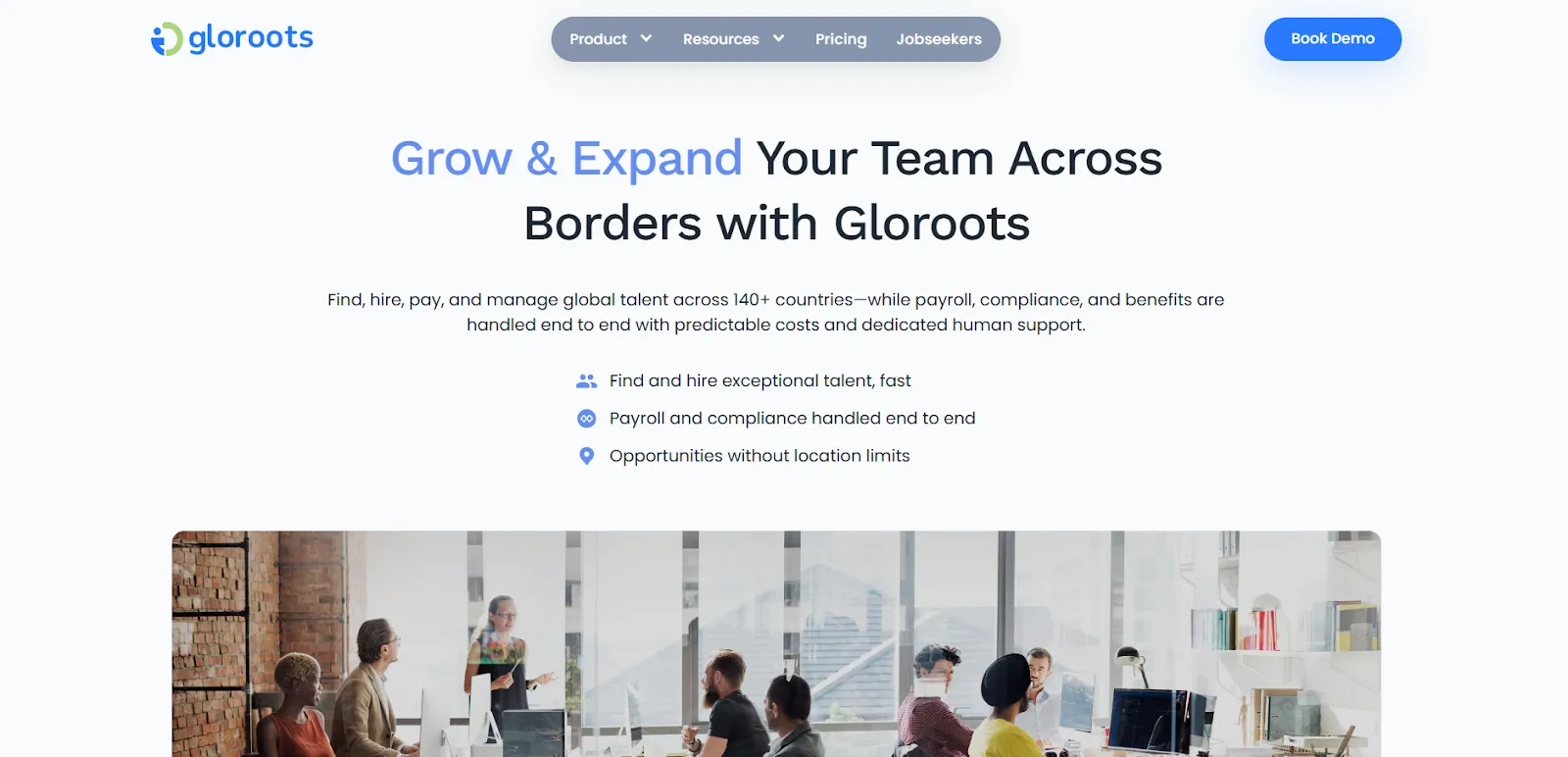
Gloroots is a compliance-centric global employment platform operating across 140+ countries, including Uganda, suited for risk-averse companies prioritizing governance and regulatory adherence over pure hiring speed.
Gloroots enables companies to manage payroll, employment contracts, NSSF pension contributions, statutory benefits, and Employment Act 2006 compliance in Uganda through a centralized platform.
A modern compliance dashboard with employee classification accuracy and dedicated payroll and compliance specialists differentiates Gloroots from traditional EOR providers.
Key Features
- Compliance monitoring dashboards providing real-time visibility into Uganda Employment Act 2006 obligations and NSSF statutory requirements.
- Payroll and statutory benefits management covering NSSF contributions, annual leave, maternity entitlements, and sick pay for Uganda-based employees.
- Employment contracts drafted to Uganda Employment Act 2006 standards, covering working hours, pay, leave entitlements, and notice terms.
- Compliance-driven onboarding within one to two weeks, prioritizing regulatory accuracy over speed for risk-averse hiring programs.
- Centralized workforce visibility platform giving HR and finance teams oversight of headcount, payroll costs, and compliance status across all countries.
Customer Review
Gloroots holds a G2 rating of 4.8 out of 5, reflecting strong customer confidence in its compliance platform and global employment capabilities.
Pros
- Competitive pricing at $199 per employee per month provides strong compliance coverage at a mid-range cost for Uganda hiring.
- Employee classification accuracy reduces misclassification risk for companies building formal full-time teams under Uganda's Employment Act.
- Dedicated payroll and compliance specialists provide retained-context support for NSSF filings and URA tax obligations in Uganda.
Cons
- One-to-two week onboarding timeline is slower than some providers offering 24 to 48-hour employment setup for urgent hiring needs.
- Newer platform than several established competitors, with a developing track record in some emerging or specialized African markets.
- Comprehensive service packages may carry higher costs for companies needing advanced tiers beyond the base EOR plan.
Pricing
Gloroots EOR services start at $199 per employee per month, with transparent pricing and no hidden compliance or support charges.
Hire in Uganda without opening a local entity
Access top Ugandan talent with Gloroots EOR while we manage local labor laws, CBAs, social contributions, and benefits. Book a Demo
{{hiring-power="/components"}}
2. Safeguard Global

Safeguard Global is a global EOR suited for companies that need compliant remote hiring in Uganda without establishing a local entity, managing payroll, taxes, benefits, and contracts end-to-end.
Safeguard Global enables companies to employ workers in Uganda with full payroll processing, tax compliance, and statutory benefits administration under the Employment Act 2006 framework.
Comprehensive payroll, tax, and benefits compliance management across a global footprint differentiates Safeguard Global for enterprises requiring structured employment infrastructure in Uganda.
Key Features
- Full payroll management and statutory tax compliance for Uganda-based employees, covering PAYE withholding and employer NSSF contributions.
- Employment contract management aligned with Uganda's Employment Act 2006, covering notice periods, leave entitlements, and probation terms.
- Statutory benefits administration for Uganda employees, including annual leave, maternity entitlements, sick pay, and pension contributions.
- Global employment platform supporting compliant remote hiring in Uganda without the need for a local corporate subsidiary or entity.
Pros
- Comprehensive compliance coverage across payroll, taxes, and benefits reduces employment risk for companies entering the Uganda market.
- Entity-free employment model removes the overhead and cost of local subsidiary setup for companies hiring in Uganda.
- Structured employment contract management aligned with Uganda's Employment Act ensures legal compliance from day one of hiring.
Cons
- Pricing at $499 per employee per month is higher than budget-tier options like Remofirst at $199 per month for Uganda.
- No specific public cons data was found for Safeguard Global's Uganda services in the research available for this comparison.
- Higher pricing may not be accessible for early-stage companies or those managing employment in a small number of markets.
Pricing
Safeguard Global charges $499 per employee per month for EOR services, positioning it as a mid-to-premium option for Uganda employment.
3. Remote People

Remote People is a global EOR with Uganda-specific compliance coverage, suited for companies requiring full NSSF, URA, and Employment Act 2006 adherence alongside work permit support for expatriate workers.
Remote People enables companies to employ workers in Uganda with employment contracts aligned to the Employment Act 2006, NSSF contributions, and work permit management for expat hires.
Full NSSF and URA compliance handling combined with work permit support differentiates Remote People for companies hiring both local and expatriate employees in Uganda.
Key Features
- Employment contracts drafted under Uganda's Employment Act 2006, covering hours, pay, leave, notice periods, and probation requirements.
- NSSF contribution management and URA PAYE withholding handling for all Uganda-based full-time employees.
- Work permit support for expatriate employees, covering the full compliance process for foreign workers employed in Uganda.
- Full statutory compliance management reducing misclassification and employment law violation risk for international hiring programs.
Pros
- Full NSSF and URA compliance handling reduces statutory filing risk for companies building formal teams in Uganda.
- Work permit support for expatriate employees provides an important additional capability for companies hiring foreign nationals.
- Employment contracts aligned with Uganda's Employment Act 2006 ensure legal compliance from the point of onboarding.
Cons
- No public starting price is available for Remote People, requiring direct contact to assess total per-employee employment costs.
- Absence of published pricing makes budget planning harder for finance teams comparing EOR options for Uganda hiring.
- Limited public customer review data makes independent performance validation for Uganda-based employment more difficult.
Pricing
No public starting price is available for Remote People in Uganda. Companies should contact the provider directly for pricing details.
4. Workforce Africa

Workforce Africa is an Africa-focused HR outsourcing and EOR provider operating in Uganda, suited for companies prioritizing local regulatory alignment and regional expertise in East African employment markets.
Workforce Africa enables companies to manage NSSF, PAYE, and statutory payroll obligations in Uganda through a locally focused HR outsourcing and employment compliance model.
Alignment with local Ugandan employment regulations and HR outsourcing expertise differentiates Workforce Africa for companies seeking a regionally specialized employment partner.
Key Features
- HR outsourcing and payroll compliance management covering NSSF contributions and PAYE withholding for Uganda-based employees.
- Local employment regulations alignment ensuring contracts, benefits, and payroll meet Uganda's statutory requirements under the Employment Act.
- Regional Africa expertise providing context-specific guidance for companies building teams across East African employment markets.
- Entity-free employment model enabling companies to hire in Uganda without the overhead of establishing a local subsidiary.
Pros
- Local regulations alignment ensures Uganda employment contracts and payroll meet all statutory obligations under the Employment Act 2006.
- Regional HR outsourcing expertise provides country-specific guidance for companies entering East African employment markets.
- Africa-focused model reduces the compliance knowledge gap for companies without in-house Uganda employment law expertise.
Cons
- No public starting price is available for Workforce Africa, requiring direct contact to understand total per-employee employment costs.
- Africa-only coverage limits suitability for companies planning multi-region global expansion beyond the African continent.
- Limited public customer review data makes independent performance validation for Uganda employment more difficult.
Pricing
No public starting price is available for Workforce Africa in Uganda. Companies should contact the provider directly for pricing details.
5. Cedar Africa Group

Cedar Africa Group is a Uganda-focused EOR suited for companies seeking a cost and time-efficient alternative to entity setup, with local talent insights and full employment compliance management.
Cedar Africa Group enables companies to employ workers in Uganda with contracts, payroll in UGX, statutory benefits administration, and full Employment Act compliance managed locally.
Cost and time efficiency compared to entity setup, combined with local talent insights, differentiates Cedar Africa Group for companies entering the Uganda market for the first time.
Key Features
- Employment contracts, UGX payroll processing, and statutory benefits management aligned with Uganda's Employment Act 2006 requirements.
- Local talent insights supporting companies with market-specific guidance when building teams in Uganda for the first time.
- Cost and time-efficient employment model providing a practical alternative to the overhead of local subsidiary establishment.
- Full statutory compliance management covering NSSF contributions, PAYE withholding, and Employment Act obligations for Uganda employees.
Pros
- Cost and time efficiency compared to entity setup reduces overhead for companies entering the Uganda market for the first time.
- Local talent insights provide market-specific guidance that supports effective team building in Uganda's employment landscape.
- Full employment compliance management covering contracts, payroll, and statutory benefits reduces internal HR administrative burden.
Cons
- No public starting price is available for Cedar Africa Group, requiring direct contact to assess per-employee employment costs.
- Uganda-specific focus may limit suitability for companies planning multi-country expansion beyond East Africa simultaneously.
- Limited public customer review data makes independent performance validation for Uganda employment more difficult.
Pricing
No public starting price is available for Cedar Africa Group in Uganda. Companies should contact the provider directly for pricing details.
6. Remofirst

Remofirst is a global EOR operating across 185+ countries, including Uganda, recommended for Africa hiring programs and suited for companies prioritizing competitive pricing with broad international coverage.
Remofirst handles onboarding, payroll processing, and statutory benefits for employees in Uganda, providing a cost-accessible employment option for budget-conscious international hiring programs.
Competitive pricing at $199 per employee per month and broad 185+ country coverage differentiate Remofirst for companies prioritizing cost efficiency in global employment.
Key Features
- Employee onboarding, payroll management, and statutory benefits administration for workers across 185+ countries, including Uganda.
- Competitive pricing at $199 per employee per month, among the lowest base rates available for Uganda EOR services.
- Africa coverage specifically recommended for companies building remote teams across East African and wider continental markets.
- Broad 185+ country platform enabling companies to manage multi-region international employment from a single provider.
Pros
- Competitive pricing at $199 per employee per month makes Remofirst one of the most cost-accessible EOR options for Uganda.
- 185+ country coverage provides a broad global employment platform that scales beyond Uganda as international hiring grows.
- Africa market coverage makes Remofirst a practical option for companies building teams across multiple East African countries.
Cons
- No specific public cons data for Remofirst's Uganda services was found in the research available for this comparison.
- Partner-network dependency for some African markets may affect compliance consistency compared to direct-entity providers.
- Limited Uganda-specific review data makes independent performance validation for East Africa hiring more difficult.
Pricing
Remofirst charges $199 per employee per month, making it one of the lowest-priced EOR options available for Uganda employment programs.
7. Multiplier

Multiplier is a global EOR recommended for Uganda and Africa hiring programs, suited for companies seeking cost-effective global employment with a centralized compliance management platform.
Multiplier enables companies to manage global workforce compliance in Uganda through a centralized employment platform covering payroll, statutory obligations, and benefits administration.
Cost-effective positioning below premium-tier providers and global workforce compliance capabilities differentiate Multiplier for companies evaluating Uganda alongside other international markets.
Key Features
- Global workforce compliance management covering payroll, statutory benefits, and employment law obligations for Uganda-based employees.
- Cost-effective EOR pricing at $400 per employee per month, positioned below Deel and Remote for comparable global coverage.
- Centralized employment platform enabling companies to manage Uganda alongside other international hiring markets from a single system.
- Global country coverage supporting employment operations across multiple markets for internationally distributed workforce programs.
Pros
- Cost-effective pricing at $400 per month offers a mid-range option below premium providers for Uganda EOR services.
- Global compliance platform supports companies managing employment across Uganda and multiple other international markets simultaneously.
- Centralized management reduces vendor fragmentation for companies scaling headcount across Africa and other global regions.
Cons
- No specific public cons data for Multiplier's Uganda services was found in the research available for this comparison.
- Pricing at $400 per month is above budget-tier options like Remofirst at $199 for companies with tighter cost constraints.
- Limited Uganda-specific review data makes independent performance validation for East Africa hiring more difficult.
Pricing
Multiplier charges $400 per employee per month, offering a mid-range EOR option for companies hiring in Uganda and other global markets.
8. Thera
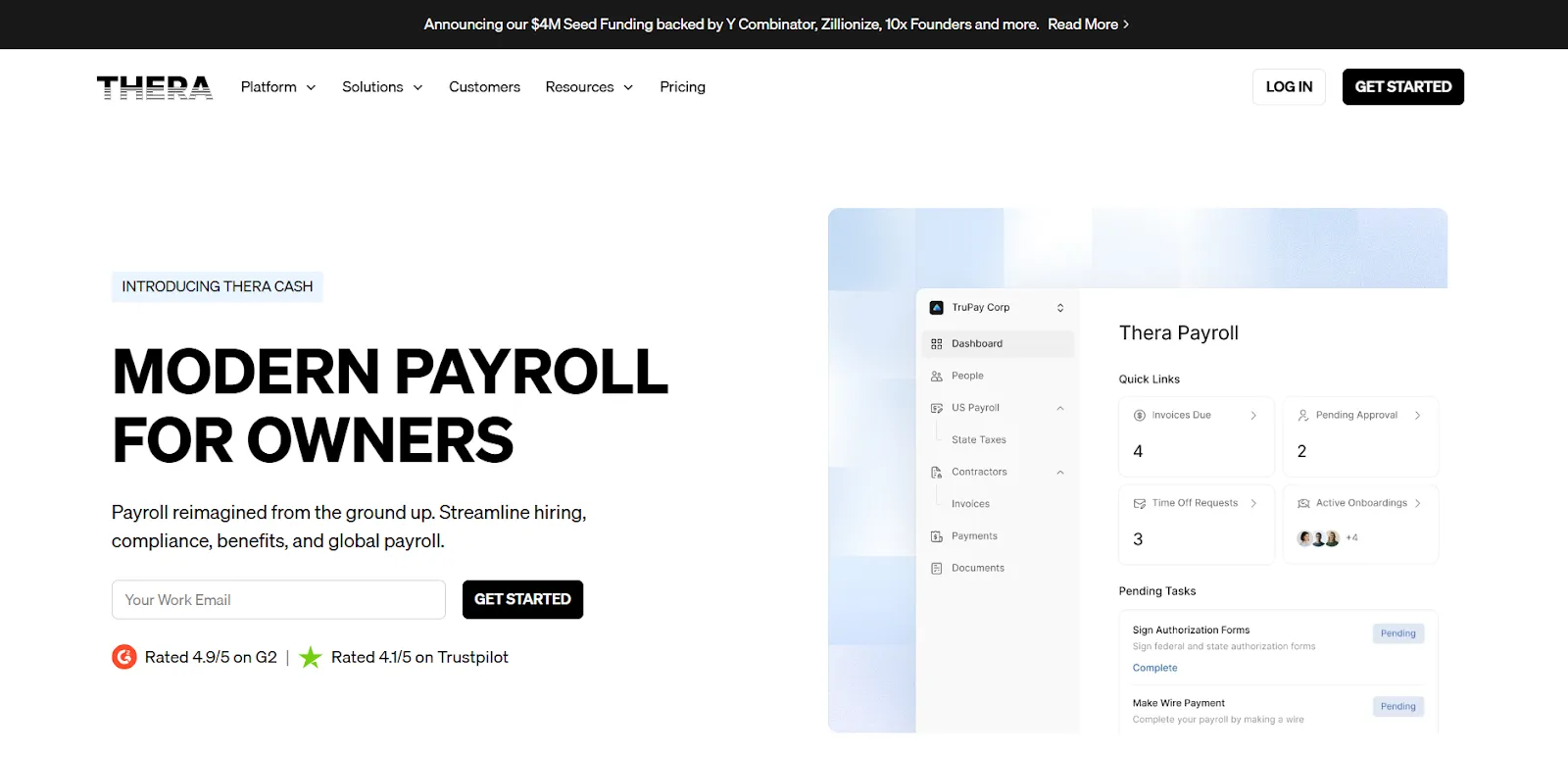
Thera is an EOR with Africa coverage, suited for companies building international teams across African markets including Uganda, with a focus on emerging market employment support.
Thera enables companies to manage international employment expansion in Uganda and other African markets through a platform designed for cross-border workforce operations.
Africa market suitability and international expansion support differentiate Thera for companies building distributed teams across emerging East African employment markets.
Key Features
- International employment expansion support covering Uganda and other Africa markets within a 174+ country operational framework.
- Africa-suited employment model providing relevant compliance and payroll infrastructure for companies entering East African markets.
- Cross-border workforce management supporting companies that need a single EOR solution for multi-country Africa employment programs.
- Entity-free employment model enabling companies to hire in Uganda without establishing a local corporate subsidiary or entity.
Pros
- Africa market suitability makes Thera a relevant option for companies building distributed teams across East African employment markets.
- International expansion focus supports companies entering Uganda as part of a broader multi-country Africa hiring program.
- Entity-free employment removes the overhead of local subsidiary setup for companies entering Uganda for the first time.
Cons
- No public starting price is available for Thera, requiring direct contact to assess total per-employee employment costs in Uganda.
- Uganda-specific coverage confirmation is qualified in the research, requiring direct verification with the provider before committing.
- Limited public customer review data makes independent performance validation for Uganda employment more difficult.
Pricing
No public starting price is available for Thera in Uganda. Companies should contact the provider directly for pricing details.
9. Deel
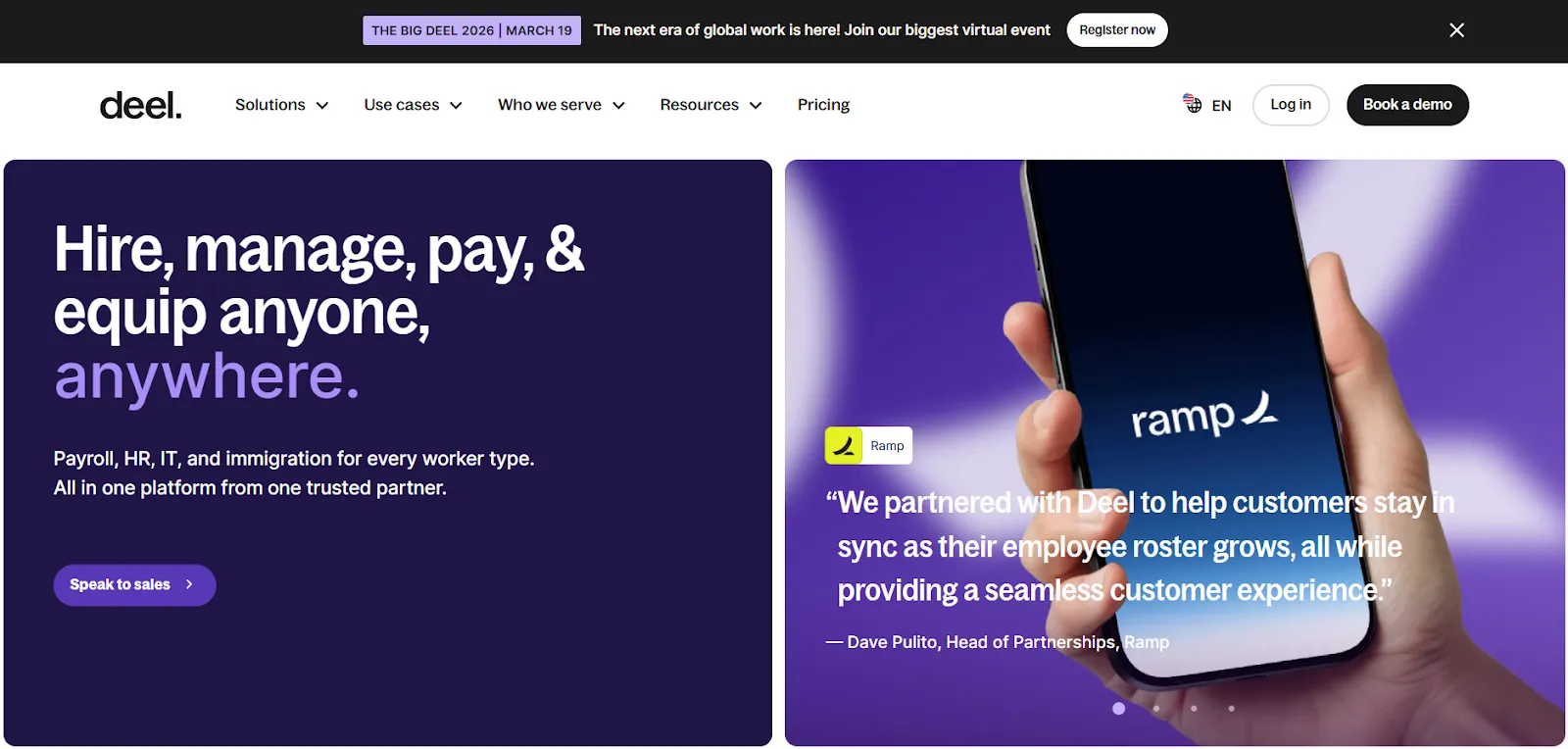
Deel is a global EOR platform across 150+ countries, suited for companies requiring a unified employee and contractor management platform with HR integrations and localized employment contracts.
Deel enables companies to employ workers in Uganda with localized employment contracts, HR workflow automation, and 24/7 support through a unified global platform.
Localized contract management and HR integrations combined with a high G2 rating differentiate Deel for companies managing complex multi-country workforce programs including Uganda.
Key Features
- Localized employment contracts aligned with Uganda's Employment Act 2006, covering statutory terms, notice periods, and leave entitlements.
- HR integrations and payroll automation supporting efficient workforce management for globally distributed international employment programs.
- Unified platform managing both full-time employees and contractors across 150+ countries from a single centralized dashboard.
- Around-the-clock customer support providing assistance for Uganda payroll, compliance, and onboarding queries across all time zones.
Customer Review
Deel holds a G2 rating of 4.6 out of 5, reflecting strong and consistent customer satisfaction across its global employment and contractor management platform.
Pros
- Localized employment contracts for Uganda reduce the risk of Employment Act 2006 non-compliance from the point of onboarding.
- HR integrations and automation reduce manual coordination overhead for teams managing Uganda alongside other global employment markets.
- High G2 rating of 4.6 out of 5 reflects consistent customer satisfaction across Deel's global employment platform capabilities.
Cons
- Pricier add-ons and premium pricing between $499 and $599 per month increase total costs compared to budget-tier EOR options.
- Higher pricing may not be accessible for early-stage companies or teams with limited Uganda employment budgets.
- Add-on cost structure may complicate budget forecasting for finance teams managing total per-employee employment costs.
Pricing
Deel EOR services are priced between $499 and $599 per employee per month, positioning it as a premium option in this Uganda comparison.
10. Remote
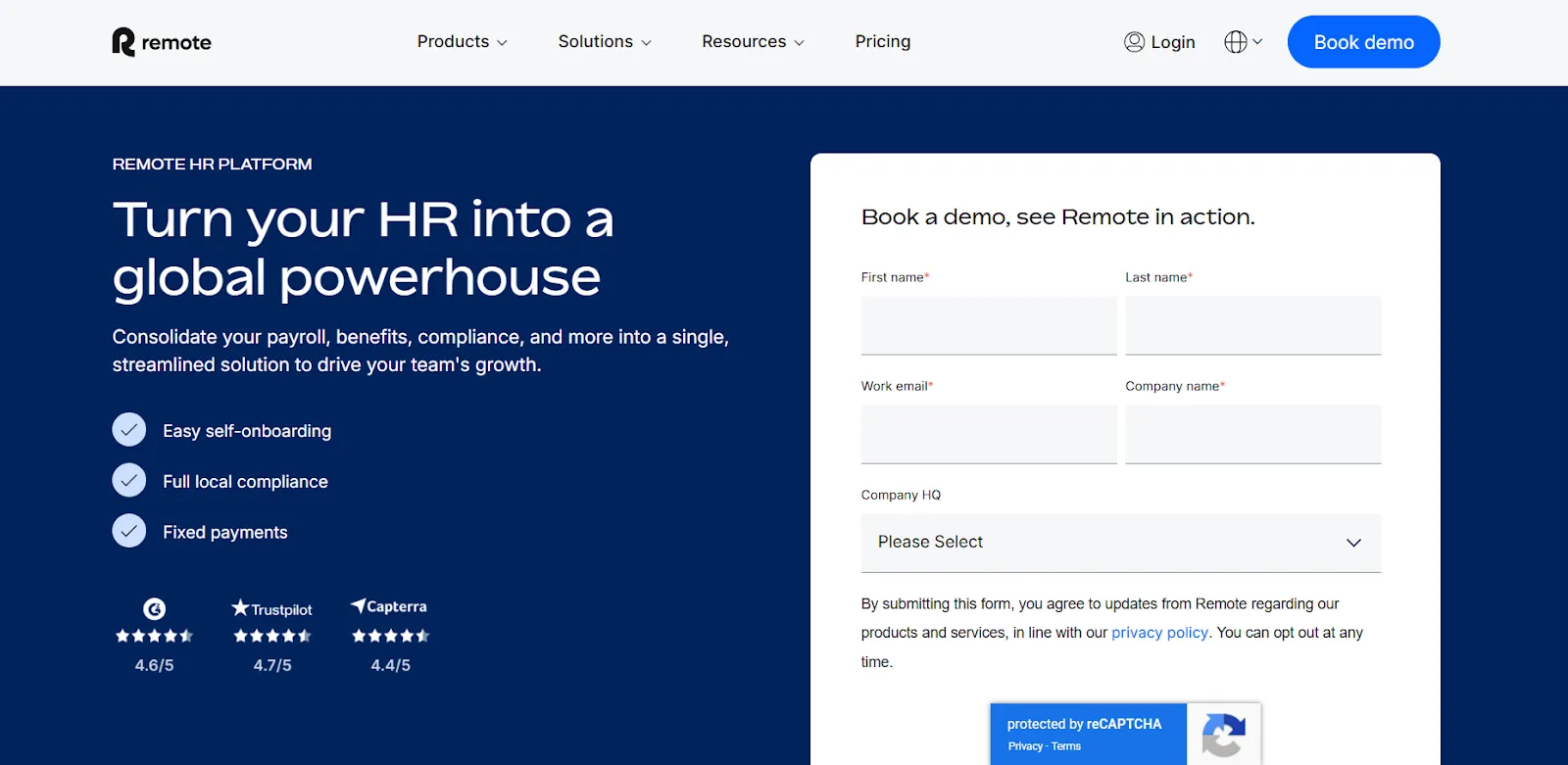
Remote is a premium global EOR with owned-entity infrastructure across 82+ EOR markets, suited for enterprises requiring direct compliance execution and intellectual property protection for Uganda teams.
Remote enables companies to employ workers in Uganda with multi-currency payroll, IP Guard protection, and owned-entity compliance management through an enterprise-grade global platform.
Owned-entity employment infrastructure and IP Guard feature differentiate Remote for enterprises prioritizing direct compliance execution without partner-network dependency in Uganda.
Key Features
- Owned-entity employment model ensuring direct compliance execution in supported markets without reliance on third-party partner networks.
- IP Guard feature protecting intellectual property rights for companies employing international team members with access to proprietary systems.
- Multi-currency payroll processing across 52 currencies, supporting accurate UGX and other international salary disbursements.
- Enterprise-grade employment infrastructure covering Uganda payroll, statutory benefits, NSSF contributions, and Employment Act compliance.
Customer Review
Remote holds a G2 rating of 4.6 out of 5 from over 2,190 reviews, reflecting strong and consistent customer satisfaction across its global employment platform.
Pros
- Owned-entity model ensures direct compliance execution in Uganda without partner-network variability affecting statutory accuracy.
- IP Guard feature protects intellectual property for companies employing Ugandan team members with access to sensitive proprietary systems.
- Strong G2 rating of 4.6 out of 5 from 2,190+ reviews reflects consistent customer satisfaction across global markets.
Cons
- Premium pricing at $599 per employee per month makes Remote the highest fixed-price EOR option in this Uganda comparison.
- Higher pricing may not be accessible for early-stage companies or those with limited Uganda employment volume and budgets.
- Cost profile requires careful evaluation when employer NSSF contributions of 10% are added to the base per-employee fee.
Pricing
Remote charges $599 per employee per month, making it the highest fixed-price EOR option reviewed in this Uganda comparison.
How to Choose the Best EOR Service Provider in Uganda
1. Country-Specific Compliance Complexity
Uganda's Employment Act 2006 governs all employment contracts, NSSF pension contributions, and URA tax obligations including progressive PAYE withholding from 0% to 40%. Assess whether your EOR manages these requirements directly or through partner networks, as owned-entity or specialist Africa providers reduce compliance risk significantly.
2. Payroll Processes
Uganda payroll runs monthly in UGX, with employer NSSF contributions of 10% and PAYE withholding at progressive rates up to 40% managed through URA filings. Verify that your EOR handles accurate statutory deduction calculations, overtime compliance, timely UGX salary disbursements, and consistent URA reporting for all Uganda-based employees.
3. Employment Norms
Written employment contracts are mandatory in Uganda under the Employment Act 2006, covering working hours, pay, leave entitlements, notice periods, and probationary terms. Confirm your EOR manages contract drafting, probation compliance, and termination processes aligned with current Ugandan statutory requirements to reduce employment law violation risk.
4. Benefits Structure
Uganda mandates NSSF pension contributions, annual leave, maternity entitlements, and sick pay for all employees under the Employment Act. Assess whether your EOR administers all statutory benefits accurately, including NSSF employer contributions of 10%, and manages leave and sick pay entitlements without requiring manual oversight from your internal HR team.
5. Support Availability
Uganda's NSSF and URA compliance requirements demand specialist knowledge for accurate filings and ongoing regulatory adherence. Assess whether your EOR provides dedicated payroll and compliance specialists with retained context for Uganda-specific queries, or relies on ticket-based responses that slow down statutory reporting and employment management.
What Are the Factors Affecting EOR Pricing in Uganda?
1. Local Labor Law Complexity
Uganda's Employment Act 2006 requires compliant written contracts, structured notice and termination processes, and NSSF registration for all employees. Managing these statutory obligations is a core driver of per-employee EOR service pricing across providers.
2. Statutory Benefits and Taxes
Employer NSSF contributions of 10% and PAYE withholding at progressive rates up to 40% are statutory costs built directly into per-employee EOR pricing structures for Uganda employment programs.
3. Payroll Frequency and Currency Handling
Uganda payroll runs monthly in UGX with overtime calculations and statutory deductions required. Multi-currency support for globally distributed teams adds operational complexity that providers reflect in their pricing models.
4. Add-On Services and Support Level
Work permits for expatriate employees, equipment provisioning, and enhanced benefits add costs beyond the base EOR fee. Specialist NSSF and URA compliance support commands a premium that varies across providers and service tiers.
Why Gloroots Is the Best EOR Provider in Uganda
Gloroots is best suited for compliance-focused companies expanding into Uganda that need full Employment Act 2006 adherence, accurate NSSF management, and centralized workforce oversight without establishing a local entity.
Gloroots runs the employment layer end-to-end across 140+ countries, combining fixed pricing at $199 per employee per month with compliance dashboards, employee classification accuracy, and dedicated Uganda payroll specialists.
- Compliance monitoring dashboards provide centralized visibility into NSSF obligations, URA filings, and Employment Act requirements for Uganda teams.
- Employee classification accuracy reduces misclassification risk for companies building formal full-time teams under Uganda's Employment Act 2006.
- Statutory benefits administration covering NSSF contributions, annual leave, maternity, and sick pay managed through a single platform.
- Transparent pricing at $199 per employee per month supports accurate Uganda employment cost forecasting for finance and HR teams.
Frequently Asked Questions About Best EOR in Uganda
1. What is an Employer of Record in Uganda?
An Employer of Record in Uganda is a third-party legal employer that manages payroll, NSSF contributions, and compliance under Uganda's Employment Act 2006 and URA tax framework.
The EOR acts as the legal employer while your company directs the employee's day-to-day work, allowing you to operate in Uganda without establishing a local corporate subsidiary or entity.
2. How much does an EOR cost in Uganda?
EOR costs in Uganda range from $199 per employee per month with Remofirst to $599 per month with Remote, with Gloroots priced at $199 per month.
All fees exclude salary and the employer NSSF contribution of 10%, which is a statutory cost added on top of the base EOR service fee for all Uganda-based employees.
3. Is using an EOR legal in Uganda?
Yes, using an EOR in Uganda is legal, provided the provider complies fully with Uganda's Employment Act 2006, NSSF requirements, and URA tax obligations.
Companies should verify that their chosen EOR manages employment contracts, NSSF registration, and PAYE withholding accurately to maintain full compliance with Ugandan employment law.
4. How does Gloroots compare to other EORs in Uganda?
Gloroots is priced at $199 per employee per month, below Safeguard Global at $499 and Remote at $599, with a 4.8 out of 5 G2 rating and a compliance-focused platform.
Gloroots manages NSSF contributions, PAYE compliance, employment contracts, and statutory benefits through a centralized dashboard with transparent fixed pricing and dedicated compliance specialists for Uganda.
5. Can an EOR manage payroll and benefits in Uganda?
Yes, an EOR in Uganda manages monthly UGX payroll, employer NSSF contributions at 10%, PAYE withholding, annual leave, maternity entitlements, and sick pay obligations.
This removes the administrative burden from internal HR teams and ensures all statutory obligations under the Employment Act 2006 and NSSF framework are met accurately and on time.

Ready to take the first step?
Request a demo now and learn how you can focus on building, without worrying for compliance, ever!