



- Greek employers must remit EFKA social security contributions of approximately 21–23% of gross salary each month, alongside mandatory income tax withholding and monthly ERGANI filings, making accurate gross-to-net payroll calculation and on-time EFKA remittance two of the most operationally critical compliance requirements when selecting an EOR provider for Greek operations.
- EOR pricing for Greece ranges from approximately $299 to $599 per employee per month, with Gloroots positioned at $299, Multiplier at approximately $400, Oyster HR at $499–$599, and Remote and Deel both at approximately $599 with Greece's 21–23% employer EFKA contributions adding materially to total employment cost above every provider's base EOR fee.
- Greece mandates 13th and 14th month salary payments, CBA-aligned employment contracts, and sector-specific statutory benefit obligations, meaning companies must confirm their EOR has demonstrable local payroll expertise, not just broad EU coverage claims. Errors in the CBA application or EFKA calculation create retroactive financial liability that compounds across the employment period.
Global hiring in Greece is growing as companies look to access skilled local talent without the delays of entity setup.
This guide gives you an expert-backed comparison of the top EOR providers operating in Greece. It covers compliance requirements, pricing benchmarks, and the key differences between providers, so you can make a confident, informed decision.
Our evaluation methodology includes:
- Customer and buyer interviews
- Review site analysis
- Hands-on platform testing
Gloroots is included in this comparison. We operate in the EOR space and have direct experience with the Greek market. This ranking is not influenced by paid placements or commercial arrangements with any provider listed.
Choose the right EOR partner for Greece with confidence.
What Is an EOR in Greece?
An Employer of Record in Greece is a third-party entity that becomes the legal employer of workers, ensuring full compliance with Greek labour laws, EFKA obligations, and employment regulations.
The EOR allows foreign companies to hire employees in Greece without registering a local legal entity or branch, removing the cost and delay of subsidiary setup.
EOR responsibilities in Greece typically include:
- Managing payroll
- Handling taxes
- Employment contracts
- Statutory benefits
- Compliance reporting
Startups, scaleups, and enterprises use EOR services in Greece to build local teams quickly while keeping employment risk and administrative overhead under control.
Detailed Comparison of Best EOR Service Providers in Greece 2026
Who Are the Best EOR Service Providers in Greece?
1. Gloroots
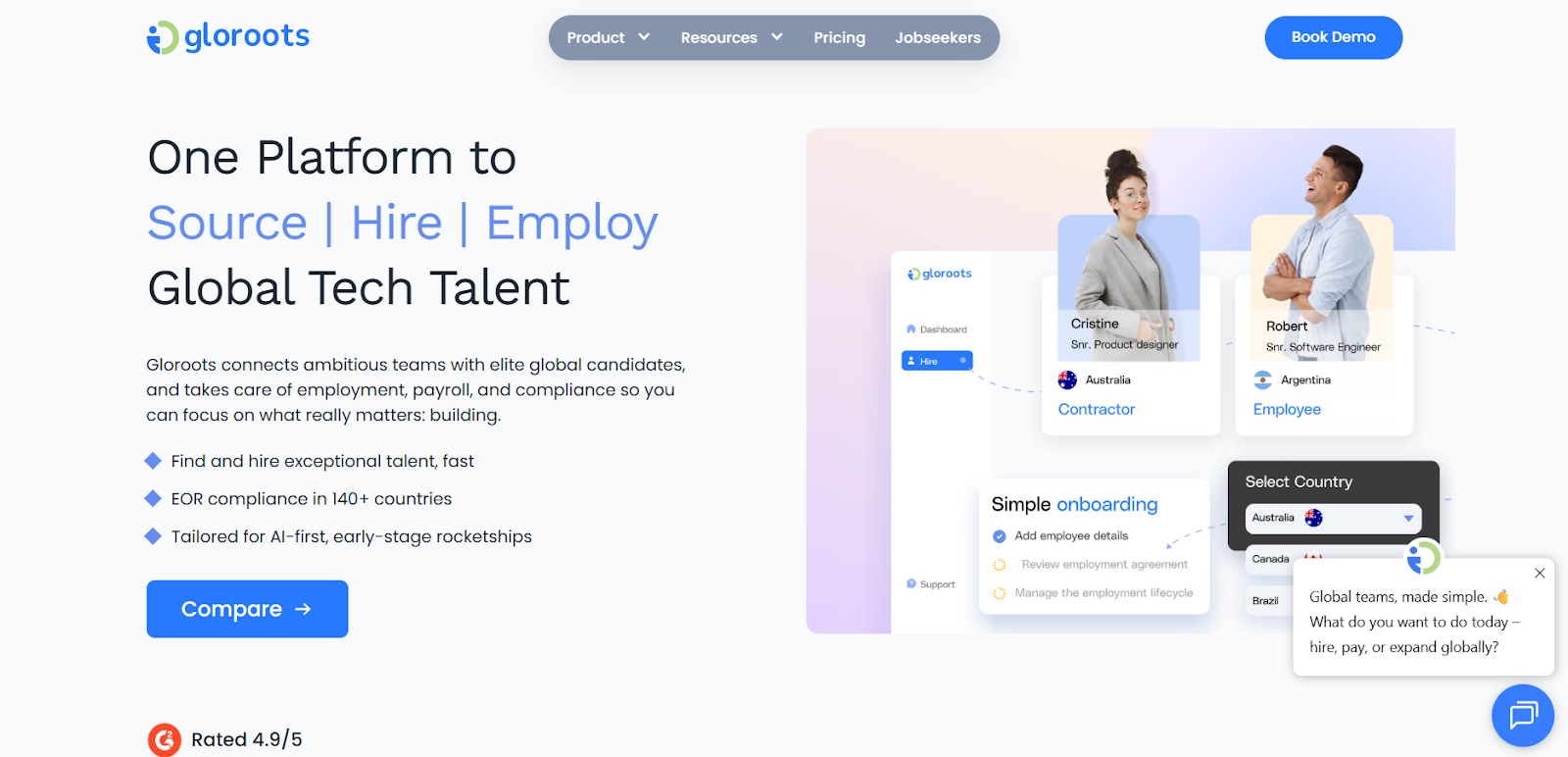
Gloroots is a global hiring and employment platform that acts as the Employer of Record, enabling companies to employ full-time team members across 140+ countries without setting up local entities. It is best suited for startups, scaleups, and mid-market companies scaling cross-border teams.
In Greece, Gloroots handles gross-to-net payroll calculations, EFKA contribution remittances, tax filings, and monthly declarations with Greek authorities, consolidating everything into a single invoice.
Gloroots differentiates through compliance-first operations, owned-entity infrastructure, and cost-planning tools that model total employment costs, including EFKA and severance.
Key Features
- Greece EOR with embedded payroll automation, covering gross-to-net calculations, EFKA contributions, and income tax remittances handled end to end.
- Compliant employment contracts structured in line with Greek labour legislation and applicable collective bargaining agreements (CBAs).
- Single consolidated monthly invoice covering salary, statutory contributions, and EOR fees for full cost visibility in Greece.
- Multi-country platform spanning 140+ countries, enabling Greece hires to sit alongside all other markets on one system.
- Integrated contractor and employee management, allowing companies to switch between engagement models on a single platform.
Customer Review
“With reasonable transaction rates and a quick turnaround time, our experience with Gloroots has been amazing. The almost immediate response from the team to answer/help us with our queries is just the cherry on top.”
Prabhav Varambally | VP, Customer Enablement at AssetMantle
Pros
- Mid-range pricing at $299 per employee per month, offering clear cost advantages compared to premium-tier competitors charging $599.
- Strong compliance orientation covering EFKA, Greek CBAs, statutory benefits, and mandatory employment contract requirements in complex local markets.
- Broad 140+ country coverage enabling unified management of global teams across regions without switching vendors or systems.
Cons
- Limited public details on country-specific add-on fee,s such as advanced benefits packaging or immigration advisory for Greece-based hires.
- Lower third-party review volume compared to large incumbents like Deel or Remote, given its position as a newer entrant in the market.
- Greece-specific EOR pricing is not publicly itemized; detailed cost breakdowns for Greek hires typically require a direct sales conversation.
Pricing
Gloroots positions full EOR services at roughly $299 per employee per month, with contractor management starting at $29 per contractor per month.
Mini Case Study
AssetMantle, a decentralized NFT marketplace, struggled with expensive OTC crypto payments and rigid minimum transaction sizes, even after trying a traditional EOR partner with poor support and rising fees.
Gloroots’ SaaS-based EOR and contractor crypto payments cut AssetMantle’s transaction costs by 80%, ensured global payroll compliance, removed minimum caps, and delivered fast, reliable customer support with flat, transparent fees.
{{hiring-power="/components"}}
2. Remote
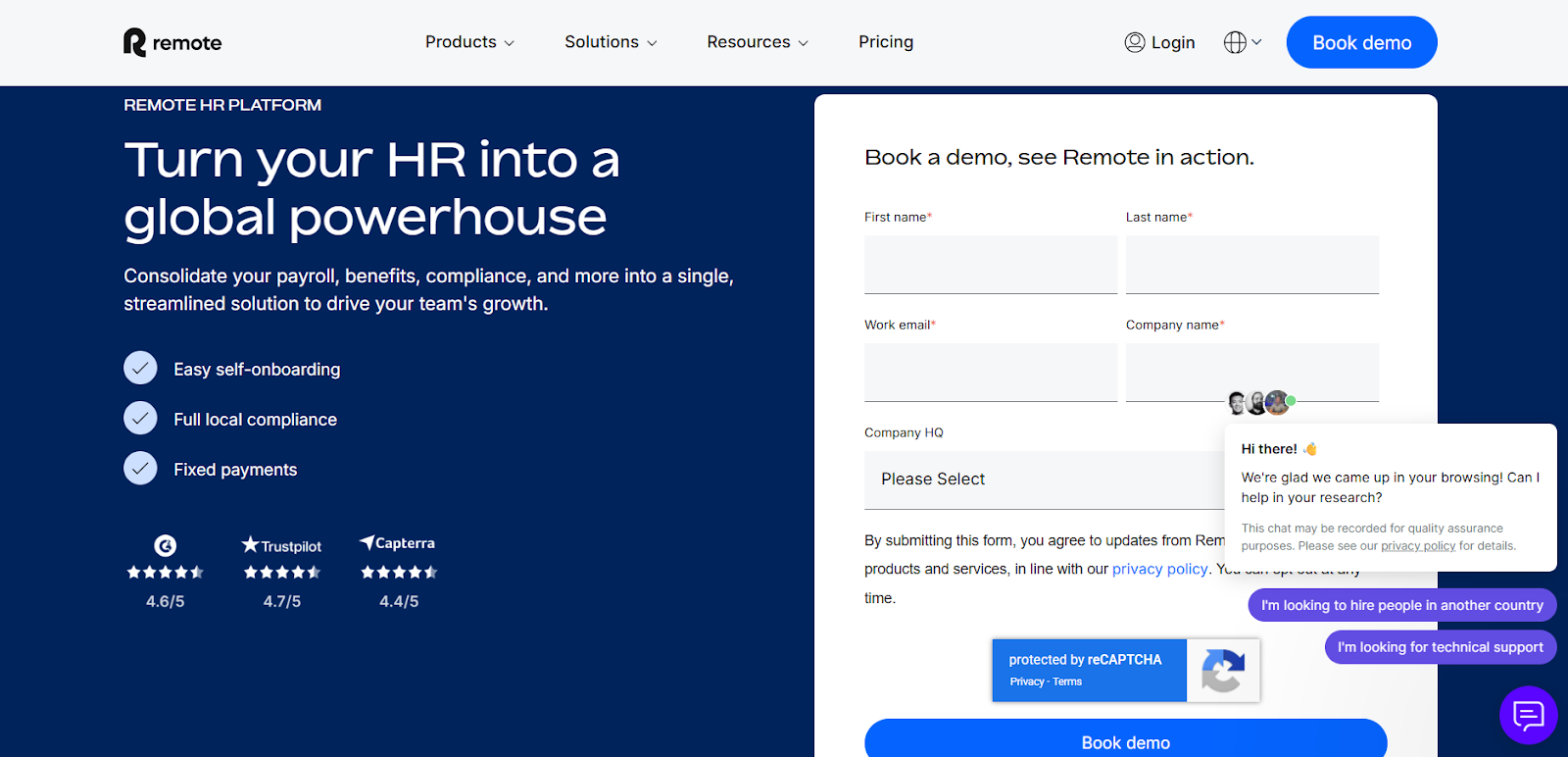
Remote is a global EOR and HR platform that helps companies hire, pay, and manage international employees, with strong statutory benefits expertise across EU markets, including Greece.
In Greece, Remote manages payroll, employment law compliance, taxation, and benefits administration, enabling foreign employers to hire local staff without a registered entity.
Remote differentiates through owned-entity infrastructure in key markets and a strong employee onboarding experience with well-documented compliance processes.
Key Features
- EOR coverage across 80–180+ countries with dedicated statutory benefits administration for EU markets, including Greece-specific payroll and tax handling.
- Structured employee onboarding workflows designed for a strong hire experience with compliance built into each stage.
- Global payroll processing with tax withholding, multi-currency salary payments, and statutory social security remittances.
- HR platform capabilities include time off management, document storage, and core HRIS functionality for distributed teams.
- Compliance-first EU expertise with documented handling of regional employment directives and market-specific statutory obligations.
Customer Review
Users frequently praise Remote's employee onboarding quality and statutory benefits depth, but note some limitations in advanced reporting functionality as team headcount increases.
Pros
- Strong EU compliance expertise, covering complex statutory environments like Greece, with documented handling of local employment and social security rules.
- Solid employee onboarding experience with structured workflows that reduce time-to-productivity for new international hires.
- Broadly recognized brand with extensive public documentation, making due diligence and internal procurement approvals more straightforward.
Cons
- EOR pricing at approximately $599 per employee per month sits at the higher end of mid-market options, increasing total cost for Greece hires.
- Some users report limitations in advanced reporting and workforce forecasting capabilities as distributed headcount scales beyond the initial setup.
- Greece-specific add-on fees, if applicable, are not transparently itemized in publicly available pricing materials.
Pricing
Remote's EOR services are commonly cited at approximately $599 per employee per month, with actual rates varying by country and benefits configuration.
3. Deel
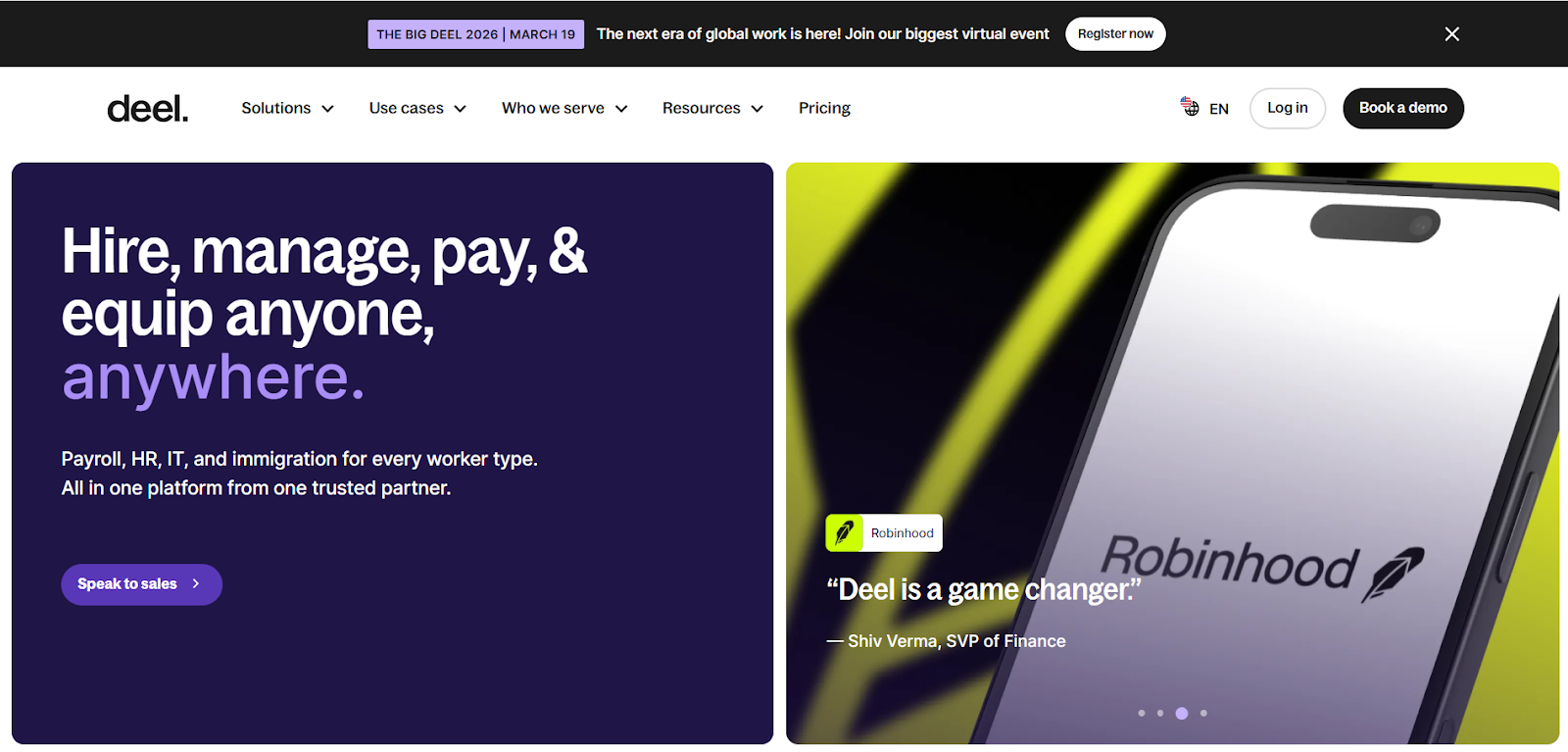
Deel is a global payroll and HR platform offering EOR, contractor management, and HRIS capabilities, with owned entities across 100+ countries and broader support in 150+ markets.
Deel lists Greece within its supported EOR countries, enabling foreign employers to hire Greek employees compliantly without registering a local legal entity.
Deel differentiates through a wide integrated product stack combining EOR, contractor payments, HRIS, immigration support, and equity management within one platform.
Key Features
- EOR services with localized employment contracts and payroll in numerous countries, including Greece, are managed through owned and partner entities.
- Contractor management and global payments supporting multiple payout methods across currencies for mixed workforce management.
- Integrated HRIS modules covering onboarding, time off, and workflow automation alongside core EOR and payroll functions.
- Immigration and equity management support is built into the platform, reducing reliance on separate vendors for mobile or equity-holding employees.
- Strong integration ecosystem connecting Deel into existing finance and HR software stacks used by scaling companies.
Customer Review
Users highlight Deel's automation capabilities and geographic coverage as key strengths, though some note variability in support responsiveness and payroll accuracy across certain markets.
Pros
- Very wide geographic coverage with sophisticated automation reducing manual HR and payroll administration for distributed, multi-country teams.
- Single platform for EOR, contractors, HRIS, and immigration, eliminating the need to manage multiple vendors across the employment lifecycle.
- Broad integration ecosystem enabling Deel to connect to existing finance, HR, and operations tools without significant technical overhead.
Cons
- EOR pricing at approximately $599 per employee per month is relatively high compared to more cost-competitive alternatives in the market.
- Some customers report variability in support response times and local compliance nuances depending on the specific country involved.
- Limited public details on Greece-specific statutory benefits handling, CBA coverage, or detailed payroll compliance documentation.
Pricing
Multiple independent sources cite Deel's EOR pricing at approximately $599 per employee per month across global markets.
4. Multiplier
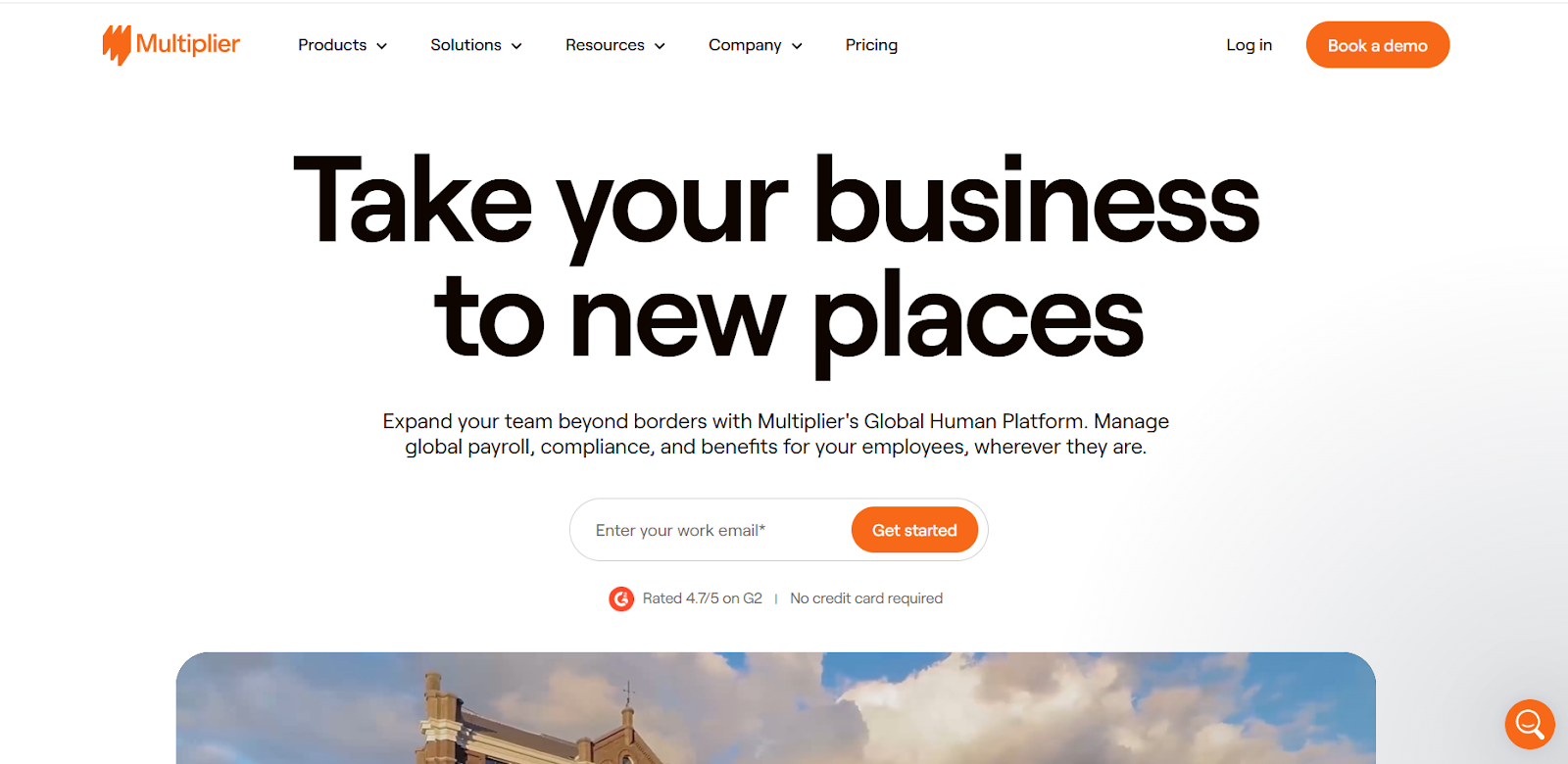
Multiplier is a global EOR and employment platform positioned for fast cross-border hiring, with coverage across 150+ countries and competitive pricing suited to startups and SMBs.
Greece falls within Multiplier's EOR coverage footprint, meaning employers can engage Greek employees through its platform without registering a local entity.
Multiplier differentiates through rapid onboarding timelines, typically two to five business days, and a human-led support model at accessible price points.
Key Features
- EOR and payroll services across 150+ countries with multi-currency salary payment support for geographically distributed teams.
- Fast onboarding processes with typical hire activation in two to five business days, reducing time-to-productivity for new country entries.
- Dedicated customer support managers providing human-led service rather than purely automated or ticket-driven support models.
- Contractor management and global payment services alongside EOR, supporting both full-time and flexible workforce structures.
- Competitive pricing positioned as accessible for startups and SMBs looking to expand internationally without premium EOR costs.
Customer Review
Comparative reviews highlight Multiplier's affordability and responsive human support as key strengths, while noting a narrower advanced feature set compared to larger platform providers.
Pros
- EOR pricing starting around $400 per employee per month offers a meaningful cost advantage over premium-tier competitors charging $599 PEPM.
- Fast onboarding timelines of two to five business days make Multiplier well-suited to companies entering new markets with urgent hiring timelines.
- Human-led support model with dedicated managers provides a consistent account context, particularly valuable during initial market entry phases.
Cons
- Platform breadth in advanced HR and finance modules is narrower than that of larger providers like Deel or Rippling for companies needing deep integration.
- Entity ownership mix by country is not always fully transparent, which can create uncertainty around compliance execution in specific markets.
- Greece-specific materials on statutory benefits, CBAs, and local compliance handling are limited in publicly available documentation.
Pricing
EOR pricing is frequently estimated starting around $400 per employee per month, with final rates varying by country and specific benefits requirements.
5. Oyster
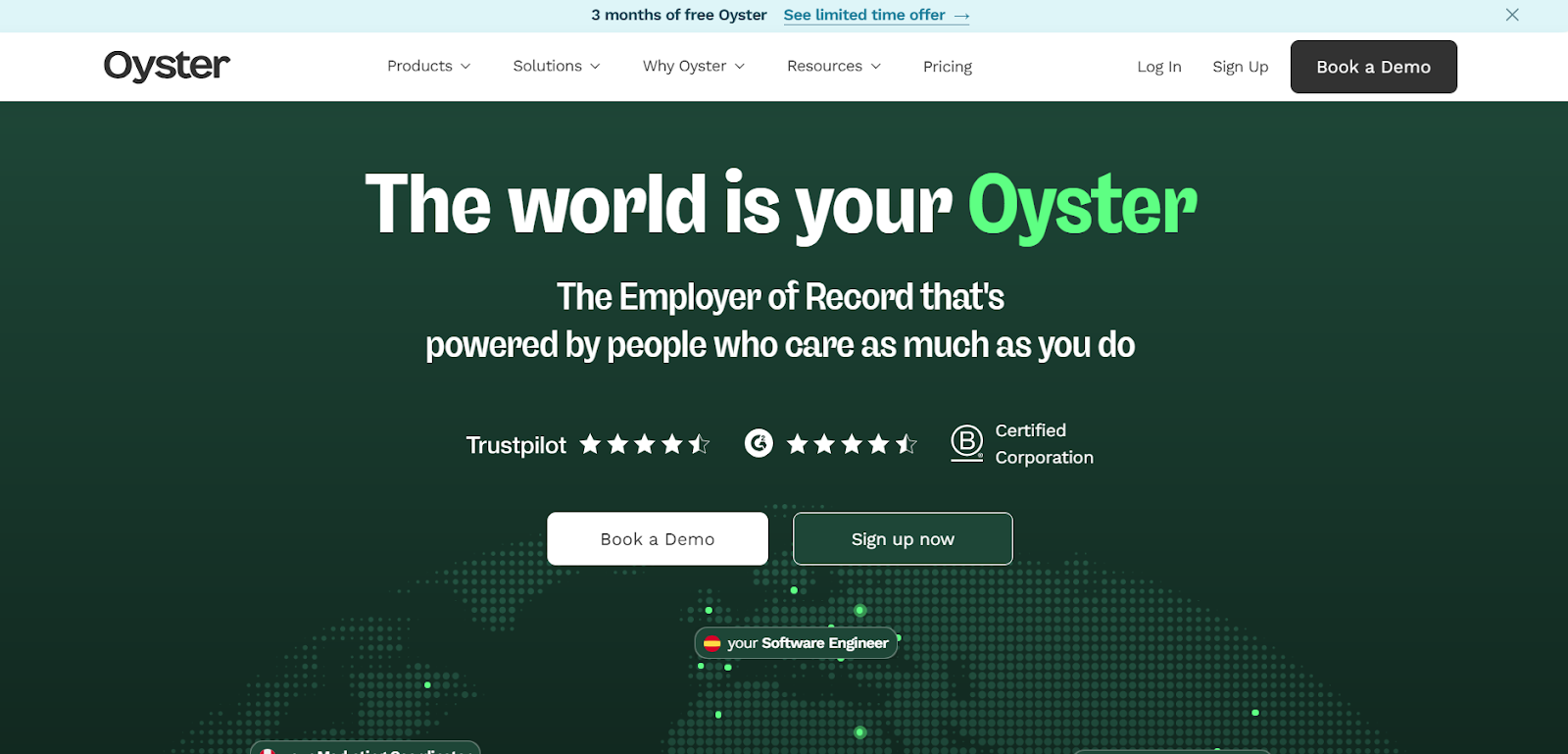
Oyster is a global employment platform offering EOR services with an emphasis on transparent pricing, strong compliance documentation, and educational resources for global hiring decisions.
Greece is included within Oyster's broad 180+ country EOR coverage, allowing foreign employers to hire Greek employees without establishing a local legal entity.
Oyster differentiates through clear pricing communication and structured compliance content that helps HR teams understand obligations before committing to a market.
Key Features
- EOR services, payroll processing, and benefits administration across approximately 180 countries with compliance documentation for each market.
- Transparent starting price communications give HR and Finance teams early cost visibility before formal procurement begins.
- Educational content and regional hiring guides help companies understand statutory obligations in new markets, including EU countries.
- Visa and relocation guidance are available in select markets, supporting international mobility alongside core EOR employment services.
- Compliance-first positioning with structured documentation designed to reduce employment risk in markets with complex labour regulations.
Customer Review
Commentary consistently notes Oyster's straightforward pricing communication and educational content as genuine strengths, alongside a compliance-focused approach for distributed team management.
Pros
- Clear starting price communication enables Finance and HR teams to model employment costs in Greece before entering a formal sales process.
- Strong compliance-focused positioning with structured documentation supports due diligence and internal approval processes for new market entries.
- Wide EOR coverage across approximately 180 countries makes Oyster suitable for companies managing distributed teams across multiple geographies simultaneously.
Cons
- Coverage breadth and owned-entity footprint may be narrower than those of the largest providers, creating potential variability in execution across some markets.
- Public materials provide limited specifics on Greece-specific statutory benefits, CBA handling, or detailed payroll compliance breakdowns.
- EOR pricing in the approximately $499–$599 per employee per month range sits at the mid-to-high end compared to more affordable alternatives.
Pricing
Oyster's EOR pricing is commonly cited starting from approximately $499–$599 per employee per month, varying by country and benefits configuration.
How to Choose the Best EOR Service Provider in Greece?
1. Evaluate Greece-Specific Compliance Depth
Greece requires accurate EFKA registration, monthly social security declarations, and CBA-aligned employment contracts. Choose a provider with demonstrable local payroll expertise, not just broad EU coverage claims.
2. Assess Payroll Process Accuracy
Greek payroll involves monthly EFKA and tax declarations, gross-to-net calculations, and 13th and 14th salary structures. Providers must operate accurate automated engines, not manual processes that increase compliance risk.
3. Review Statutory Benefits Administration
Employer EFKA contributions of roughly 21–23 percent of gross salary represent a high cost. Verify that the EOR accurately calculates, remits, and reports these contributions without errors that expose client companies to penalties.
4. Confirm Support Availability and Local Expertise
Greece is a higher-complexity employment market. Prioritize providers offering dedicated account managers with genuine local knowledge, not generic support desks with limited country-specific context available.
5. Compare Total Cost of Employment Transparency
Beyond the EOR fee, model EFKA contributions, severance risk, and statutory benefits to understand actual total employment costs. Choose providers that offer cost-planning tools rather than opaque pricing structures.
What Are the Factors Affecting EOR Pricing in Greece?
1. Local Labor Law Complexity
Greece has detailed labour laws covering working hours, overtime, leave entitlements, notice periods, and sector-specific CBAs. Markets with higher regulatory complexity typically carry higher EOR service fees to reflect the operational and compliance burden involved.
2. Statutory Benefits and Taxes
Employer EFKA contributions of approximately 21–23 percent of gross salary, combined with pension and health obligations, significantly affect the total cost. EOR providers must factor in the risk and effort of calculating and remitting these contributions accurately each month.
3. Payroll Frequency and Currency Handling
Greek payroll runs monthly, with mandatory social security and tax declarations filed each cycle. EOR pricing increases when multi-currency payments, FX conversion, or more frequent reporting cycles are required by the client.
4. Add-On Services and Support Level
Immigration assistance, equipment provisioning, and advanced HR advisory services are priced above standard EOR packages. Higher-touch support tiers, such as dedicated account managers and custom reporting, also add to the total monthly cost per employee.
Why is Gloroots the Best EOR Provider in Greece?
Gloroots is best suited for growing companies that need to hire in Greece without establishing a local entity, particularly those that need clear cost visibility and strong statutory compliance from the start.
Its core strengths lie in compliance-first operations, owned-entity infrastructure, and cost-planning tools designed to model Greece-specific employment costs, including EFKA, severance, and benefits.
- Single-invoice cost consolidation covering salary, EFKA contributions, tax, and EOR fees, simplifying budgeting and financial planning for Greece hires.
- Embedded EFKA and tax engines reduce payroll errors and lower compliance risk for companies managing Greek employees at scale.
- CBA-aligned employment contracts and localized benefits policies help employers stay compliant and competitive in the Greek labour market.
Ready to hire in Greece without setting up a local entity? Book a demo with Gloroots to get country-specific guidance and a clear cost breakdown for your team.
Frequently Asked Questions About the Best EOR in Greece
1. What is an Employer of Record in Greece?
An Employer of Record in Greece is a third-party entity that becomes the legal employer of your workers, managing payroll, EFKA social security contributions, taxes, and compliance with Greek labour law on your behalf.
This allows foreign companies to hire employees in Greece without registering a local legal entity. The EOR assumes the employment risk and administrative burden while your company retains day-to-day direction of the work.
2. How much does an EOR cost in Greece?
EOR pricing globally ranges from approximately $200 to $1,000 or more per employee per month, depending on the provider and market complexity. Europe-focused estimates for providers like Remote, Deel, and Oyster cluster between $400 and $700 PEPM.
Greece's mandatory employer EFKA contributions of roughly 21–23 percent of gross salary mean total employment costs will be significantly higher than gross salary alone. No provider currently publishes a precise Greece-specific EOR starting price publicly.
3. Is using an EOR legal in Greece?
Using an EOR in Greece is recognized by advisory firms and providers as a compliant approach for foreign companies to employ local staff without establishing a legal entity, provided all obligations under Greek law are met.
The EOR must register employees with EFKA, remit social security contributions, and comply with Greek employment and tax legislation. There is no single Greek statute formally defining the EOR construct; legality is established through the correct application of existing employment, agency, and tax laws.
4. How does Gloroots compare to other EORs in Greece?
Gloroots competes with providers like Deel, Remote, Multiplier, and Oyster on global EOR services. It differentiates on compliance-first operations, mid-range transparent pricing of approximately $299 PEPM, and detailed total employment cost modeling.
Larger incumbents typically offer broader product suites or wider country footprints but often charge higher per-employee rates. No independent Greece-specific benchmark currently ranks Gloroots against named competitors on a head-to-head basis.
5. Can an EOR manage payroll and benefits in Greece?
Yes. EOR providers in Greece explicitly manage payroll processing, income tax withholding, and monthly EFKA social security remittances. Many also administer statutory benefits, including pension, health coverage, and applicable allowances.
The depth of benefits support, such as private health insurance, equity, or supplemental allowances, varies by provider. Greece-specific benefits catalogues are rarely fully detailed in publicly available materials, so verifying scope directly with the provider before signing is advisable.

Ready to take the first step?
Request a demo now and learn how you can focus on building, without worrying for compliance, ever!