
How to Hire Employees in Bulgaria
Learn how to hire employees in Bulgaria compliantly. Understand hiring options, employment laws, payroll, taxes, contracts, and how EORs simplify hiring.
Begin your Journey with Gloroots
Schedule a call with our solution expert
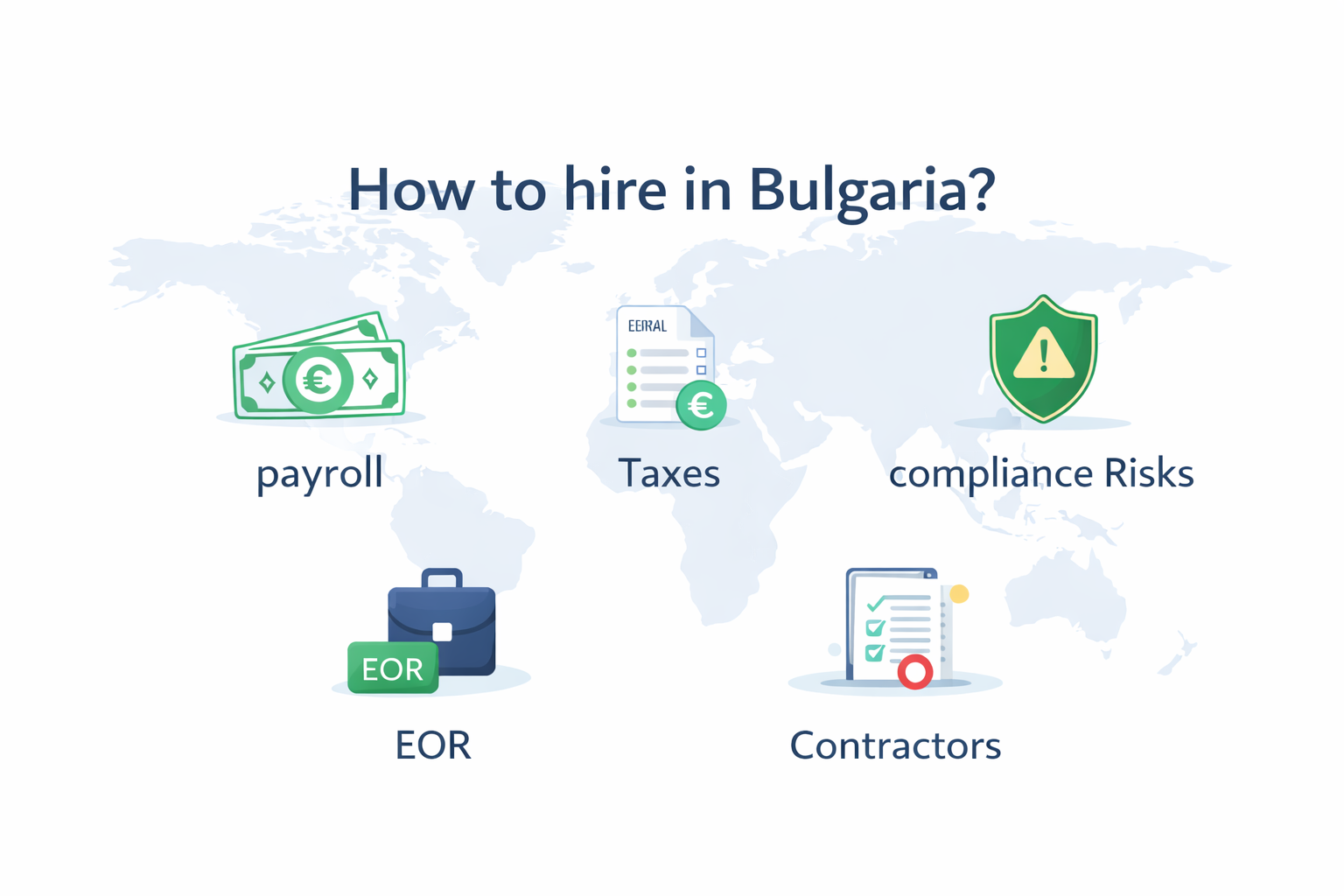
Bulgaria offers foreign companies a compelling entry point into the European Union. Skilled workforce, competitive labor costs, proximity to Western European markets without Berlin's price tags.
But EU membership doesn't mean plug-and-play hiring.
Bulgaria enforces country-specific labor laws with strict compliance expectations. Early missteps in contract structure, payroll setup, or employee classification trigger costly disputes, regulatory penalties, and expansion delays that compound with every hire.
Hiring employees in Bulgaria requires
- Clarity on hiring models (entity vs. Employer of Record vs. contractor)
- Mandatory employer obligations under the Bulgarian Labor Code
- Payroll tax structures
- Termination protections
- Legal distinctions separating compliant employment from misclassification risk
This guide walks you through each step: choosing the right hiring model, onboarding your first employee, managing payroll, navigating termination rules, and avoiding compliance traps that catch unprepared employers off guard.
Core truth: Hiring employees in Bulgaria requires the right hiring model and strict adherence to local labor laws. One hire done wrong costs more than doing ten right.
What Are Your Employment Options When Hiring in Bulgaria?
Before posting a job or signing an offer letter, decide how you'll employ talent. Foreign companies typically choose between three models: establishing a local entity, partnering with an Employer of Record (EOR), or engaging contractors. Each has distinct implications for compliance risk, cost structure, and operational control.
Entity setup → means full legal presence. Register a Bulgarian subsidiary, handle all employer obligations directly, and bear complete liability.
EOR hiring → outsources employment compliance to a third-party legal employer while you retain operational control.
Contractor engagement → treats individuals as independent service providers, not employees. But only when the relationship genuinely reflects independence.
The stakes are higher than they appear. Misclassifying an employee as a contractor triggers back taxes, penalties, and reclassification claims. Setting up a local entity in Bulgaria for hiring costs €800–€1,500 total, including registration fees, notary, legal services, translations, and bank setup.
Choosing the wrong model doesn't just slow hiring. It creates legal exposure that compounds with every additional hire.
1. Hiring Through a Local Entity
Establishing a Bulgarian entity gives you direct control over employment, payroll, and benefits administration. You become the legal employer. Full responsibility for Labor Code compliance, tax withholding, social security contributions, and statutory filings.
This model makes sense when:
- You're committing to long-term operations in Bulgaria
- Hiring at scale (typically 10+ employees)
- You need to own intellectual property and operational infrastructure locally
The trade-off: entity formation takes months, requires ongoing legal and accounting support, and locks you into administrative obligations even if hiring slows.
2. Hiring Through an Employer of Record (EOR)
An EOR becomes the legal employer in Bulgaria while you direct the employee's day-to-day work. The EOR handles employment contracts, payroll processing, tax compliance, benefits administration, and statutory filings.
You maintain operational control. They absorb legal liability.
EOR hiring suits:
- Companies testing the Bulgarian market
- Scaling quickly (hires live in days, not months)
- Expanding into multiple countries without establishing entities everywhere.
It's not a workaround. It's a legitimate employment model under Bulgarian law, ideal when speed, compliance assurance, and low upfront cost matter more than direct entity ownership.
3. Hiring Independent Contractors
Contractors are appropriate for project-based work, specialized services, or genuinely independent engagements. Bulgarian law distinguishes employees from contractors based on control, exclusivity, and economic dependence. Not what the contract says.
Misclassification happens when companies treat contractors like employees:
- Setting their hours and work schedules
- Providing equipment and workspace
- Directing how work is done
- Maintaining exclusive relationships
Local Entity Vs EOR Vs Independent Contractor: Side-by-Side Comparison
What Are The Legal Requirements for Hiring in Bulgaria?
Bulgarian employment law is codified in the Labor Code (Kodeks na truda), which governs employment contracts, working conditions, termination procedures, and employee protections. Bulgaria adheres to EU labor directives but enforces country-specific interpretations, particularly around probation periods, notice requirements, and severance calculations that differ from neighboring EU markets.
Key employer obligations:
- Register employees with NSSI before their first working day
- Provide written contracts in Bulgarian
- File contracts with the NRA within three days of the start date
- Maintain accurate payroll records
- Withhold income tax and social contributions
- Comply with collective bargaining agreements where applicable
Employment relationships are presumed indefinite unless a fixed-term contract meets specific legal criteria. Probationary periods cannot exceed six months for managerial roles or three months for others.
Bulgaria's enforcement environment is not theoretical. Labor inspectorates conduct audits. Employees can challenge terminations in court. Non-compliance with payroll or contract standards results in financial penalties and reputational damage.
The presumption favors employee protection, not employer flexibility.
What Are the Employment Contract Rules in Bulgaria?
Written, locally compliant employment contracts are not optional. They're legally required.
Verbal agreements or foreign-language contracts without Bulgarian translations carry no legal weight. The contract must be signed before the employee begins work and filed with the National Revenue Agency (NRA) and NSSI within three days of the employment start date.
Types of Employment Contracts
- Indefinite-term contracts are the default and most common form. They continue until lawfully terminated by either party with proper notice.
- Fixed-term contracts are permitted for specific circumstances such as temporary project work, seasonal demand, or employee absences. Bulgarian law caps consecutive fixed-term renewals. Exceeding limits automatically converts the contract to indefinite-term status.
- Full-time employment follows a standard 40-hour workweek. Part-time arrangements are permitted but must specify working hours, proportional salary, and benefits.
- Probationary clauses allow employers to assess new hires during the first three to six months (depending on seniority), with simplified termination rules during this window.
What to Include in an Offer Letter?
Employment offers must specify the job title, duties, reporting structure, and work location.
Essential contract elements:
- Gross monthly salary and payment frequency
- Working hours and overtime policies
- Annual leave entitlement (minimum 20 working days)
- Bonus or commission eligibility
- Benefits and allowances
Clarity matters. Ambiguous job descriptions or vague compensation terms create disputes during performance reviews or terminations. Bulgarian courts interpret contract ambiguities in favor of employees.
NDAs and Confidentiality Agreements
Confidentiality clauses are enforceable under Bulgarian law, particularly when protecting trade secrets, client information, or proprietary processes. Intellectual property (IP) created during employment typically belongs to the employer unless otherwise specified.
Post-employment non-compete clauses are valid but must be reasonable in scope, duration (usually 6 to 12 months), and geography. They often require compensation during the restriction period.
Overly broad non-competes risk being struck down as unenforceable.
How Payroll Costs and Taxes Work in Bulgaria?
Bulgaria's labor cost advantage is real. But only if you understand the full employer burden.
As of January 1, 2026, Bulgaria's minimum monthly wage is 1,213 BGN (€620.20), a 12.6% increase affecting nearly 600,000 workers. Typical total employer costs for mid-level hires range from BGN 3,000 to BGN 8,000 per month, including gross salary and mandatory contributions.
1. Payroll and Salary Structure in Bulgaria
- Salaries are quoted and paid in Bulgarian lev (BGN). Compensation typically includes base salary, performance bonuses (if applicable), and mandatory benefits.
- Employers cannot pay below minimum wage thresholds, even for junior roles.
2. Employer Payroll Obligations
Employers contribute 21.68 to 22.38% of gross salary toward social security funds covering:
- Pension insurance
- Health insurance
- Unemployment insurance
- Workplace accident protection
These contributions sit on top of the employee's gross salary. Not embedded within it.
3. Employee Tax Contributions
- Employees face a flat 10% personal income tax on gross earnings, withheld at source. They also contribute approximately 13% toward social security (pension, health, and unemployment funds).
- Total employee deductions hover around 23% of gross pay.
4. Social Security Contributions
- Both employer and employee contributions fund Bulgaria's unified social security system. Employer rates vary slightly based on working conditions (hazardous roles carry higher accident insurance rates).
- Contributions are remitted monthly to the NSSI alongside tax payments to the NRA.
5. Minimum Wage and Statutory Pay Requirements
- Minimum wage applies to all employees, regardless of contract type. Employers cannot avoid this through creative compensation structures.
- Salary increases affect budgets immediately. Failure to adjust violates labor law and triggers penalties.
In practical terms, employers should budget 18–19% above gross salary for statutory taxes and social security contributions. For most roles, this puts the true monthly cost of hiring in Bulgaria between BGN 3,000 and BGN 8,000, depending on seniority, role, and working conditions.
How Employers Pay Employees in Bulgaria?
1. Payment Methods
Salaries are paid via bank transfer to the employee's Bulgarian bank account.
Cash payments are uncommon and create compliance risks.
Payslips must contain
- Gross salary
- Deductions (tax and social security)
- Net pay
provided electronically or in print.
2. Salary Payment Frequency
- Payroll runs monthly, with salaries due by the end of the month for work performed that month.
- Delays in payment breach labor law and give employees grounds for immediate contract termination without notice.
How To Onboard Employees in Bulgaria?
1. New Hire Onboarding Checklist
Register the employee with the NSSI and NRA before their first day. Provide signed employment contracts, company policies, role-specific training materials, and access to payroll/benefits systems.
Onboarding essentials:
- Register the employee with NSSI and NRA
- Sign and file the employment contract
- Provide company policies and role training
- Schedule workplace safety orientation
- Set up payroll and benefits access
- Assign a direct manager and clarify expectations
Schedule orientation sessions covering workplace safety (mandatory under Bulgarian occupational health regulations), data privacy policies, and reporting structures. Ensure the employee understands leave policies, overtime rules, and performance review timelines.
2. Required Employee Documentation
Bulgarian labor and tax regulations require employers to collect specific employee documents at the time of onboarding. These records support payroll processing, social security registration, and statutory compliance.
Documents you need from new hires:
- National ID or passport copy
- Tax identification number (EGN for Bulgarian citizens)
- Proof of address
- Bank account details for payroll
- Work permit (for non-EU nationals)
Maintain signed copies of the employment contract, confidentiality agreements, and acknowledgment of company policies in the employee's personnel file. These documents become critical during audits or disputes.
What Are The Best Practices Of Interviewing and Hiring in Bulgaria?
Bulgarian labor law prohibits discrimination based on age, gender, ethnicity, religion, disability, or marital status. Interview questions must focus on job-related qualifications and competencies.
- Avoid questions about family planning, political affiliation, or health conditions unless directly relevant to the role's requirements.
- Data privacy matters. Under GDPR (enforced in Bulgaria), candidate information must be collected with consent, stored securely, and deleted after the hiring process concludes (unless the candidate becomes an employee).
- Document retention and processing justifications carefully.
- Bulgarian candidates value clarity and professionalism.
- Communicate hiring timelines, provide prompt feedback, and set realistic expectations about compensation and role responsibilities.
A sluggish or opaque hiring process signals organizational dysfunction.
Work Permits and Right to Work in Bulgaria
1. EU/EEA/Swiss nationals enjoy free movement rights and require no work permits to work in Bulgaria. They must register with local authorities if staying longer than three months, but employment authorization is automatic.
2. Non-EU nationals need a work permit issued by the Bulgarian Employment Agency before starting employment. The employer must demonstrate that no suitable EU candidate exists for the role (labor market test).
Key considerations for non-EU hires:
- Processing times: expect 1 to 3 months
- Work permits are tied to specific employers and roles
- Changing jobs requires a new permit
- Employers must submit applications and prove job necessity
- Employee must maintain legal residence status
Hiring non-EU nationals without valid permits exposes employers to fines and reputational damage.
How Does Employment Termination Work in Bulgaria?
1. Lawful Grounds for Termination
- Employers can terminate for cause (misconduct, poor performance, breach of contract) or without cause (redundancy, business closure).
- Termination for cause requires documented evidence and adherence to disciplinary procedures.
- Employees enjoy strong protections against unfair dismissal. Arbitrary terminations trigger severance claims and legal disputes.
2. Notice Periods
- Notice periods depend on employment duration and contract terms, typically ranging from 30 to 90 days.
- During probation, shorter notice applies (usually 3 to 7 days).
- Both parties must provide written notice.
3. Severance Requirements
- Severance is mandatory for redundancy-based terminations, calculated based on tenure and salary.
- Employees with three or more years of service receive at least two months' gross salary.
- Fixed-term contract terminations before expiration also trigger compensation unless the contract explicitly states otherwise.
Employee vs Contractor Classification in Bulgaria
Bulgarian authorities assess classification based on three key factors: control, exclusivity, and economic dependence. Contracts labeled "independent contractor" mean nothing if the working relationship resembles employment.
Misclassification consequences include:
- Retroactive employer social security contributions (21.68 to 22.38% on all past payments)
- Back taxes and penalties
- Potential reclassification of the entire relationship
The "one contractor won't attract attention" myth dies fast when payroll audits begin.
What Compliance Risks Should Employers Know When Hiring in Bulgaria?
- Payroll non-compliance (late tax remittance, incorrect social security calculations, or failure to register employees with NSSI) results in financial penalties and interest charges. Repeated violations flag your company for closer scrutiny.
- Contract violations (unsigned contracts, missing mandatory clauses, or foreign-language-only agreements) create unenforceable employment terms and favor employees in disputes.
- Termination disputes arise when employers bypass proper procedures, fail to document performance issues, or miscalculate severance. Bulgarian labor courts tilt toward employee protection. Weak documentation guarantees costly settlements.
With a net employment outlook of +6 percentage points through March 2026 (28% of employers planning to increase staff), competition for talent is intensifying.
Compliance failures don't just cost money. They damage the employer brand in a tight labor market with around 5.2% unemployment.
How an Employer of Record (EOR) Helps You Hire in Bulgaria?
An EOR eliminates entity formation delays, absorbs compliance risk, and handles payroll, tax, and benefits administration.
What you gain with an EOR:
- Speed: Hires go live in days instead of months
- Certainty: Labor Code adherence, contract compliance, accurate tax remittance
- Control: Employee reports to you, performs work under your direction
EORs don't replace strategic workforce planning. They enable it.
- Testing the Bulgarian market without committing to entity setup costs? An Employer of Record (EOR) model makes sense.
- Scaling from 2 to 20 employees within six months? An EOR enables rapid, compliant growth.
- Hiring across multiple EU countries without setting up local subsidiaries? An EOR keeps expansion flexible and manageable.
The model works because it's legally recognized: the EOR is the statutory employer, you're the operational employer, and the employee receives full Labor Code protections.
How Gloroots Simplifies Hiring in Bulgaria?
When hiring in Bulgaria through Gloroots, the entire process is managed for you end-to-end. You do not need to coordinate vendors, navigate local regulations, or manage administrative steps.
Gloroots runs the complete hiring workflow:
- Candidate sourcing, shortlisting, and background verification
- Initial screening to assess skills, experience, and role fit
- Interview coordination for final selection
- Offer issuance and compliant employment setup
- Statutory registrations, payroll setup, and benefits enrollment
- Employee onboarding aligned with Bulgarian labor regulations
This model removes operational overhead entirely, allowing you to focus on building and managing your team while Gloroots handles hiring execution, compliance, and onboarding from start to finish.
Gloroots provides end-to-end EOR services in Bulgaria, handling employment contracts, payroll processing, tax compliance, benefits administration, and statutory filings. Local compliance expertise ensures your hiring aligns with Bulgarian Labor Code requirements, from contract drafting to termination procedures.
The platform combines self-service functionality (contract management, onboarding workflows, payroll visibility) with dedicated customer success support.
With Gloroots, you get:
- Audit-ready reporting
- Transparent cost breakdowns
- Finance-team-friendly invoicing with country-level detail
- GL mapping
Gloroots scales with you: whether hiring your first Bulgarian employee or expanding a distributed team across 140+ countries, the infrastructure supports growth without the complexity of multi-entity management.
It's not a vendor relationship. It's workforce infrastructure that adapts to your expansion strategy.
Include Gloroots CTA Banner - Here
FAQs About Hiring Employees in Bulgaria
1. Can a foreign company hire employees in Bulgaria without setting up a local entity?
Yes. Foreign companies can hire through an Employer of Record (EOR) without establishing a Bulgarian entity. The EOR becomes the legal employer, handling compliance, payroll, and tax obligations while you direct the employee's work.
2. What are the legal requirements for hiring employees in Bulgaria?
Employers must provide written contracts in Bulgarian, register employees with NSSI and NRA before the first working day, withhold taxes and social contributions, and comply with Labor Code provisions on hours, leave, and termination.
3. What taxes and social security contributions do employers pay in Bulgaria?
Employers contribute 21.68 to 22.38% of gross salary toward social security. Employees pay 10% income tax and approximately 13% in social security contributions. Total employer cost for mid-level hires ranges from BGN 3,000 to BGN 8,000 monthly.
4. How long does it take to hire and onboard an employee in Bulgaria?
Through an EOR, hiring and onboarding can occur within 5 to 10 business days. Establishing a local entity first adds 3 to 6 months for registration and regulatory approvals.
5. What is the easiest way to hire employees in Bulgaria compliantly?
Partnering with an EOR is the fastest, lowest-risk path. The EOR handles contracts, payroll, tax compliance, and benefits while you maintain operational control, eliminating entity formation costs and enabling hiring within days.

Ready to take the first step?
Request a demo now and learn how you can focus on building, without worrying for compliance, ever!

Get the Free hiring guide