



- Top global payroll providers like ADP, Deel, Rippling, and Papaya Global simplify multi-country payroll and compliance.
- Startups/SMBs benefit from Remote, Oyster, and Deel for easy global hiring and EOR services.
- Enterprises rely on ADP and CloudPay for scale, compliance, and advanced payroll management.
- Choose providers based on service scope, country coverage, features, pricing, and local compliance expertise.
Managing payroll across countries gets more complex with every new market you enter. Each country has its own taxes, filings, currency rules, and employment laws.
Many companies realize too late that local payroll vendors can’t keep up once their team grows past 50 employees, and the challenge only multiplies as they scale.
The global payroll market reached USD 32.6 billion in 2025 and is projected to hit USD 51.4 billion by 2030. That growth shows why businesses are moving from fragmented local payroll operations to unified platforms.
Consolidation reduces compliance risk, improves reporting visibility, and removes the operational friction that slows finance teams down.
This guide looks at the top global payroll companies based on what truly matters when managing multi-country payroll operations,compliance accountability, local expertise, transparent pricing, and scalable infrastructure.
The Top Global Payroll Companies – A Quick Overview
Before diving into detailed profiles, here's a scannable comparison of the leading global payroll providers based on decisive factors:
Ready to consolidate your global payroll operations? Book a demo with Gloroots to see how compliance-first payroll infrastructure works in practice.
Top Global Payroll Companies You Should Consider
Here’s an overview of key players shaping global payroll compliance today.
1. Gloroots
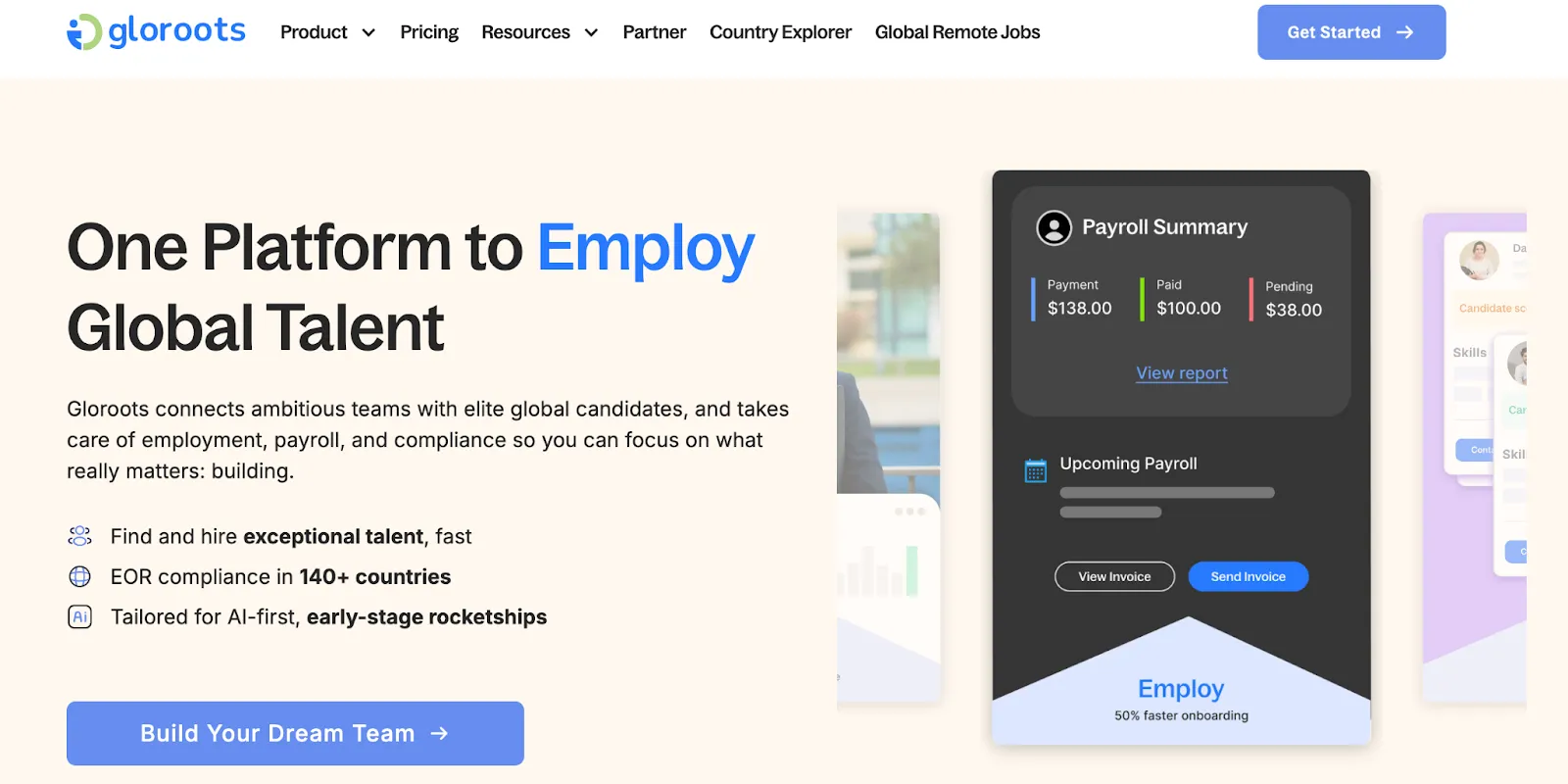
Gloroots is a global employment and payroll platform built for companies managing teams across multiple countries without setting up local entities.
Unlike payroll-only providers, Gloroots acts as the legal Employer of Record (EOR). It takes full responsibility for statutory compliance, benefits administration, and labor law management in more than 140 countries.
Gloroots expertise in managing multi-country teams and enabling Global Capability Centers (GCCs) makes it ideal for businesses building or scaling technical and operational hubs in fast-growing markets.
Key Features
1. Integrated EOR and Payroll Platform
Gloroots combines employment contracts, payroll processing, tax filing, and compliance under one system. As the legal employer, it ensures every hire meets local labor laws without requiring separate vendors or manual oversight.
2. Global Expertise
The platform provides specialized support for companies building or scaling teams across 150+ countries. This includes assistance with local payroll, social security contributions, statutory benefits, work permit compliance, compensation benchmarking, and HR advisory.
3. Contractor-to-Employee Conversion
Easily convert global contractors into full-time employees using Gloroots’ guided compliance framework. The transition process is quick, secure, and compliant with country-specific employment laws.
4. Transparent, Line-Item Billing
All invoices include a detailed cost breakdown by country. Finance teams can review salary components, taxes, and statutory deductions clearly, eliminating hidden fees and improving cost forecasting.
5. Human Support with Local Insight
Each client is paired with a dedicated Customer Success Manager who understands their markets and compliance needs. Support is available 24/7 with real-time guidance for complex labor or tax questions.
Pros
- Takes full compliance ownership as the legal Employer of Record.
- Offers fixed, transparent pricing with no hidden charges.
- Strong India and GCC expertise for regional expansion.
- Delivers audit-ready payroll and compliance reports.
Cons
- Slightly narrower coverage in select niche markets.
- Limited enterprise-level API and multi-entity features.
Pricing
- Contractors: Starting at $29/month per contractor
- Full-time employees: Starting at $399/month per employee
For detailed pricing across different engagement types and geographies, visit the Gloroots pricing page. The platform also offers volume discounts for teams scaling beyond 10+ international hires.
"Now that Gloroots handles all contracts, I am no longer worried about compliance when onboarding a new contractor"
- Julio Arias
- Co-founder, Sketchnote
Best For
Gloroots is best suited for:
- Startups and SMBs hiring their first global employees and needing compliant payroll without local entities.
- Mid-market companies in India building or scaling GCCs with PF, ESIC, and gratuity compliance needs.
- Finance and HR teams seeking transparent pricing, predictable costs, and audit-ready payroll reports.
2. ADP
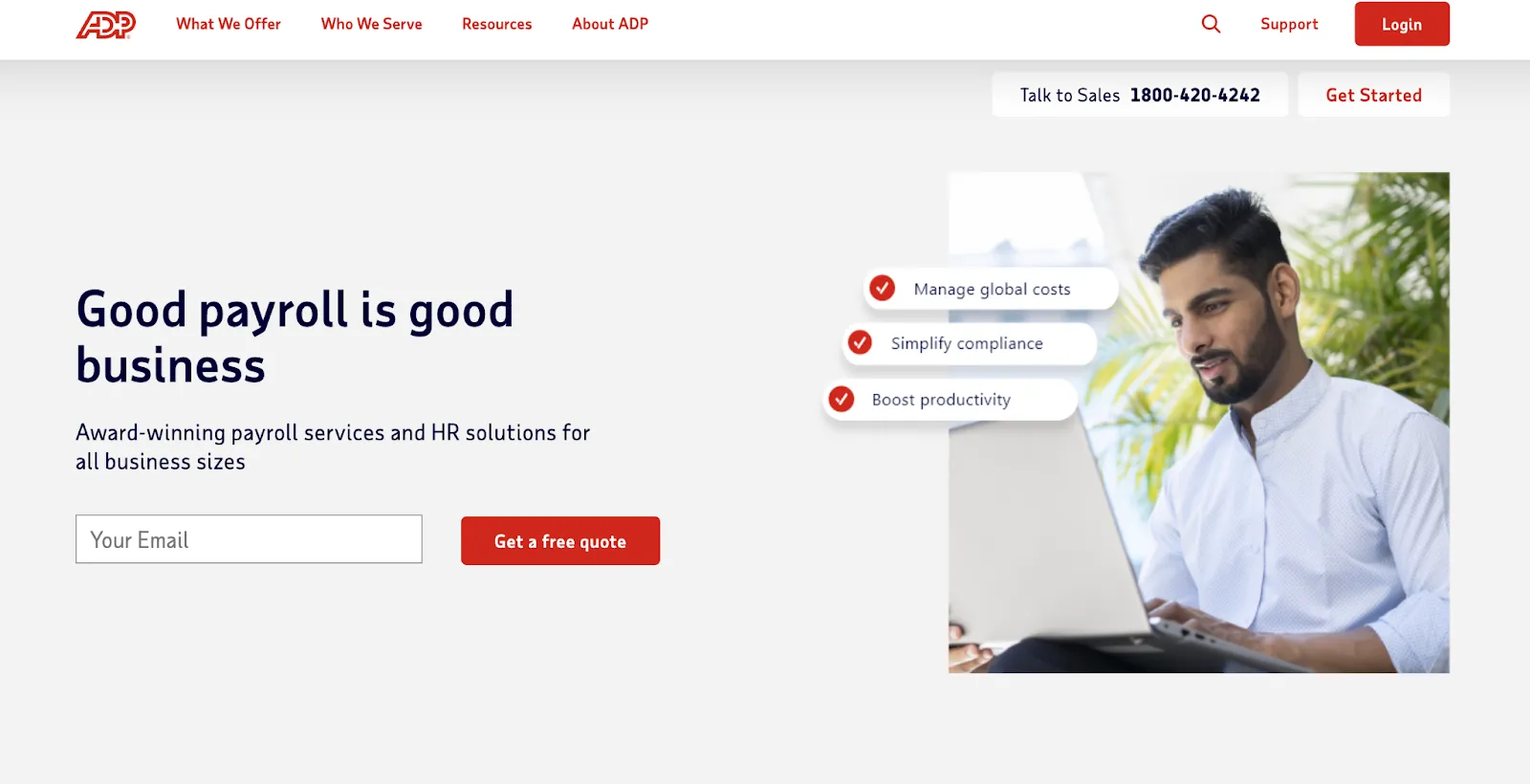
ADP is a global payroll and HR provider with operations spanning 150+ countries, processing payroll for over 42 million employees worldwide. Unlike full EOR providers, ADP primarily works through aggregator partnerships, coordinating with local vendors rather than owning entities directly.
This model provides broad coverage but can add coordination complexity and limit direct compliance control.
ADP focuses on enterprise payroll, reporting, and HR system integration, making it a go-to choice for companies with established processes and legacy HR infrastructure.
However, the platform is less suited for businesses seeking rapid international expansion or full EOR services.
Key Features
- Multi-country payroll aggregation — manage payroll across multiple regions through a coordinated vendor network.
- Established vendor network — leverage local partners in 150+ countries for statutory compliance.
- Legacy HRIS integrations — connect with SAP, Oracle, and other enterprise systems.
- Tax and statutory compliance support — compliance managed via local vendors.
- Advanced reporting — consolidated dashboards for multi-entity payroll and analytics.
Pros
- Decades of enterprise payroll experience with strong brand recognition.
- Broad global reach, including markets new platforms may not cover.
- Deep feature set for large organizations with ERP and multi-entity needs.
Cons
- Aggregator models can create compliance accountability gaps.
- Complex pricing with setup fees, per-country charges, and tiered volume costs.
- Long implementation timelines (6–12 months) unsuitable for fast expansion.
Pricing
Custom quotes based on country coverage, headcount, and service level. Typical per-employee-per-month fees range from $8–$25+, plus one-time implementation costs.
What Do Users Say?
Enterprise clients appreciate ADP’s stability, broad coverage, and integrations with existing HR tech. Mid-market companies often report slow support and difficulty obtaining transparent pricing during vendor evaluation.
Best For
- Large enterprises (500+ global employees) with existing ADP infrastructure.
- Companies needing consolidated payroll across established international markets.
- Organizations relying heavily on ERP or legacy HR systems for reporting and analytics.
3. Deel
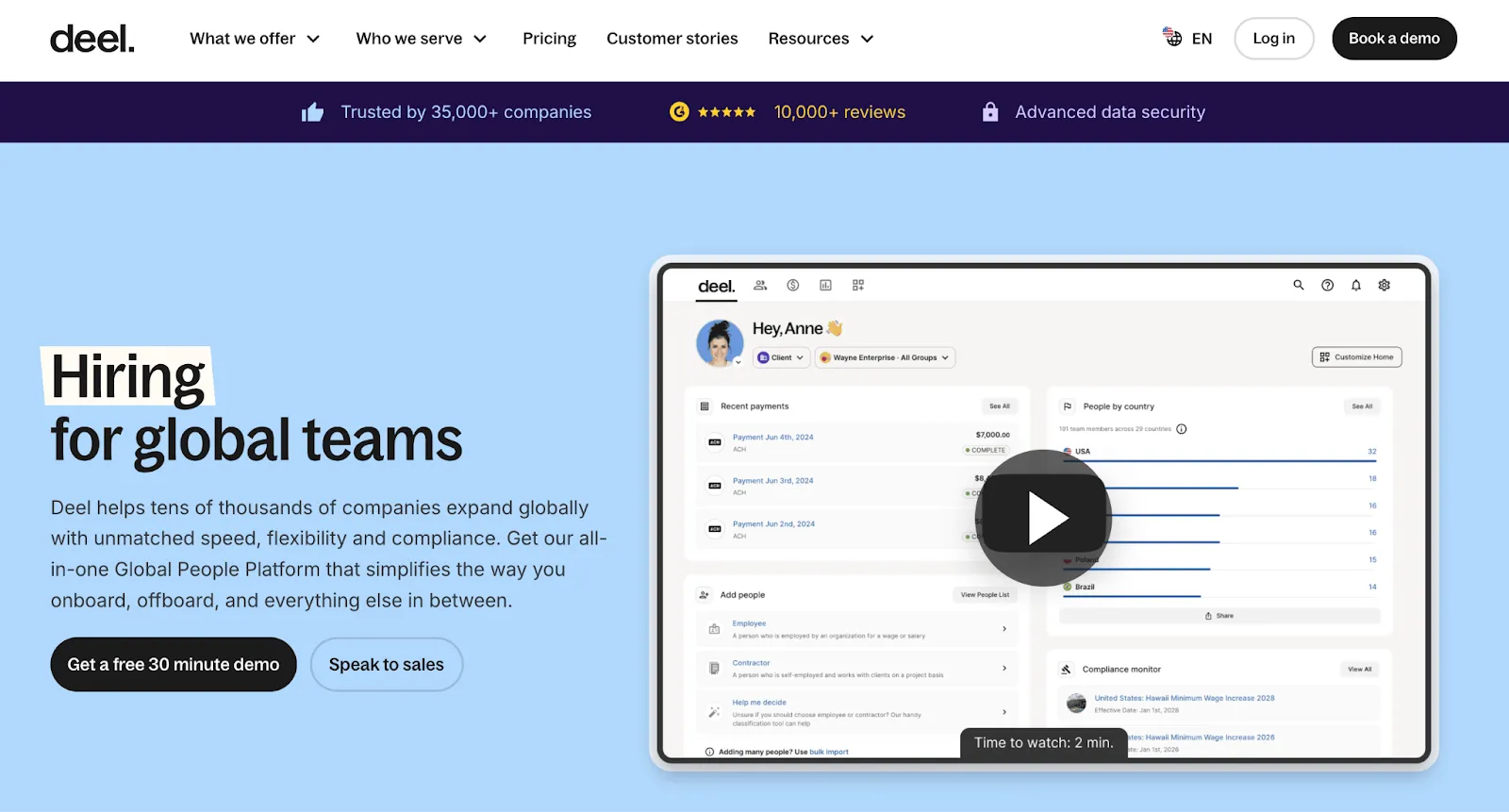
Deel built its reputation on contractor payments and has evolved into a full-stack global employment platform. They offer both EOR services and direct payroll capabilities, making them particularly strong for companies with mixed workforce types (contractors + full-time employees).
Deel combines self-service onboarding, compliance workflows, and immigration support, helping businesses scale globally while keeping administrative overhead low.
Their platform is best suited for distributed teams needing fast hiring and contractor-to-FTE flexibility.
Key Features
- Contractor and employee payroll — manage both workforce types from a single platform.
- Self-service onboarding and compliance workflows — fast, automated processes for distributed teams.
- 130+ country coverage — growing entity ownership for global compliance.
- Built-in immigration and visa support — simplify work permits and cross-border employment.
Pros
- Contractor-to-FTE flexibility without platform switching.
- Fast onboarding and self-service designed for distributed teams.
- Transparent pricing tiers in many markets reduce evaluation friction.
Cons
- Compliance depth varies by region; strong in UK, Germany, Canada, less proven in India and Middle East.
- Limited white-glove support for complex employment classification questions.
- Rapid growth sometimes leads to inconsistent support quality.
Pricing
EOR services start at ~$599 per employee/month. Contractor payments have lower fees; pricing varies by country and service level.
What Do Users Say?
Startups appreciate the speed and ease of use, especially for contractor payments. Finance teams in regulated industries sometimes note concerns around compliance accountability where Deel partners rather than owns the legal employer relationship.
Best For
- Tech startups and remote-first companies with contractor-heavy teams.
- Organizations hiring across 10+ countries needing fast, self-service onboarding.
- Companies want a flexible solution for both freelancers and full-time employees.
4. Papaya Global
Papaya Global focuses on enterprise clients with complex multi-country payroll needs, offering a unified platform for payroll, payments, and workforce management across 160+ countries.
They operate on a hybrid model, combining owned entities with local partnerships to ensure compliance and operational efficiency.
The platform centralizes payroll, compliance, and workforce insights, making it ideal for organizations managing large, distributed teams with advanced reporting and automation requirements.
Key Features
- Enterprise-grade payroll automation — streamline global payroll with minimal manual intervention.
- Real-time payroll analytics and forecasting — make data-driven decisions across regions.
- Multi-currency payment infrastructure — pay employees in their local currencies efficiently.
- Integrated compliance and risk dashboards — proactive monitoring of statutory changes and filing deadlines.
Pros
- Sophisticated enterprise features: Advanced reporting, scenario modeling, and ERP integration.
- Single platform consolidation: Replace multiple regional payroll vendors with one system.
- Automated compliance monitoring: Alerts for statutory updates reduce risk.
Cons
- Enterprise-focused pricing: Expensive for startups or small teams.
- Implementation complexity: Requires significant internal process alignment.
- Overkill for simple setups: Companies hiring in 2–3 countries may not need full enterprise capabilities.
Pricing
Custom enterprise pricing based on global headcount and country coverage. Typically involves annual contracts plus implementation fees.
What Do Users Say?
Enterprise HR and finance leaders appreciate centralized visibility and robust reporting. Smaller companies often cite long implementation timelines (6+ months) and challenging contract negotiations.
Best For
- Enterprises (500+ employees) operating in 15+ countries.
- Companies needing consolidated payroll infrastructure with advanced analytics.
- Organizations requiring proactive compliance monitoring across multiple markets.
5. Rippling
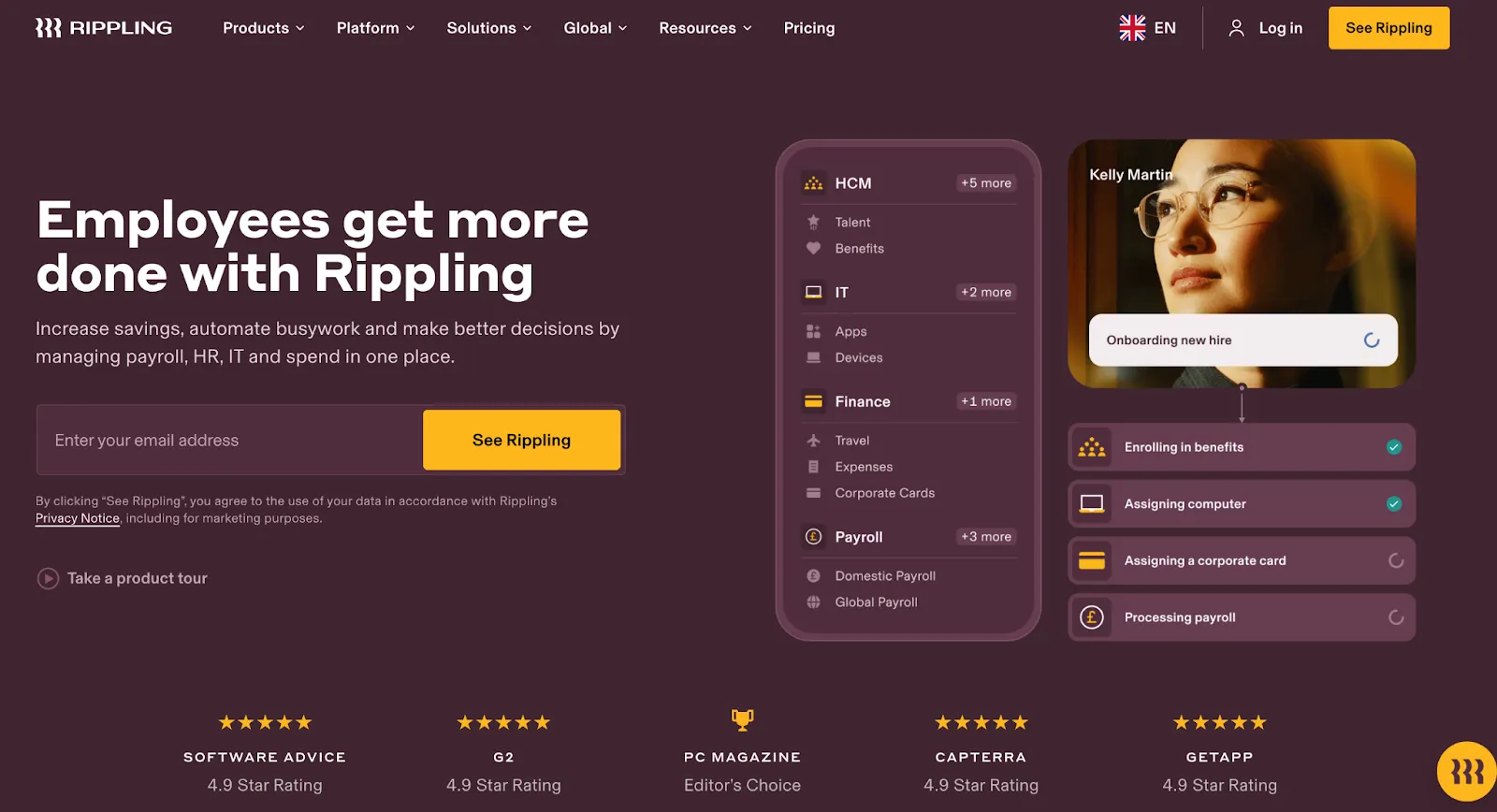
Rippling brings HR, IT, and payroll together in a single platform, letting companies manage employee devices, software access, benefits, and global payroll across 150+ countries.
Its main strength is operational integration, not deep global payroll specialization. The platform helps teams reduce manual processes and keep everything connected in one system.
Rippling is best for tech-focused companies that want to streamline onboarding, simplify HR and IT workflows, and manage payroll alongside other employee systems.
Key Features
- Unified HR, IT, and payroll administration — manage all employee systems from a single platform.
- Automated device provisioning and app access — trigger IT workflows alongside HR processes.
- Global payroll with EOR capabilities in select markets — pay international employees and contractors.
- Custom workflow automation — automate employee lifecycle tasks from onboarding to payroll enrollment.
Pros
- Operational efficiency: Eliminates data sync issues between HR, payroll, and IT systems.
- Strong US payroll capabilities: Best-in-class domestic payroll features for US-centric teams.
- Workflow automation: Reduces manual tasks across employee lifecycle.
Cons
- Global payroll depth: International coverage exists but is limited compared to specialized EOR providers
- Pricing complexity: Modular add-ons for payroll, benefits, IT, and EOR can be expensive.
- Over-engineered for simple setups: Organizations without integrated IT/HR needs may not use full potential.
Pricing
Starts at ~$8/employee/month for core HRIS, with additional fees for payroll, benefits, IT management, and international EOR. Total costs vary based on modules selected.
What Do Users Say?
Tech companies praise Rippling for reducing tool sprawl and centralizing HR/IT/payroll functions. However, teams focused on global payroll best practices note that Rippling’s international payroll depth is less robust than specialized providersBest For
- US-based tech companies with 50–500 employees.
- Teams needing integrated HR, IT, and payroll infrastructure.
- Companies with lighter international hiring needs (5–10 countries).
6. Oyster HR
Oyster is a remote-first employment platform covering 180+ countries, designed to simplify global hiring for distributed teams. It focuses on compliance, using AI-assisted checks to help companies navigate local labor laws and reduce misclassification risks.
The platform handles both EOR and contractor management, making payroll, benefits, and equipment provisioning seamless across multiple countries. Its workflows are built for companies without dedicated international HR teams, so onboarding and managing global employees is straightforward.
Oyster offers transparent per-employee pricing and tools for distributed team enablement, making it especially suitable for startups and small-to-mid-size companies hiring internationally without building internal HR infrastructure.
Key Features
- EOR and contractor management across 180+ countries — hire and pay globally from one platform.
- AI-powered compliance risk scoring — identify misclassification and local labor law issues.
- Distributed team onboarding workflows — streamline onboarding for international hires.
- Integrated benefits and equipment management — manage perks, insurance, and remote work setup.
Pros
- Remote-work focus: Tailored for distributed teams, not retrofitted from legacy payroll systems.
- Compliance guidance: AI tools highlight potential risks and regulatory requirements.
- Transparent per-employee pricing: Clear monthly rates simplify vendor evaluation (learn more).
Cons
- Limited enterprise features: Best suited for companies <200 employees.
- Newer market presence: Less operational track record than legacy EOR providers.
- Support depth variability: Self-service model may lack specialized legal guidance for complex cases.
Pricing
EOR services: $599–$699/employee/month depending on country. Contractor payments have lower fees.
What Do Users Say?
Remote-first startups praise the ease of use and distributed team support. Companies with significant India or APAC operations note that Oyster’s compliance depth is not as strong as regional specialist providers.
Best For
- Remote-first startups with 20–150 employees.
- Teams hiring distributed talent across 8–15 countries.
- Organizations seeking straightforward employment and payroll workflows.
7. Remote
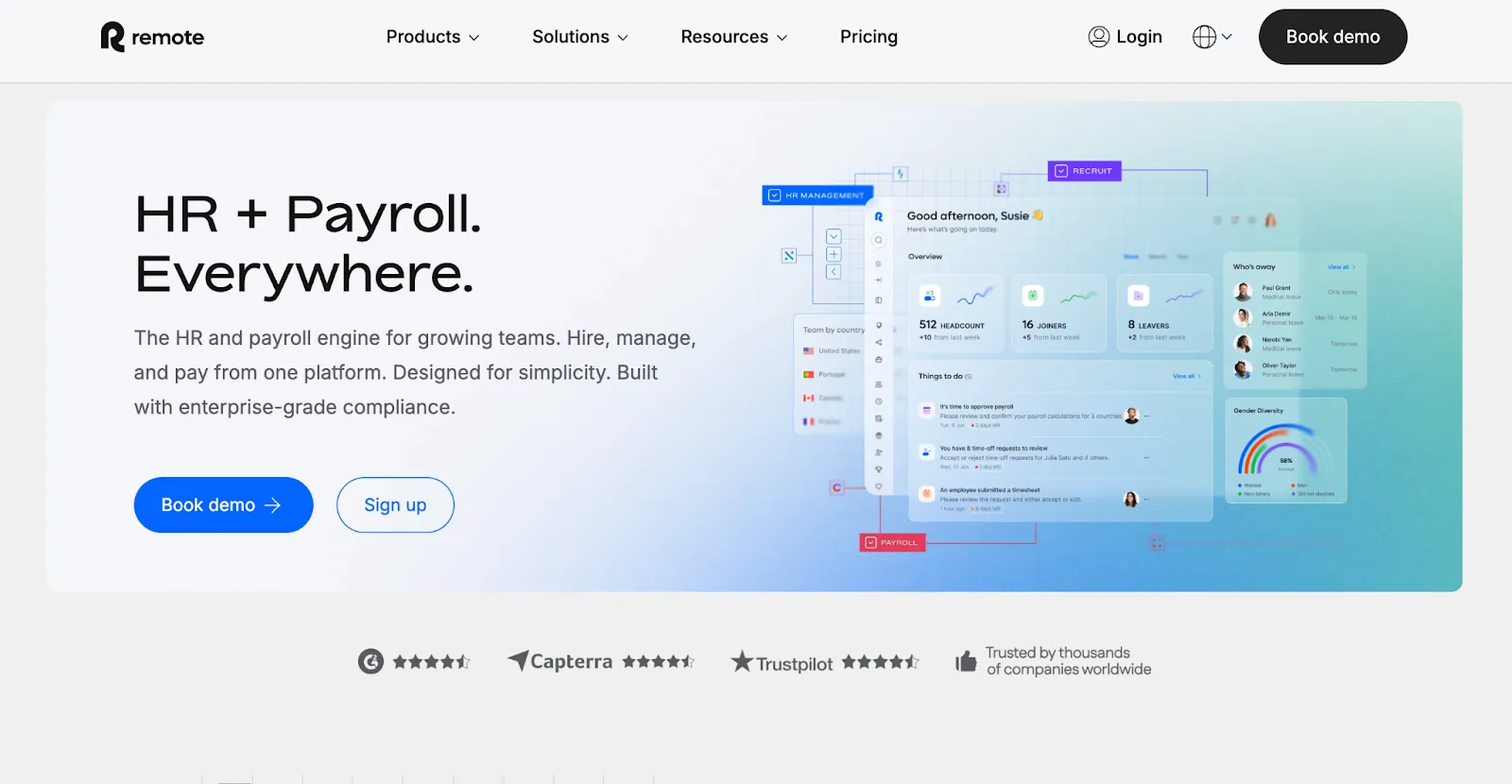
Remote provides a self-service global employment platform designed to make international hiring simple and transparent. It covers 100+ countries and focuses on smooth contractor-to-employee conversion workflows, helping teams manage both freelancers and full-time employees efficiently.
The platform emphasizes developer-friendly integrations, API access, and automation, allowing companies to connect payroll, benefits, and compliance processes with existing HR and finance systems. Onboarding, payments, and reporting are streamlined for distributed teams.
With clear pricing and easy-to-use dashboards, Remote is ideal for tech-forward SMBs and mid-market companies looking to hire globally without complex setup or extensive HR infrastructure.
Key Features
- EOR, payroll, and contractor payments from a single platform — manage all workforce types in one place.
- Public, transparent pricing — reduces vendor evaluation friction and surprises.
- API-first architecture — enables custom integrations for tech-forward teams.
- Intellectual property and equipment management tools — secure assets for distributed employees.
Pros
- Pricing transparency: Published rates simplify budgeting.
- Developer-friendly: Strong API support for integrations and automation.
- Fast onboarding: Self-service workflows accelerate contractor and employee activation.
Cons
- Support model: Limited white-glove assistance for complex compliance questions.
- Country coverage depth: 100+ countries is solid but less than 160–180+ competitor platforms.
- Enterprise scalability: Better suited for mid-market companies than large enterprises needing dedicated account management.
Pricing
EOR services: Starting around $599/employee/month. Contractor management fees are lower; prices vary by country.
What Do Users Say?
Tech companies praise the transparent pricing and API capabilities. Some finance teams note limited customization for multi-entity reporting and complex organizational structures.
Best For
- Tech-forward SMBs with 30–200 employees.
- Engineering teams hiring developers and contractors across 5–12 countries.
- Companies seeking self-service global employment with transparent pricing.
8. TopSource Worldwide

TopSource Worldwide delivers enterprise-grade global employment solutions with coverage across 180+ countries through 60+ owned legal entities. Their platform is designed for companies with complex regulatory environments, ensuring legal compliance and operational consistency.
The platform provides dedicated in-country HR and payroll specialists, multi-entity consolidation, and custom compliance solutions tailored to regulated industries like financial services, healthcare, and government contracting. This hands-on model reduces coordination risk and ensures accuracy across global operations.
TopSource Worldwide is best suited for large enterprises that require white-glove service, deep local expertise, and robust infrastructure to manage multi-country payroll and compliance without relying on third-party vendors.
Key Features
- Owned legal entities — direct employment relationships in 60+ countries.
- Dedicated in-country HR and payroll specialists — local expertise for compliance and workforce management.
- Custom compliance solutions — tailored for regulated industries like finance, healthcare, and government.
- Multi-entity consolidation and reporting — unified visibility across global operations.
Pros
- Deep local infrastructure: Reduces risk from third-party coordination.
- Enterprise service model: Dedicated account teams for high-touch support.
- Regulated industry expertise: Strong track record in compliance-heavy sectors.
Cons
- Enterprise pricing: Not cost-effective for startups or SMBs.
- Technology gaps: Less self-service automation compared to modern platforms.
- Long implementation timelines: Custom deployments can take 6–9 months.
Pricing
Custom enterprise pricing based on countries, headcount, and service level. Expect higher per-employee costs than self-service platforms.
What Do Users Say?
Enterprise clients value the compliance depth, hands-on support, and local expertise. Tech startups, however, find the platform less intuitive and slower to implement than modern alternatives.
Best For
- Large enterprises (1,000+ employees) in regulated industries.
- Companies needing owned-entity infrastructure across 20+ countries.
- Organizations requiring high-touch, customized compliance and HR support.
9. Paylocity
Paylocity started as a US-focused payroll and HR platform and has expanded its global capabilities through a network of partner vendors. The platform integrates payroll, benefits administration, and employee engagement tools, making it familiar and easy to adopt for companies with established domestic operations.
While its core strength lies in US payroll and HR management, Paylocity enables limited international payroll through partnerships. This allows companies to add a small number of employees abroad without switching platforms or disrupting domestic processes.
Paylocity is best suited for US-centric companies with 100–500 employees that need to maintain strong domestic operations while gradually extending payroll to 5–15 international employees in major markets.
Key Features
- Integrated US payroll and HR suite — manage payroll, benefits, and HR in one platform.
- Global payroll via partner network — limited international coverage through trusted vendors.
- Benefits administration — open enrollment, health, and retirement management.
- Employee engagement and performance modules — track feedback, goals, and recognition.
Pros
- Unified US platform: Excellent domestic payroll and benefits infrastructure.
- Familiar interface: Easy adoption for teams already using Paylocity.
- Modular pricing: Pay only for features you need.
Cons
- Global payroll depth: International payroll relies on partners, adding coordination complexity.
- Limited EOR functionality: Not a legal employer in most international markets.
- Best for US-centric operations: Less suited for companies with large global teams.
Pricing
Quote-based pricing depending on modules and headcount. Expect per-employee-per-month fees plus implementation costs.
What Do Users Say?
US HR teams value the integrated domestic platform but note limited international capabilities compared to global-first providers.
Best For
- US-centric companies (100–500 employees) adding 5–15 international hires.
- Organizations seeking domestic HR/payroll excellence with minimal global expansion.
- Teams wanting to extend existing Paylocity usage without switching platforms.
10. CloudPay
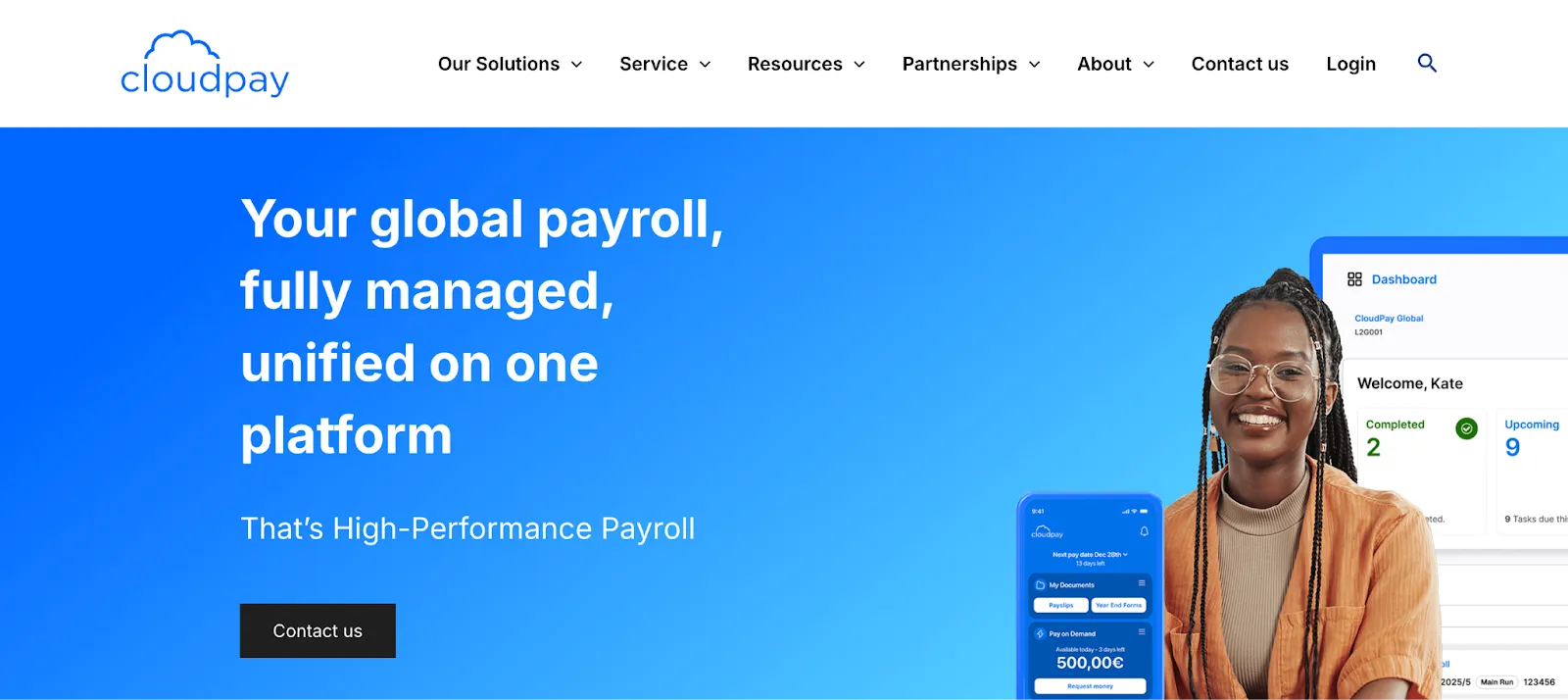
CloudPay is a managed global payroll provider operating in over 170 countries, offering payroll services with dedicated local specialists in each market. The platform emphasizes accuracy and compliance, ensuring statutory requirements are met without relying solely on automated processes.
Unlike EOR-focused platforms, CloudPay does not act as the legal employer. Its strength lies in providing reliable, human-in-the-loop payroll processing, making it ideal for organizations that prioritize precision and regulatory adherence across multiple regions.
CloudPay is best suited for large enterprises with complex payroll needs across 15+ countries that require managed service accuracy, country-specific expertise, and detailed reporting rather than self-service automation.
Key Features
- Managed payroll services with dedicated country experts — ensure accurate statutory payroll processing.
- Unified multi-country payment infrastructure — consolidate payments across currencies and regions.
- Compliance monitoring — stay updated with statutory changes and labor law requirements.
- White-label payroll solutions — tailored for enterprise clients with complex needs.
Pros
- Payroll accuracy: Human specialists reduce errors versus fully automated systems.
- Deep local expertise: Country teams understand statutory nuances and regulatory changes.
- Enterprise customization: Flexible service models for unique corporate requirements.
Cons
- Managed service costs: Higher fees than self-service platforms.
- Technology interface: Less modern platform compared to newer competitors.
- Not EOR-focused: Primarily payroll processing; limited legal employer services internationally.
Pricing
Custom enterprise pricing based on countries, headcount, and service level. Expect setup fees per country plus monthly management charges.
What Do Users Say?
Enterprise finance teams praise payroll accuracy and support, while self-service-oriented companies find the managed model expensive and less flexible.
Best For
- Enterprises (500+ employees) with multi-country payroll across 15+ countries.
- Organizations prioritizing accuracy and compliance over automation.
- Companies needing dedicated country specialists and white-glove service.
Why Should You Consider Different Global Payroll Companies?
Choosing a global payroll provider is about finding the right fit for your operational needs. Companies actively compare providers for several reasons:
Compliance responsibility
Some providers act as the legal employer, taking full responsibility for taxes and labor law compliance. Others just process payroll based on the data you provide. Knowing who is accountable when mistakes happen is critical.
Geographic coverage vs. depth
A provider might list 180 countries, but that doesn’t mean they have teams or legal entities in your key markets. True operational depth matters more than the number of countries on a website.
Reporting and transparency
Multiple local vendors or unclear invoices can make cost tracking a headache. The best platforms give line-item breakdowns so you can forecast expenses accurately.
Pricing structure
Different providers charge per employee, per country, or include hidden FX spreads and annual minimums. A “cheap” provider at first could end up costing more as your team grows.
Scalability
Platforms designed for 20 employees may struggle when you reach 200 or more. Make sure your provider can grow with you without requiring a disruptive switch.
Understanding these tradeoffs helps you select a provider that matches your growth, compliance, and visibility needs, not just the one with the flashiest marketing.
How to Choose the Best Global Payroll Company

Use this practical framework to evaluate global payroll providers based on what really matters.
1. Country Coverage vs. Local Expertise
Do not just look at the number of countries. Check if the provider has in-country teams, owned legal entities, and proven experience in your key markets. Ask if they act as the legal employer in your priority countries or if they partner with a local provider. This shows who is legally responsible.
2. Compliance and Risk Responsibility
Find out who is accountable if a tax filing is late or an employee is misclassified. EOR providers take on legal employer liability, while payroll-only services leave the risk with you. Make sure the model matches your company’s risk tolerance and internal legal capacity.
3. Payroll Accuracy and Timeliness
Late payrolls harm employee trust very quickly. Check the provider’s processing timelines, error rates, and how they handle shifts in statutory deadlines such as holidays or government extensions. Ask for clear service level commitments, not just marketing promises.
4. Reporting, Analytics, and Audit Readiness
Finance teams need visibility into total compensation costs by country, not just high-level invoices. Look for platforms that provide GL-ready exports, multi-currency reporting, and audit-ready documentation without extra manual work. Payroll software should simplify reporting, not create more work.
5. Pricing Transparency and Scalability
Request country-specific pricing for your top markets. Clarify what is included, such as statutory filings, benefits, and compliance updates, and what triggers extra fees. Model total costs for 50, 100, and 200 employees to see if pricing scales predictably or has hidden spikes.
Common Mistakes to Avoid When Choosing a Global Payroll Provider
1. Choosing based on price alone
The cheapest option may pass compliance risk back to you. Paying a bit more for a provider that acts as the legal employer is usually much cheaper than facing a large misclassification penalty.
2. Ignoring compliance responsibility
Always confirm who is liable if something goes wrong. If a provider uses local partners, you could still be the legal employer responsible for taxes and labor law compliance. Make sure liability is clearly stated in the contract.
3. Underestimating local payroll rules
Each country has its own payroll requirements. India requires PF, ESIC, gratuity, and professional tax. Middle East countries have end-of-service benefits. Brazil requires a 13th-month salary. Coverage doesn’t guarantee compliance and ask for country-specific compliance guides.
4. Choosing platforms without local support
Self-service platforms work until a tricky issue arises, like employee classification right before a filing deadline. Ensure the provider offers dedicated local support, not just chatbots or help articles.
5. Overlooking long-term growth
Platforms built for small teams often lack advanced features like multi-entity reporting, custom integrations, or consolidated payroll. Checking that the provider can scale with your growth switching later is expensive and disruptive.
Why Choose Gloroots for Global Payroll
Gloroots was built to solve the common challenge most global payroll providers overlook: companies need both compliance certainty and clear operational visibility without compromise.
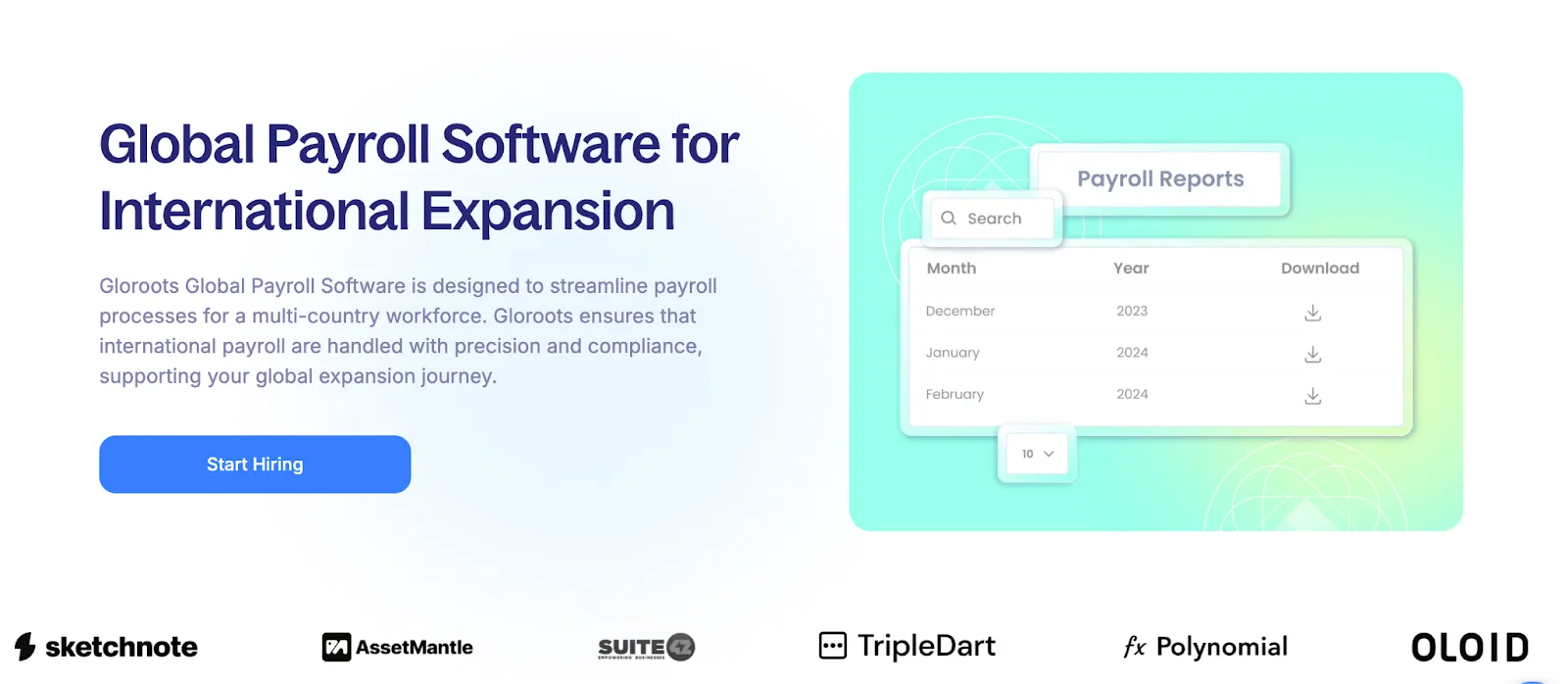
As the legal Employer of Record, Gloroots takes on statutory compliance liability, so your finance and HR teams aren’t left navigating tax codes or labor law updates alone.
Key Benefits:
- Assumes full compliance responsibility with in-house legal and country-specific expertise
- Direct employment relationships reduce misclassification risk and audit exposure
- Line-item invoices with country-level cost breakdowns for accurate forecasting
- GL-ready exports, multi-currency reporting, and audit documentation included
- GCC-specific infrastructure for India: PF/ESIC/gratuity compliance, local talent sourcing, and compensation benchmarking
- Hybrid models that transition temporary EOR arrangements into full entity operations
Whether you’re hiring your first international employee or consolidating multiple regional payroll vendors, Gloroots scales from 10 to 250+ employees without platform changes or operational rework, giving your team predictable, compliant, and transparent global payroll management.
Ready to see how compliance-first payroll infrastructure works in practice?
Explore Gloroots' global payroll solutions or book a demo to discuss your specific markets and growth plans.
Frequently Asked Questions
1. What’s the difference between global payroll software and an Employer of Record (EOR)?
Payroll software only processes payments and taxes for employees under your company’s legal entity.
An EOR like Gloroots becomes the legal employer in each country, taking care of tax, compliance, and labor laws on your behalf.
2. How can I tell if a global payroll provider is compliant in my target countries?
Ask these:
- Do you act as the legal employer or just process payroll?
- Do you have local teams or owned entities there?
- Can you show examples of local compliance documents?
A reliable provider will handle each country’s unique laws and provide client references.
3. Why does pricing transparency matter?
Because hidden fees add up fast. Some vendors charge extra for filings, benefits, or currency conversions.
Clear, itemized pricing helps you forecast costs accurately and avoid surprises later.
4. Can one provider manage payroll for all my international employees?
Sometimes. One provider usually works well if you’re in 3–15 countries.
Larger companies often use a mix of providers to cover all regions effectively.
The key is balancing convenience with strong local compliance.
5. What are the risks of managing global payroll in-house?
- Compliance mistakes or late filings
- Misclassification penalties
- Constantly changing tax laws
- Heavy admin work and audit risk
Partnering with a global payroll expert helps reduce these risks and keeps your team compliant everywhere.

Ready to take the first step?
Request a demo now and learn how you can focus on building, without worrying for compliance, ever!