











- Align remote sales hiring with strategy, local pay, and compliance using EOR solutions like Gloroots.
- Source top talent through niche remote job boards, LinkedIn, and global recruiters.
- Hire for communication, self-discipline, and digital proficiency via structured virtual interviews.
- Use AI and CRMs to onboard, manage, and measure remote sales performance effectively.
Remote sales is no longer an experiment.
Many companies that built distributed teams in 2020 as a temporary fix have made them permanent. The reason goes beyond saving costs and it's better performance.
Remote sales reps reach 47% of their quotas compared to 43% for office teams, and remote roles attract 43% more applicants.
However, hiring remote teams requires a new approach.
What worked in offices daily standups, whiteboard sessions, or in-person coaching doesn’t fit global teams. Companies that reuse local hiring methods often face compliance issues, uneven pay structures, and poor performance.
The goal is to build distributed revenue teams with the right systems, compliance, and performance frameworks.
This guide covers what remote sales teams are, why companies are hiring them, the risks you must avoid, how to hire step-by-step, and how to manage distributed sales teams without compliance headaches.
What is a Remote Sales Team?
A remote sales team works without a central office. Reps sell from different cities, countries, or time zones, often as part of a global structure. Typical roles include:
- Sales Development Representatives (SDRs): Handle outbound prospecting
- Account Executives (AEs): Close deals
- Account Managers (AMs): Manage renewals and expansions
- Sales Operations (Sales Ops): Maintain tools, data, and reporting

These teams rely fully on digital tools. CRMs such as Salesforce or HubSpot track deals, video platforms support demos, and communication tools keep teams aligned across time zones. Sales enablement platforms centralize training and onboarding.
Performance measurement also changes. Companies focus on outcomes rather than presence. Success is measured by pipeline growth, win rates, and deal velocity instead of hours worked or office attendance.
Why Are Companies Hiring Remote Sales Teams?
More companies are building remote sales teams because they offer access to better talent, faster growth, and improved efficiency across global markets.
- Access to specialized sales talent
Companies in fields like cybersecurity, fintech, and supply chain software often cannot find experienced sellers locally. Remote hiring expands the pool to include reps who know the product type, understand buyer behavior, and bring relationships from similar industries.
- Faster market expansion
Hiring sellers who already work in target regions helps companies grow faster. Local reps understand procurement cycles, buying habits, and relationship-driven sales cultures that remote managers from other countries may miss.
- Cost efficiency through smart hiring
Cost savings come from aligning pay with market expectations, not lowering quality. The same skill level that costs $180,000 OTE in San Francisco may cost $110,000 in Austin or $85,000 in Lisbon, offering better margins for the same performance.
- Higher productivity and work-life balance
Remote work suits many sellers’ natural work styles. Those who struggle in noisy offices often perform better in focused, flexible environments. Without long commutes, reps can dedicate more energy to prospecting and closing deals.
Remote sales teams help businesses find better talent, scale faster across markets, and maintain strong results while keeping costs under control.
What Are the Prerequisites Before Hiring a Remote Sales Team?
Before hiring remote sales professionals, companies need to prepare their systems, budgets, and compliance frameworks to support a distributed setup effectively.
- Budget and compensation benchmarking
Pay structures must reflect local market conditions. Use tools like Gloroots’ Salary Calculator to compare salaries by role and region. Compensation should balance cost of living with a fair premium for remote flexibility.
- Clear sales goals and KPIs
Define revenue targets, pipeline expectations, and activity benchmarks before hiring. Remote sales teams need specific, measurable goals since managers cannot rely on in-person supervision.
- Defined target markets and time zone strategy
Hiring must align with your customer base. Selling to EU clients, for example, requires hiring in similar time zones or setting up shifts that overlap with European business hours.
- Technology and process readiness
Ensure your sales tools are globally accessible. CRMs, commission software, and communication platforms should handle multi-currency transactions, remote logins, and async training efficiently.
- Compliance and legal preparedness
Every country has unique employment laws, tax rules, and notice requirements. Misclassifying workers or using non-compliant contracts can lead to penalties. Compliance should be addressed before onboarding your first remote hire.
Laying the right financial, operational, and legal groundwork ensures your remote sales team can perform efficiently and stay compliant from day one.
5 Remote Sales Hiring Risks You Must Avoid in 2026
Hiring remote sales talent opens new opportunities, but it also brings unique compliance and operational risks. Understanding these early helps you avoid costly mistakes.
1. Worker Misclassification
Treating full-time employees as contractors to save on taxes or benefits can trigger audits, penalties, and back-pay claims. Many countries, including Germany, Spain, and Brazil, actively enforce misclassification laws.
2. Non-Compliant Contracts Across Countries
Using the same employment agreement across countries rarely works. Each location has specific requirements for benefits, notice periods, working hours, and termination clauses. A valid U.S. contract may be illegal in France.
3. Payroll and Tax Errors
Mistakes in withholding taxes, late filings, or missed social contributions lead to fines and, in some regions, personal liability for company directors. Global payroll accuracy is essential.
4. Time Zone Misalignment Affecting Performance
Poorly planned meeting schedules can cause burnout and poor productivity. For example, expecting EMEA reps to attend 8 a.m. ET calls daily disrupts work-life balance and reduces performance.
5. Data Security and CRM Access Risks
Remote sales reps often work from homes or public networks. Enforce secure access policies like VPNs, two-factor authentication, and restricted CRM permissions to protect sensitive data.
What Skills Should You Look for in a Remote Sales Representative?
How Do You Hire a Remote Sales Team Step by Step?
Building a remote sales team requires structured planning across leadership, hiring, and compliance functions. Follow these six steps to set a strong foundation.
Step 1: Prepare Your Organization
Align sales leadership, finance, HR, and legal on headcount, compensation, territories, and timelines. Document your sales process, define performance expectations, and prepare onboarding materials before posting any job listings.
Step 2: Define Role Requirements
Clarify deal size, sales cycle, buyer personas, and the mix between inbound and outbound sales. List essential criteria such as “2+ years closing SMB SaaS deals” and note preferred experience, like working with procurement teams or enterprise clients.
Step 3: Source Candidates Globally
Use multiple sourcing channels, including LinkedIn, regional job boards like InfoJobs (Spain) or Naukri (India), and remote-first platforms such as Remote OK and We Work Remotely.
Referrals from current employees and partnerships with sales academies or bootcamps can further expand your reach.
Step 4: Screen for Remote-Ready Talent
Ask behavioral and situational questions to assess independence and self-management. Examples include: “How do you structure your day in a remote role?” or “Tell me about a deal you closed entirely over video and email.” Look for proactive, self-driven candidates.
Step 5: Interview with Real Sales Scenarios
Go beyond standard interviews. Assign mock discovery calls using your actual product and buyer persona. Evaluate how candidates qualify prospects, handle objections, and communicate value clearly.
Step 6: Make Compliant Offers
Issue country-specific employment contracts that include mandatory clauses, local benefits, and clear commission structures.Define notice periods according to local law.
Use EOR models if you're hiring in markets without legal entities.
Where Can You Find Remote Sales Talent Globally?
- Global job boards: LinkedIn, Indeed Global, and Glassdoor reach broad audiences
- Regional hiring platforms: Seek in Asia-Pacific, StepStone in DACH countries, Catho in Brazil
- LinkedIn sourcing: Target passive candidates at competitors
- Recruitment partners: Use specialized sales recruiters for senior roles
- Remote staffing and EOR platforms: Gloroots combines sourcing, compliance, and payroll
How Do You Interview and Assess Remote Sales Candidates Effectively?
- Mock sales calls reveal more than resumes. Give candidates your product overview, a buyer persona, and 20 minutes to run a discovery call with you playing the prospect.
- Role-play scenarios should match reality. If your product requires navigating procurement, have them present ROI to a fictional CFO.
- Product pitch assessments test learning speed. Send product materials 48 hours before the interview, then ask them to pitch back to you.
- Communication and language evaluation matters for global teams. Look for clarity, confidence, and ability to explain complex concepts simply.
- Remote collaboration readiness surfaces through logistics. Did they join the Zoom call on time? Was their video and audio clear? Did they follow up with a thank-you email?
How Should You Onboard and Train a Remote Sales Team?
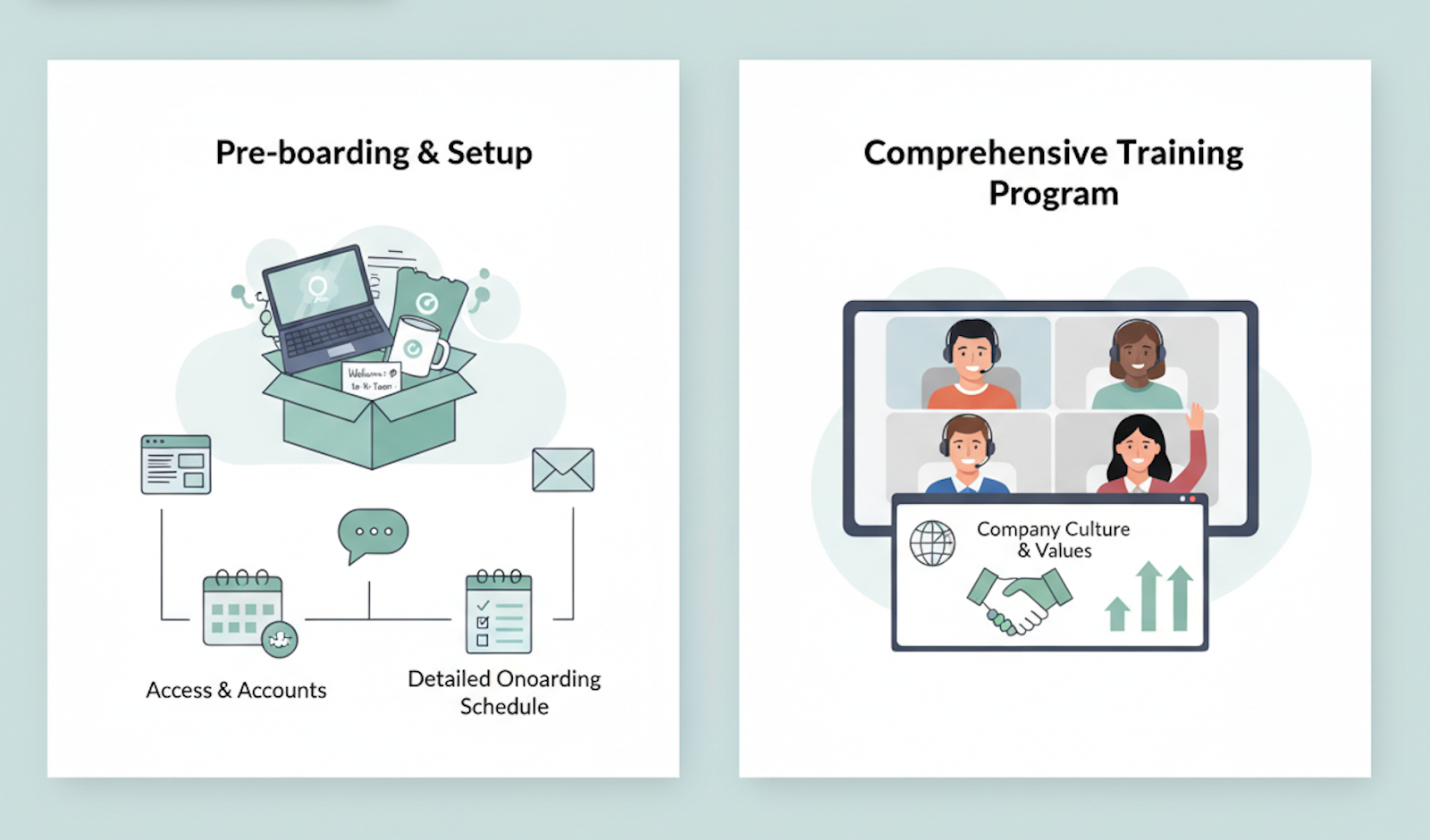
- Sales process orientation: Walk new reps through your entire sales cycle from lead entry to close procedures
- Product and market training: Assign them to shadow live calls and review recorded demos from top performers
- CRM and tool onboarding: Grant access, assign training modules, and have them log mock activities
- Sales messaging alignment: Provide email templates, objection-handling scripts, and pitch decks
- Early performance benchmarks: Set 30-60-90 day goals with clear pipeline and activity targets
How Do You Manage and Scale a Remote Sales Team Successfully?
Managing a remote sales team requires structure, visibility, and consistent communication. The goal is to keep teams aligned, motivated, and accountable while maintaining a strong performance culture.
- Track KPIs in real time
Build live dashboards that display key metrics such as pipeline coverage per rep, win rates by stage, activity levels, and forecast accuracy. Real-time visibility helps identify issues before they affect results.
- Hold regular performance reviews
Schedule monthly one-on-ones to discuss pipeline health, deal challenges, and skill development. Conduct quarterly business reviews to measure progress toward sales targets and identify high performers.
- Use sales enablement tools
Centralize resources through platforms like Highspot or Seismic. These tools store pitch decks, case studies, competitor information, and training content, ensuring every rep has consistent and updated material.
- Establish communication rhythms
Keep teams connected and informed with structured touchpoints:
- Daily standups (15 minutes, async updates)
- Weekly pipeline reviews (live sessions focused on deal progression)
- Monthly team calls (share learnings and celebrate wins)
- Quarterly offsites (in-person or virtual strategy alignment)
- Motivate beyond commission
Recognize top performers publicly and create tiered recognition programs. Offer professional development paths into senior or specialized roles to encourage long-term growth.
What Compliance and Payroll Challenges Come With Remote Sales Hiring?
Countries like Germany and France heavily favor employee classification and impose strict criteria for contractor status. Misclassifying creates liability for back taxes, benefits, and penalties.
Payroll across borders involves currency conversion, local tax withholding, social security contributions, and timely remittance to government agencies. Use global payroll software that handles multi-country compliance automatically.
Local labor regulations dictate working hours, overtime, vacation days, and sick leave. France mandates 5 weeks paid vacation, Brazil requires 13th-month salary, India has complex provident fund rules.
Should You Hire Directly or Use an Employer of Record (EOR)?
When hiring remote sales reps internationally, companies can either employ them directly or work through an Employer of Record (EOR). The right choice depends on your growth stage and compliance capacity.
1. Direct Hiring
Direct hiring means employing reps through your own legal entity. It gives full control over payroll, contracts, and benefits but requires significant time and cost.
- Best for: Companies with existing entities and local HR or legal teams.
- Cost: Entity setup often ranges from $20,000–$50,000 and takes 6–12 months, plus annual upkeep fees.
2. EOR Hiring
An EOR employs your team legally in their country while you manage their daily work. It covers contracts, payroll, and compliance so you can hire faster.
- Best for: Companies testing new markets or hiring in multiple countries.
- Cost: Typically $400–$800 per employee per month, with no setup required.
In summary:
Direct hiring offers control for long-term market presence.
EOR hiring offers speed, compliance, and lower upfront cost.
How Does an EOR Reduce Risk When Hiring Remote Sales Teams?
An EOR provides:
- Misclassification protection because the EOR employs workers properly according to local law
- Compliant contract creation using country-specific templates updated for regulatory changes
- Payroll and tax accuracy with automatic withholding, filing, and remittance
- Benefits administration covering statutory requirements and competitive additions
- Local expertise from HR professionals who understand market norms and labor disputes
How Gloroots Simplifies Remote Sales Hiring?
Gloroots eliminates the infrastructure burden of building distributed sales teams. Setting up entities, managing local payrolls, and ensuring compliance with labor laws take time and resources.
Gloroots removes these challenges by acting as the legal employer, allowing you to focus on managing and growing your sales team.
Here’s how Gloroots helps:
- Hire without setting up entities
Whether you need an SDR in Mexico, an AE in Poland, or a sales engineer in Singapore, Gloroots employs them through its local entities. This eliminates the 6–12 month process of establishing your own subsidiary. - Stay compliant and avoid misclassification
Gloroots ensures all employment relationships are legally sound from day one, with country-specific contracts, statutory benefits, and correct tax handling. - Run global payroll with accuracy
Pay salaries, bonuses, and commissions in local currencies with automated tax deductions and social contributions. Gloroots manages payroll compliance across 100+ countries. - Scale quickly and safely
Whether expanding from one to ten reps, Gloroots handles onboarding, contracts, and compliance without extra infrastructure or administrative overhead. - Manage everything in one platform
Track hiring progress, review contracts, approve payroll, and access compliance reports all from a single dashboard.
Building a high-performing remote sales team takes the right people, systems, and compliance foundation. Gloroots simplifies every step so you can focus on hitting your revenue goals.
Book a demo with Gloroots to see how we help companies hire and manage remote sales teams across 100+ countries.
Frequently Asked Questions
1.How do companies hire remote sales teams internationally?
Companies hire internationally through direct employment (requiring local entities), contractor agreements (with misclassification risk), or EOR services that provide legal employment infrastructure without entity setup.
2.Are remote sales reps employees or contractors?
Classification depends on control, exclusivity, and local labor law. If you dictate work hours, provide equipment, and require exclusivity, most countries will classify them as employees regardless of contract language.
3.What tools do remote sales teams need to succeed?
CRM (Salesforce, HubSpot), video conferencing (Zoom, Google Meet), sales engagement (Outreach, SalesLoft), contract management (DocuSign, PandaDoc), and communication (Slack, Microsoft Teams) form the core stack.
4.How do companies manage time zones in remote sales teams?
Successful strategies include hiring in regional clusters, establishing overlapping core hours (4 hours minimum), using async communication for non-urgent matters, and rotating meeting times to share time zone burden.
5.Do businesses need a local entity to hire remote sales reps?
No. EOR services allow hiring without entity formation by employing reps through their existing legal entities while you maintain operational control.

Ready to take the first step?
Request a demo now and learn how you can focus on building, without worrying for compliance, ever!