











- New Horizons covers 180+ countries but lacks customization and India-specific compliance depth. Standardized contracts don't accommodate unique equity structures or localized benefits as teams scale.
- Entity ownership determines legal liability during disputes. Third-party subcontracting creates ambiguity in high-risk markets where compliance errors cost six figures.
- Pricing ranges from $199 to $1,000+ per employee monthly. Remofirst ($199), Deel/Remote ($599), and Globalization Partners ($800+) offer different service levels at corresponding price points.
- India expansion requires local experts, not templates. GCC setup, PF/ESIC compliance, and contractor conversions need specialists who understand state-level labor law variations.
- The global EOR market grows from $6.9B (2025) to $12B by 2030. Rising competition improves pricing transparency and compliance expertise across providers.
New Horizons Global Partners built a solid reputation in the EOR space. But as companies scale into new markets or refine their compliance standards, the fit changes. What worked for 20 employees across three countries may not hold up at 150 across twelve.
This guide compares the leading alternatives worth evaluating if you're reconsidering your EOR provider.
Our evaluation is based on:
- Direct customer conversations with HR leaders managing distributed teams
- Platform testing across onboarding, payroll, and compliance workflows
- Analysis of verified reviews from G2, Capterra, and TrustRadius
- Pricing transparency and total cost of ownership assessments
Gloroots is included in this comparison. We've approached every provider with the same evaluation criteria.
The goal here is simple: help you choose the EOR that matches your expansion priorities, risk tolerance, and operational complexity, regardless of where that decision lands.
What Is New Horizons Global Partners?
New Horizons Global Partners operates as a global Employer of Record, enabling companies to hire employees in international markets without establishing local entities. The platform handles payroll, benefits, tax withholding, and statutory compliance across 180+ countries.
It's built for mid-market and enterprise teams expanding into multiple regions simultaneously, particularly those prioritizing speed over customization.
Companies typically use New Horizons to activate hires in hard-to-reach markets, manage distributed teams under one contract structure, or test new geographies before committing to entity formation.
Key Features of New Horizons Global Partners
- Entity network across 180+ countries: Coverage spans emerging and established markets, reducing the need for fragmented vendor relationships across regions.
- Consolidated invoicing and reporting: Finance teams receive unified billing across all countries, simplifying budget forecasting and audit preparation without manual reconciliation.
- Managed onboarding and offboarding: HR teams delegate employee lifecycle workflows to New Horizons, including contract generation, benefit enrollment, and exit processing in each jurisdiction.
- Multi-country payroll engine: Payroll runs centrally with automated tax calculations, statutory deductions, and local currency disbursements that adjust for jurisdiction-specific requirements.
- Compliance monitoring and updates: Legal teams receive alerts on regulatory changes in active markets, with contract amendments and policy updates managed by New Horizons' local advisors.
- Benefits administration across jurisdictions: Employees access region-appropriate health insurance, retirement contributions, and statutory leave entitlements without HR needing to source local brokers.
When to Consider a New Horizons Global Partners Alternative
Teams often outgrow New Horizons when operational demands shift from breadth of coverage to depth of service in specific regions. Here's when alternatives make sense:
1. Pricing scalability becomes a concern. The per-employee-per-month model compounds quickly as headcount grows. Finance leaders start questioning whether they're paying for 180 countries of access when they only operate in eight.
2. Customization limitations surface. Standardized contracts work early on, but companies with unique equity structures, performance bonus frameworks, or localized benefits strategies find the platform rigid when they need flexibility at the country level.
3. Visibility gaps create friction.HR leaders need real-time payroll status, audit trails, or granular reporting that goes beyond monthly summaries. Some teams report delayed responses during offboarding or mid-cycle payroll corrections.
4. Service depth doesn't match complexity. Mature teams handling contractor conversions, GCC setups, or high-risk jurisdictions need specialized guidance that generalist support queues can't provide at the required speed or expertise level.
One HR director told us: "New Horizons got us into 12 countries fast, but when we needed to adjust contractor conversion timelines in India, the lag between request and execution cost us two key hires."
Top 10 New Horizons Global Partners Alternatives in 2026
1. Gloroots
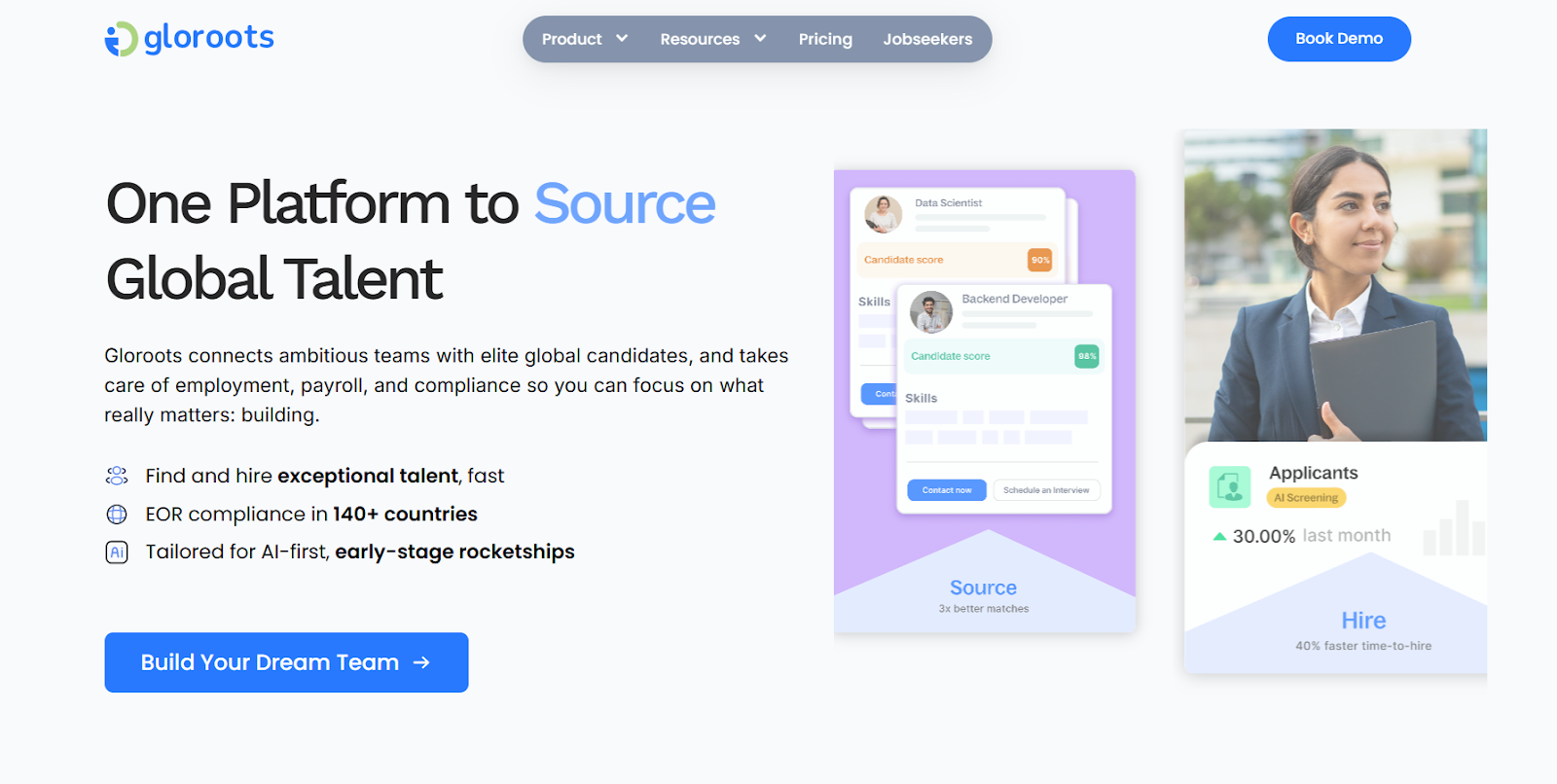
Gloroots is a global EOR and employment platform designed for companies expanding into India and managing distributed teams across 100+ countries.
The platform combines self-service tools for contract generation and payroll visibility with dedicated Customer Success Managers who act as extensions of your HR team, not ticket responders. This hybrid model works for HR leaders who need more than coverage lists: deep compliance expertise, entity ownership transparency, and hands-on support during critical hiring windows.
What sets Gloroots apart is its India specialization:
- PF/ESIC/gratuity handling and statutory audits
- Recruiting advisory with compensation benchmarks reflecting real market conditions
- Interim EOR support during entity formation timelines
Key Features
- Global Capability Center (GCC) enablement in India: Accelerates entity formation and provides interim EOR support during incorporation, handling payroll, statutory compliance, and local HR advisory while your legal entity is being activated.
- Contractor-to-employee conversion pathways: Manages classification risk and reclassification workflows when contractors transition to full-time roles, ensuring compliant employment terms without gaps in benefits or payroll continuity.
- Transparent FX handling and multi-currency payroll: Eliminates hidden markups on currency conversion with clear exchange rate disclosures and predictable payroll costs that finance teams can forecast accurately.
- Audit-ready financial reporting with GL mapping: Delivers line-item invoices with country-level cost breakdowns, accounting exports, and pre-configured general ledger codes that integrate directly into NetSuite, QuickBooks, or SAP.
- Dedicated Customer Success Managers with SLA-backed response times: Assigns a named CSM who learns your org structure, escalates payroll issues before they hit employees, and provides proactive guidance on compliance changes in your active markets.
Customer Review
"Gloroots handled our India expansion with zero payroll errors across 80 employees. The CSM caught a statutory filing deadline we didn't know existed. That level of oversight doesn't exist with our previous EOR." (HR Operations Lead, SaaS Company)
Pros
- India specialization delivers recruiting support, salary benchmarking, and GCC setup guidance that generalist EORs cannot match at the same service level.
- The hybrid model combines platform automation for routine tasks with managed service support for compliance escalations, contract amendments, and multi-country payroll corrections.
- Finance visibility includes transparent FX rates, detailed invoicing, and audit-ready exports that reduce month-end reconciliation time for distributed finance teams.
Cons
- Pricing transparency requires a custom quote; no self-service calculator is available for teams evaluating multiple providers simultaneously before initial conversations.
- Platform UI prioritizes function over design; teams accustomed to modern SaaS interfaces may find the dashboard less visually intuitive than Deel or Remote.
- Country coverage spans 100+ markets but trails providers like New Horizons (180+) or Multiplier (150+), limiting options for companies entering frontier markets.
Why Choose Gloroots Over New Horizons Global Partners?
- Direct legal employer accountability: Gloroots owns its entities in key markets, eliminating third-party subcontracting that obscures liability when employment disputes arise in complex jurisdictions.
- India operations consolidation: Recruiting advisory, compensation benchmarking, and GCC setup support are included, while New Horizons treats these as separate services requiring additional vendor relationships.
- Proactive CSM support: Dedicated Customer Success Managers provide compliance monitoring and SLA-backed response times during payroll cycles, while New Horizons routes most inquiries through generalist support queues with longer resolution windows.
Pricing
Gloroots operates on custom pricing based on employee count, countries of operation, and service level requirements. Enterprise agreements include volume discounts and bundled recruiting support for India-based teams.
2. Remofirst
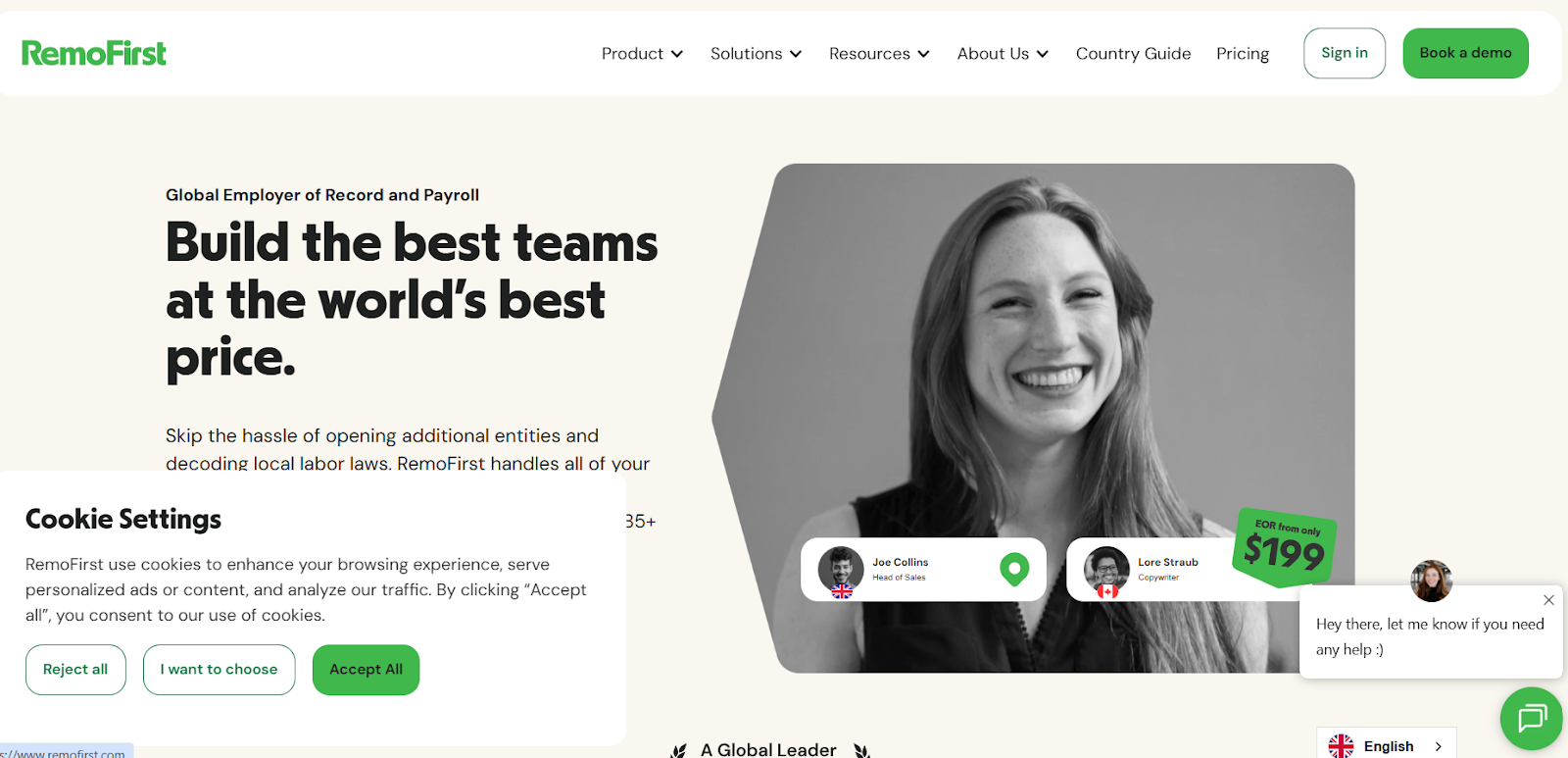
Remofirst positions itself as the budget-friendly EOR for startups and SMBs hiring across multiple countries without enterprise budgets. The platform handles payroll, benefits, and statutory compliance in 150+ countries, with a self-service interface that keeps HR teams moving without waiting for account manager approvals.
At $199 per employee per month, it undercuts New Horizons significantly. Remofirst appeals to early-stage teams testing international markets or running lean operations where cost predictability matters more than white-glove service.
Key Features
- Flat-rate pricing at $199 per employee per month: Removes pricing opacity and budget surprises common with enterprise EORs, making cost forecasting straightforward for finance teams managing distributed headcount.
- Self-service onboarding and contract generation: HR teams draft employment agreements, initiate background checks, and activate payroll without account manager bottlenecks, reducing time-to-hire in fast-moving talent markets.
- 150+ country coverage with localized compliance: Supports hiring in emerging markets where New Horizons may rely on third-party partnerships, though legal entity ownership transparency varies by jurisdiction.
- Integrated contractor management alongside EOR: Consolidates freelancer payments and full-time employee payroll in one platform, simplifying vendor management for hybrid workforce models.
Customer Review
"Remofirst let us hire in Brazil and Poland without blowing our budget. Setup was fast, support was responsive, and we got compliant contracts in 48 hours." (Founder, Early-Stage SaaS Startup)
Pros
- Pricing undercuts most competitors by 40 to 60%, making international expansion accessible for bootstrapped startups or companies testing new markets before committing larger budgets.
- Self-service workflows reduce dependency on account managers, allowing HR teams to move quickly during high-volume hiring without waiting for manual approvals or email chains.
- Unified contractor and employee management simplifies payments and compliance tracking for companies running hybrid teams across freelancers and full-time staff in the same countries.
Cons
- Legal entity ownership is unclear in some jurisdictions; Remofirst may subcontract to third-party EORs in certain markets, introducing liability ambiguity during employment disputes or audits.
- Support quality varies based on plan tier; lower-cost plans route inquiries through generalist queues rather than dedicated CSMs, leading to slower resolution during payroll escalations.
- Compliance depth lacks the legal advisory layer that enterprise teams expect; companies facing misclassification risk or complex equity structures may find guidance insufficient for high-stakes decisions.
Why Choose Remofirst Over New Horizons Global Partners?
- 50 to 60% cost savings: Remofirst's $199 per employee per month pricing makes it viable for startups or SMBs hiring internationally without venture funding.
- Self-service speed advantage: Onboarding reduces time-to-hire by eliminating account manager approval workflows, allowing HR teams to activate employees in days rather than weeks during competitive talent cycles.
Pricing
Remofirst charges a flat $199 per employee per month for EOR services. Contractor management starts at $29 per contractor per month.
3. Multiplier
Multiplier operates as a global employment platform combining EOR services with contractor management, built for companies running hybrid workforce models across full-time employees and freelancers. It covers 150+ countries with a unified interface that consolidates payments, compliance, and contract generation.
The platform targets mid-market teams scaling internationally without wanting to juggle separate vendors for employees versus contractors. Multiplier's strength lies in handling contractor-to-employee conversions, a workflow that often creates compliance gaps and payroll delays with fragmented systems.
Key Features
- Unified platform for EOR and contractor payments: Consolidates full-time employee payroll and freelancer invoicing in one system, eliminating dual vendor relationships and simplifying compliance tracking across workforce types.
- Contractor-to-employee conversion workflows: Automates reclassification processes when contractors transition to full-time roles, managing contract updates, benefits enrollment, and payroll continuity without employment gaps or misclassification risk.
- 150+ country coverage with direct entity ownership: Multiplier owns legal entities in key markets rather than subcontracting to third parties, providing clearer liability lines during employment disputes or statutory audits.
- Multi-currency payroll with transparent FX rates: Displays exchange rates upfront and eliminates hidden currency markups, giving finance teams predictable payroll costs and accurate budget forecasting for distributed teams.
Customer Review
"Multiplier made it easy to convert six contractors in Poland to full-time employees without payroll disruption. The platform handled everything, and we didn't need to involve our legal team." (Head of People, Fintech Startup)
Pros
- Contractor and EOR consolidation reduces vendor fragmentation, simplifying payments and compliance for companies running hybrid teams across multiple countries with mixed workforce classifications.
- Conversion workflows eliminate the manual compliance work required when reclassifying contractors, reducing legal risk and payroll delays during critical hiring transitions.
- Transparent FX handling provides upfront exchange rates without hidden markups, giving finance teams accurate cost forecasts and eliminating month-end reconciliation surprises.
Cons
- Customer support quality varies by pricing tier; lower-tier plans route inquiries through ticketing systems rather than dedicated account managers, leading to slower resolution during payroll escalations.
- Platform depth trails specialized EORs in complex markets; companies hiring in high-risk jurisdictions may find legal advisory and entity infrastructure less robust than single-region specialists.
- Pricing transparency requires custom quotes for larger teams; self-service calculators aren't available, making upfront cost comparisons difficult for HR leaders evaluating multiple providers.
Why Choose Multiplier Over New Horizons Global Partners?
- Workforce consolidation: Multiplier handles contractor and employee management in one platform, while New Horizons requires separate systems for freelancer payments.
- Automated conversions: Contractor-to-employee transitions happen within Multiplier's platform with automated compliance checks, while New Horizons treats conversions as manual escalations requiring account manager intervention.
Pricing
Multiplier operates on custom pricing based on employee count, countries of operation, and contractor volume. Typical EOR costs range from $300 to $500 per employee per month depending on service level.
4. Deel
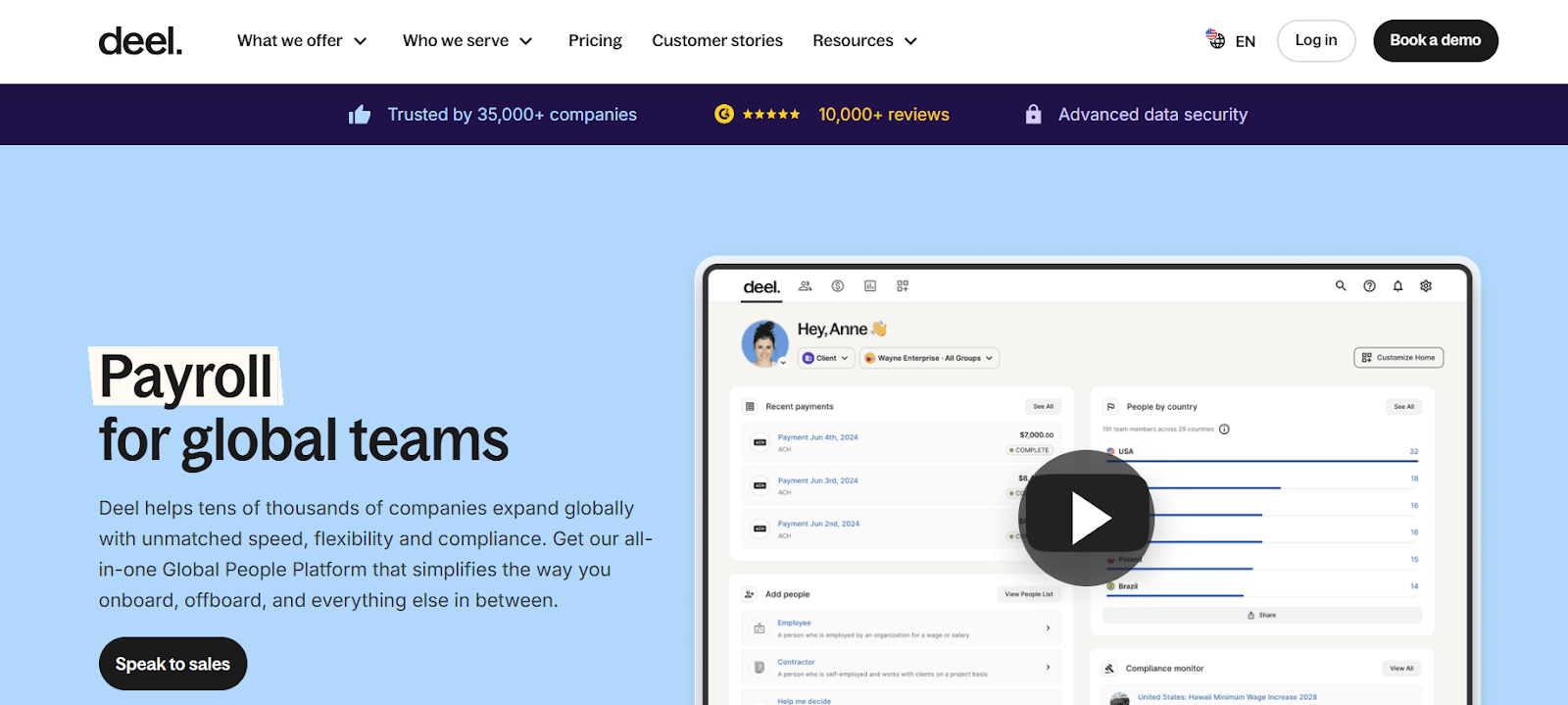
Deel is a global HR platform combining EOR services, contractor payments, and HRIS in one interface, built for companies prioritizing self-service automation over managed service handholding. The platform handles hiring, onboarding, payroll, and compliance across 150+ countries, with a focus on speed and user experience.
At $599 per employee per month for EOR services, Deel sits at the premium end of the pricing spectrum. Deel's strength lies in its modern interface and integrated workflows that reduce the number of tools HR teams need to manage distributed teams.
Key Features
- Fastest onboarding in the category: Employees can be hired and activated in under 24 hours in most markets, with automated contract generation, background checks, and payroll setup that eliminate manual HR workflows.
- Integrated HRIS and EOR in one platform: Consolidates employee data, document management, time-off tracking, and payroll in a single system, reducing tool sprawl and improving data accuracy.
- Self-service compliance and contract amendments: HR teams can update employment terms, process promotions, or adjust compensation without submitting tickets or waiting for account manager reviews.
- Global benefits marketplace with employee choice: Provides localized benefits options that employees can select and manage directly, reducing HR administrative burden while improving satisfaction.
- API-first architecture for custom integrations: Connects to existing HR tech stacks including Workday, BambooHR, and Greenhouse, automating data sync and eliminating manual entry across systems.
Customer Review
"Deel got us into 15 countries in three months. The platform is intuitive, onboarding is fast, and our team didn't need training to use it. Support has been solid when we needed it." (VP of People, Series B SaaS Company)
Pros
- Onboarding speed is unmatched; companies can hire and activate employees in under 24 hours in most markets, critical for competitive talent acquisition in high-demand roles.
- Integrated HRIS eliminates the need for separate tools like BambooHR or Workday for smaller teams, consolidating employee data, payroll, and compliance tracking in one platform.
- Self-service workflows reduce dependency on account managers for routine tasks like contract amendments or compensation adjustments, keeping HR teams moving during rapid headcount growth.
Cons
- Pricing at $599 per employee per month positions Deel at the premium end, making it cost-prohibitive for bootstrapped startups or companies hiring high volumes in lower-cost markets.
- Compliance depth may not match specialized providers in complex jurisdictions; companies facing misclassification disputes or statutory audits may find legal advisory insufficient.
- Platform complexity can overwhelm smaller HR teams; the breadth of features and settings requires onboarding time, and lean operations may underutilize capabilities.
Why Choose Deel Over New Horizons Global Partners?
- 24-hour onboarding: Deel completes onboarding in 24 hours for most markets, while New Horizons typically requires three to five business days for contract generation and payroll activation.
- HRIS consolidation: Integrated employee management and payroll in one platform, while New Horizons requires separate tools for document storage, time-off tracking, and performance management.
Pricing
Deel charges $599 per employee per month for EOR services. Contractor management starts at $49 per contractor per month. HRIS-only plans are available for $29 per employee per month.
5. Remote
Remote is a global employment platform focused on compliance infrastructure and transparent pricing, built for fast-growing startups expanding into Europe and APAC. The platform handles EOR services, contractor payments, and global payroll across 80+ countries with direct entity ownership.
Remote's positioning centers on trust and simplicity: upfront pricing, clear legal accountability, and compliance depth that reduces risk for HR leaders navigating unfamiliar labor laws. HR teams choose Remote when they need confidence that contracts, benefits, and payroll align with local regulations in markets like Germany, the UK, or Singapore, where missteps carry steep penalties.
Key Features
- Direct entity ownership in 80+ countries: Remote owns its legal entities rather than subcontracting to third-party EORs, providing clear liability lines and direct accountability during employment disputes.
- Transparent pricing with no hidden fees: Published pricing tiers eliminate surprises, and Remote discloses FX rates, benefit costs, and administrative fees upfront for accurate budget forecasts.
- Localized benefits administration with employee choice: Employees select from region-appropriate health insurance, retirement plans, and statutory leave options, with Remote handling enrollment and carrier relationships.
- Compliance-first contract generation: Contracts are drafted by in-house legal teams for each jurisdiction, ensuring alignment with local labor codes and statutory notice periods.
Customer Review
"Remote gave us confidence expanding into Germany and France. Contracts were airtight, payroll was accurate from day one, and support actually knew local labor law." (Head of Global Operations, EdTech Company)
Pros
- Direct entity ownership eliminates third-party subcontracting risk, providing clearer legal accountability during employment disputes in complex jurisdictions like France or Brazil.
- Transparent pricing removes budget uncertainty; HR and finance teams can forecast costs accurately without hidden FX markups or surprise fees.
- Compliance depth matches specialized legal providers; contracts and policies are reviewed by in-house counsel familiar with local labor codes.
Cons
- Country coverage at 80+ markets trails competitors like New Horizons (180+) or Multiplier (150+), limiting options for companies entering frontier markets.
- Pricing sits above budget alternatives like Remofirst; companies prioritizing cost optimization may find Remote's premiums difficult to justify for straightforward hiring.
- Platform features focus on core EOR functions; teams expecting integrated HRIS or recruiting tools may need additional vendors to fill gaps.
Why Choose Remote Over New Horizons Global Partners?
- Pricing transparency: Remote eliminates hidden fees and provides upfront cost visibility, while New Horizons requires custom quotes that obscure the total cost of ownership.
- Entity ownership clarity: Direct ownership in key markets provides clearer legal accountability, while New Horizons relies on third-party partnerships in some jurisdictions.
Pricing
Remote charges $599 per employee per month for EOR services in most markets. Contractor management starts at $29 per contractor per month.
6. Globalization Partners
Globalization Partners operates as an enterprise-grade EOR with a focus on complex multi-region expansion, built for mid-market and large organizations that need deep legal support and dedicated account management. The platform covers 187 countries with direct entity ownership in key markets.
It's designed for companies entering high-risk jurisdictions, managing large distributed teams, or navigating complex employment scenarios like executive hires, equity compensation, or workforce reductions across multiple countries simultaneously. HR leaders choose Globalization Partners when compliance stakes are high, legal advisory is non-negotiable, and they need a partner that can handle edge cases without escalating every issue to their internal legal team.
Key Features
- Dedicated account management with legal advisory: Each client receives a named account manager and access to in-house legal counsel who provide jurisdiction-specific guidance on misclassification, terminations, and contract disputes.
- Direct entity ownership in 187 countries: Provides clearer liability lines and direct employer accountability during statutory audits or employment litigation.
- Executive-level hire support: Platform handles complex compensation structures, including equity grants, retention bonuses, and multi-country tax implications.
- Multi-country workforce reduction management: Coordinates redundancy processes, severance calculations, and notice periods across multiple jurisdictions simultaneously during organizational restructuring.
Customer Review
"Globalization Partners managed a 30-person reduction across eight countries with zero legal issues. Our account manager coordinated everything, and we didn't have to become experts in redundancy law." (Chief People Officer, Enterprise SaaS Company)
Pros
- Enterprise support includes dedicated account managers and in-house legal counsel who provide proactive guidance on complex scenarios, reducing internal legal spend.
- Direct entity ownership in 187 countries provides the broadest coverage in the category, enabling expansion into frontier markets without third-party partnerships.
- Complex hire capabilities support executive compensation, equity grants, and specialized roles that entry-level EORs cannot handle.
Cons
- Pricing targets enterprise budgets; smaller companies or startups may find Globalization Partners cost-prohibitive compared to self-service platforms.
- Platform usability lags modern competitors; the interface prioritizes function over design, and HR teams may find workflows less intuitive.
- Onboarding timelines are longer due to manual compliance reviews and account manager coordination, making it slower for companies needing to activate hires in days.
Why Choose Globalization Partners Over New Horizons Global Partners?
- Legal advisory access: Dedicated account management and in-house legal counsel provide proactive guidance, while New Horizons routes inquiries through generalist support.
- Entity ownership breadth: Direct ownership in 187 countries eliminates third-party subcontracting in frontier markets compared to New Horizons' partnership model.
Pricing
Globalization Partners operates on custom pricing based on employee count, countries of operation, and service level requirements. Enterprise agreements typically include dedicated account management and legal advisory as standard.
7. Oyster
Oyster is a global employment platform focused on employee experience and distributed team culture, built for companies that view EOR as more than payroll infrastructure. The platform handles hiring, onboarding, and compliance across 180+ countries while emphasizing benefits, flexibility and localized perks.
Oyster appeals to remote-first companies and startups building global teams where employee satisfaction and retention directly impact business outcomes. HR leaders choose Oyster when they need an EOR that supports their employer brand and helps create consistent employee experiences across markets with different statutory baselines.
Key Features
- Employee-centric benefits marketplace: Workers select from localized health insurance, retirement plans, and supplemental perks tailored to their country, with Oyster managing carrier relationships and enrollment.
- Distributed team culture tools: Platform includes onboarding playbooks, equity education resources, and remote work policies designed to create cohesive team experiences across time zones.
- Transparent compensation benchmarking: Provides salary data and cost-of-living adjustments by role and location, helping HR teams make competitive offers while maintaining internal equity.
- Equity management for global teams: Handles option grants, vesting schedules, and tax implications for employees in countries with complex equity regulations.
Customer Review
"Oyster made our team feel like one company, not contractors scattered across countries. Benefits were great, onboarding was smooth, and people actually wanted to join." (Head of People, Remote-First Startup)
Pros
- Employee experience design differentiates Oyster from compliance-first providers; benefits flexibility, onboarding tools, and culture resources improve satisfaction and reduce turnover.
- Compensation benchmarking helps HR teams make data-driven offers that balance competitiveness with budget constraints in unfamiliar markets.
- Equity management capabilities handle complex option grants and tax implications that most EORs treat as separate services.
Cons
- Pricing sits at the premium end; companies prioritizing cost optimization may find Oyster's employee experience features difficult to justify.
- Country coverage at 180+ markets is broad but entity ownership transparency varies; Oyster may subcontract to third-party EORs in certain jurisdictions.
- Platform complexity can overwhelm smaller HR teams; the breadth of culture tools and employee-facing features requires onboarding time.
Why Choose Oyster Over New Horizons Global Partners?
- Employee experience focus: Benefits marketplace and culture tools improve satisfaction and retention, while New Horizons provides statutory minimums without customization flexibility.
- Integrated compensation tools: Benchmarking and equity management are built into Oyster's platform, while New Horizons treats these as separate services requiring additional vendors.
Pricing
Oyster operates on custom pricing based on employee count and countries of operation. Typical EOR costs range from $500 to $650 per employee per month, depending on service level and benefits selections.
8. Papaya Global
Papaya Global is a payroll and workforce management platform with EOR capabilities, built for finance-first organizations that prioritize audit-ready reporting and multi-entity consolidation. The platform handles global payroll, contractor payments, and EOR services across 160+ countries.
It's designed for CFOs and finance leaders who need granular visibility into payroll costs, statutory deductions, and cross-border payments with the ability to map everything into their ERP or accounting system without manual reconciliation. Companies choose Papaya when payroll analytics, compliance reporting, and financial transparency matter as much as operational speed.
Key Features
- Granular payroll analytics with GL mapping: Finance teams receive line-item breakdowns of gross pay, statutory deductions, employer contributions, and FX costs that map directly into NetSuite, SAP, or Oracle.
- Multi-entity consolidation for global operations: Companies running both owned entities and EOR arrangements can consolidate payroll across all structures in one platform.
- Automated statutory filings and compliance reporting: Papaya handles tax submissions, social security filings, and labor authority reporting in each jurisdiction, generating audit-ready documentation.
- Transparent FX handling with rate disclosures: Exchange rates are displayed upfront for every payroll run, with historical tracking and variance analysis for budget forecasting.
Customer Review
"Papaya gave our finance team visibility we never had with New Horizons. We can see exactly what we're paying per country, per employee, and reconcile everything in minutes, not days." (CFO, FinTech Scale-Up)
Pros
- Financial transparency exceeds most competitors; line-item invoicing, GL mapping, and audit-ready exports reduce month-end close time.
- Multi-entity consolidation supports companies running hybrid structures with both owned entities and EOR arrangements.
- Statutory compliance reporting generates documentation required for audits, tax submissions, and labor authority reviews.
Cons
- Platform complexity requires finance team onboarding; the depth of reporting and configuration options can overwhelm smaller operations.
- HR usability trails employee-centric platforms; Papaya prioritizes finance workflows over HR experience.
- Pricing targets mid-market and enterprise budgets; startups may find Papaya's costs difficult to justify when simpler EORs meet their operational needs.
Why Choose Papaya Global Over New Horizons Global Partners?
- Financial reporting depth: Granular reporting and GL mapping eliminate manual reconciliation work, while New Horizons provides summary invoicing requiring data transformation.
- Multi-entity support: Consolidation handles hybrid structures, while New Horizons treats owned entities and EOR arrangements as separate systems.
Pricing
Papaya Global operates on custom pricing based on employee count, countries of operation, and platform features. Enterprise agreements typically include multi-entity consolidation and dedicated implementation support.
9. Velocity Global

Velocity Global operates as a global EOR specializing in high-risk and emerging markets, built for companies entering jurisdictions where compliance complexity, political instability, or legal ambiguity create operational challenges. The platform covers 185+ countries with direct entity ownership in difficult markets.
It's designed for organizations that can't afford employment missteps in countries with aggressive labor authorities, high misclassification penalties, or limited legal recourse during disputes. Companies choose Velocity when they're expanding into Africa, Latin America, Eastern Europe, or Southeast Asia and need an EOR partner with on-the-ground legal expertise and entity infrastructure in jurisdictions that carry meaningful risk.
Key Features
- Direct entity ownership in high-risk jurisdictions: Velocity owns legal entities in markets where compliance errors carry steep penalties, eliminating third-party subcontracting risk.
- In-country legal advisors for complex markets: Local counsel provides jurisdiction-specific guidance on misclassification, terminations, and labor authority interactions.
- Employment litigation support: Platform includes legal representation during disputes, arbitration, or labor court proceedings.
- Rapid entity activation in emerging markets: Velocity can establish legal employer presence in high-risk countries faster than owned entity formation.
Customer Review
"Velocity managed our Nigeria expansion when two other EORs said they couldn't support us. Their local team knew the system, and we avoided issues that would have shut us down." (VP of International Operations, Supply Chain Platform)
Pros
- High-risk market expertise differentiates Velocity from generalist EORs; direct entity ownership and local legal counsel reduce risk in jurisdictions where compliance errors carry significant penalties.
- Employment litigation support provides legal representation during disputes, reducing internal legal spend in markets where labor authorities favor employees.
- Rapid activation in emerging markets enables expansion timelines that owned entity formation cannot match.
Cons
- Pricing reflects the specialized nature of service; companies hiring in low-risk markets may find Velocity's costs difficult to justify.
- Country coverage prioritizes difficult markets; teams needing broad global footprint may still require secondary vendors for straightforward jurisdictions.
- Platform features focus on compliance over employee experience; HR teams expecting modern UX may find Velocity's interface functional but less intuitive.
Why Choose Velocity Global Over New Horizons Global Partners?
- High-risk market depth: Direct entity ownership and in-country legal advisors provide deeper compliance expertise, while New Horizons may subcontract to third parties.
- Litigation support included: Legal representation during disputes is provided, while New Horizons leaves litigation management to the client's internal legal team.
Pricing
Velocity Global operates on custom pricing based on employee count, countries of operation, and risk profile of target markets. High-risk jurisdictions typically carry premium rates reflecting entity ownership and legal advisory costs.
10. Atlas HXM
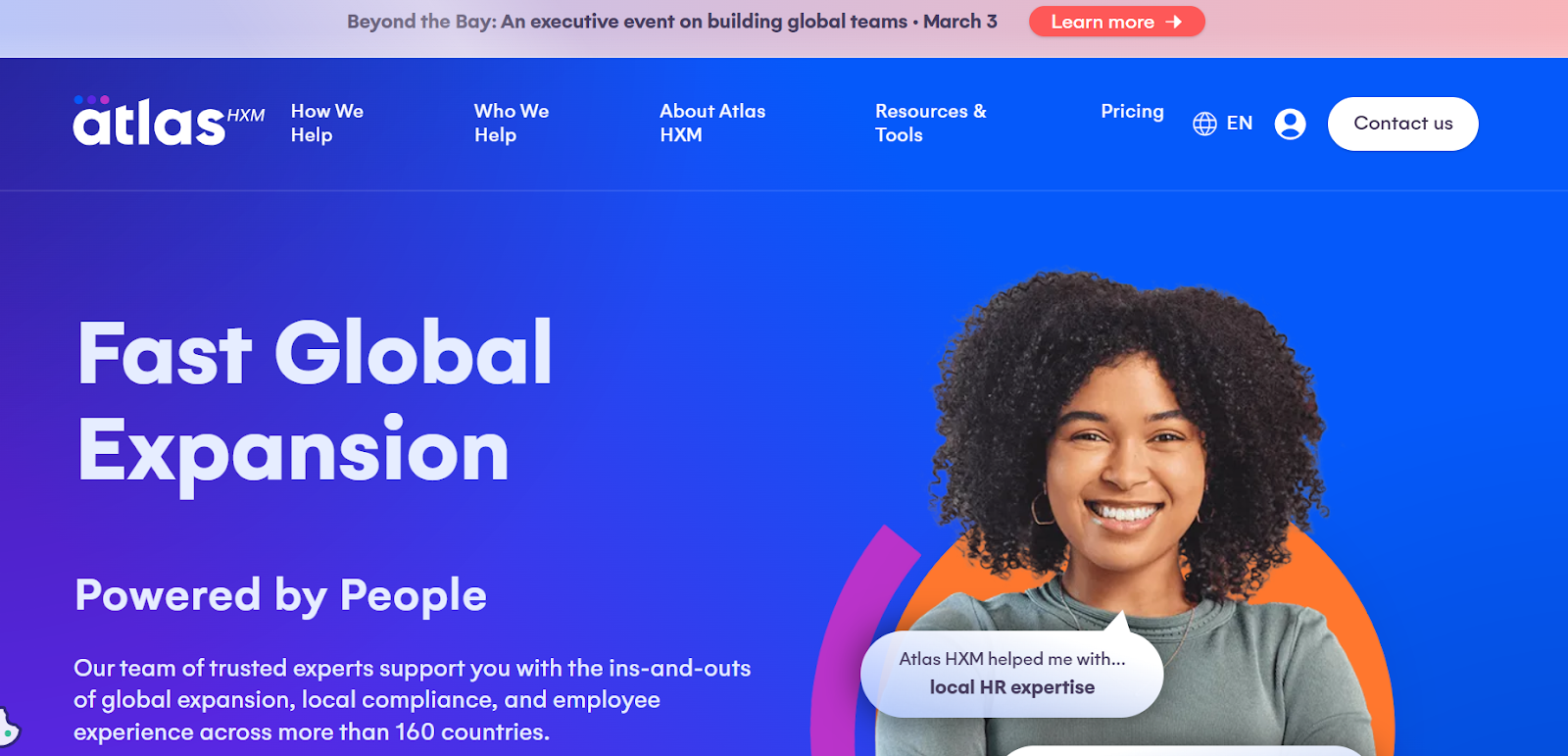
Atlas HXM is a unified platform combining HRIS, global payroll, and EOR services, built for mid-market companies that want to consolidate HR technology into one system. The platform handles employee management, benefits administration, and compliance across 160+ countries.
It's designed for HR leaders tired of juggling separate tools for applicant tracking, onboarding, payroll, performance management, and benefits enrollment. Companies choose Atlas when they're ready to replace fragmented HR tech stacks and want one vendor accountable for employee data, payroll accuracy, and compliance across their entire organization, domestic and international.
Key Features
- Unified HRIS and EOR in one platform: Consolidates employee records, document storage, time-off tracking, performance reviews, and global payroll in a single system.
- Integrated benefits administration: HR teams manage health insurance, retirement plans, and supplemental benefits for both domestic and international employees from one interface.
- Applicant tracking and onboarding workflows: Platform includes recruiting tools, offer letter generation, and new hire onboarding sequences that connect directly to payroll activation.
- Performance management and review cycles: Managers conduct evaluations, set goals, and track development plans within the same system that houses compensation data.
Customer Review
"Atlas replaced four HR tools and gave us one source of truth. Our team doesn't need to check multiple systems anymore, and payroll errors dropped to zero." (Director of HR Operations, Professional Services Firm)
Pros
- Platform consolidation eliminates HR tech sprawl; teams managing 200+ employees across multiple countries can replace separate tools with one integrated system.
- Unified employee data improves accuracy and reduces compliance risk; information flows automatically between hiring, payroll, and benefits without manual updates.
- Domestic and international payroll consolidation simplifies finance workflows; companies with both owned entities and EOR arrangements can process all payroll through Atlas.
Cons
- Platform complexity requires significant implementation time; companies must migrate employee data, configure workflows, and train teams across multiple HR functions.
- Feature depth in individual modules may trail specialized tools; teams expecting best-in-class ATS or performance management may find Atlas less sophisticated.
- Pricing reflects the breadth of features; startups or smaller companies needing only EOR services may find Atlas cost-prohibitive.
Why Choose Atlas HXM Over New Horizons Global Partners?
- HRIS consolidation: Atlas combines employee management, payroll, and EOR in one platform, while New Horizons provides only EOR services and requires separate tools.
- Recruiting integration: Applicant tracking and onboarding connect directly to payroll activation, while New Horizons treats recruiting as separate workflows requiring manual handoffs.
Pricing
Atlas HXM operates on custom pricing based on employee count, countries of operation, and platform modules required. HRIS-only plans start around $8 to $12 per employee per month, with EOR services priced separately based on jurisdiction.
How Do You Evaluate New Horizons Global Partners Alternatives?
1. Does the Provider Own Entities or Subcontract?
Direct entity ownership determines who's legally accountable when employment disputes arise. Some key questions to ask:
- Do you own the legal entity in my target country, or do you partner with a local EOR?
- Who is the legal employer of record on the employment contract?
- What happens if there's a misclassification dispute or labor authority audit?
Providers that subcontract to third parties in certain markets create liability ambiguity. This matters most in high-risk jurisdictions where compliance errors carry steep penalties or where labor authorities favor employees in disputes.
2. What's Included in the Per-Employee Price?
Some EORs advertise low rates but charge separately for:
- Benefits enrollment and administration
- Offboarding and termination support
- Mid-cycle payroll corrections or adjustments
- Contract amendments for promotions or compensation changes
- Compliance updates when regulations change
Request a detailed cost breakdown that includes all recurring and one-time fees. Understanding total cost of ownership beyond the headline rate prevents budget surprises six months into the relationship.
3. How Long Does It Take to Activate a Hire?
Onboarding timelines vary from 24 hours to two weeks, depending on the provider and country. Key factors that impact speed:
- Contract generation and legal review processes
- Background check requirements and turnaround times
- Payroll system integration and benefits enrollment
- Account manager approval workflows vs. self-service automation
If you're competing for talent in fast-moving markets, delays cost you candidates. Confirm expected timelines for your priority countries and ask about expedited options for critical hires.
4. What Happens If You Need to Switch Providers?
Offboarding employees from one EOR and re-onboarding to another creates operational challenges:
- Payroll gaps between the final payment with the old provider and the first payment with the new provider
- Benefits of disruption during the transition period
- Potential employment contract issues depending on the jurisdiction
- Employee communication and change management burden
Understand termination notice periods (often 30 to 90 days), data portability, and employee communication protocols before committing to a multi-year contract. Some providers make switching intentionally difficult to increase retention.
5. Who Responds When Payroll Issues Arise Mid-Cycle?
Support models range from ticketing systems to dedicated CSMs with SLA-backed response times. Critical questions to clarify:
- Do I get a dedicated account manager or share support queues with other clients?
- What are your SLA guarantees for payroll issue resolution?
- Who handles urgent escalations outside business hours?
- Can I reach someone by phone during critical payroll windows?
If an employee in Brazil reports a missing tax deduction two days before payday, you need clarity on who fixes it and how fast. Generic support emails don't cut it when payroll accuracy impacts employee trust.
Why Gloroots Is a Strong Alternative to New Horizons Global Partners
Gloroots is built for companies scaling into India or managing distributed teams across 100+ countries, where compliance depth and hands-on support matter more than coverage lists.
The platform combines entity ownership transparency with India specialization that generic EORs cannot match. Companies setting up Global Capability Centers (GCCs) or scaling engineering teams in Bangalore, Hyderabad, or Pune get:
- PF/ESIC/gratuity handling and statutory compliance expertise
- Recruiting advisory with real-time compensation benchmarking
- Interim EOR support during entity formation timelines
- Dedicated CSMs who provide proactive compliance monitoring
Gloroots vs New Horizons Global Partners: Feature Comparison
What Makes Gloroots Different?
1. Local compliance experts, not generic templates
Gloroots has specialists in India who understand the nuances: PF calculation differences across states, ESIC exemption rules, and gratuity payment timing. New Horizons uses automated templates that miss these details and create audit risks.
2. Invoices your finance team can actually use
You get itemized breakdowns showing costs per employee, per country, per service, with GL mapping built in. No more spending hours decoding bundled invoices during quarter-close.
3. Real support when payroll goes wrong
If India payroll breaks at midnight before a deadline, you call your dedicated CSM, who knows your account. With New Horizons, you open a ticket and wait for a response from someone reading scripts.
4. GCC setup support included
Building a Global Capability Center in India means entity formation, banking setup, talent sourcing, and compliance infrastructure. Gloroots handles all of it. New Horizons gives you generic EOR coverage and leaves you coordinating multiple vendors.
5. Transparent pricing from day one
Gloroots shows you exactly what you'll pay upfront. New Horizons requires custom quotes that often include hidden fees for benefits, tax filing, implementation, and premium support.
6. Guided contractor conversions
Converting contractors to employees in India requires navigating misclassification laws and tax compliance. Gloroots provides legal support and guided workflows. New Horizons gives you templates and makes you responsible for any mistakes.
When Gloroots Makes More Sense Than New Horizons Global Partners
Gloroots works best for mid-market and enterprise companies hiring 20 to 250 employees internationally, especially if you're:
- Expanding in India: You need GCC setup support, deep local compliance knowledge, and talent advisory, not just basic EOR coverage.
- Answering to a demanding CFO: Your finance team requires audit-ready reports, GL-mapped invoices, and cost transparency that bundled billing doesn't deliver.
- Operating in high-compliance markets: Asia, the Middle East, and Latin America have complex labor laws where automated templates create legal exposure.
- Needing hands-on support: You want self-service speed for routine tasks but expert guidance when compliance gets complicated, which automation can't provide.
Ready to explore how Gloroots can support your global expansion? Schedule a demo to discuss your international hiring needs with our team.
Frequently Asked Questions About New Horizons Global Partners Alternatives
1. What are the top New Horizons Global Partners alternatives?
Top options include Gloroots for India hiring, Remofirst for budget teams at $199/employee/month, Multiplier for hybrid workforce management, and Deel for 24-hour onboarding. Remote provides transparent pricing for Europe and APAC expansion.
2. Is New Horizons Global Partners suitable for large-scale use?
New Horizons handles large distributed teams across 180+ countries, but scalability concerns surface around pricing predictability and service personalization as headcount grows. Enterprise teams may find dedicated account management insufficient compared to specialized providers.
3. How does Gloroots compare to New Horizons Global Partners?
Gloroots differentiates through India specialization, direct entity ownership, and hybrid platform plus managed service delivery. Companies get recruiting advisory, compensation benchmarking, and GCC setup expertise that New Horizons treats as separate services, plus dedicated CSMs vs. generalist support queues.
4. What is the best free alternative to New Horizons Global Partners?
No enterprise-grade EOR offers truly free services due to legal liability and entity ownership costs. Remofirst provides the lowest entry point at $199/employee/month for EOR coverage across 150+ countries.

Ready to take the first step?
Request a demo now and learn how you can focus on building, without worrying for compliance, ever!