



- Align global workforce management with business goals for efficiency, compliance, and scale.
- Use automation and integrated platforms to unify payroll, HR, and compliance processes.
- Balance global consistency with local labor laws and cultural nuances for smoother operations.
- Continuously monitor, optimize, and adapt GWM systems for long-term productivity and cost control.
Quick Summary
- What it is: Global workforce management (GWM) is the structured way to hire, pay, and manage employees across multiple countries while staying compliant.
- Why it matters: It reduces compliance risk, controls payroll costs, and supports retention across markets.
- How to run it: Align stakeholders, centralize payroll and compliance, and use automation with country-specific oversight.
Global workforce management becomes essential as soon as a company expands beyond one country. Without structure, hiring abroad often leads to scattered systems, repeated payroll work, and compliance confusion.
The global workforce management market is projected to grow steadily through 2030, with Grand View Research estimating it will exceed USD 17 billion by the end of the decade. Companies have accepted that manual processes cannot scale, and local partners don't take responsibility for the compliance risks they create.
Managing a global workforce is about building a system that keeps operations compliant, transparent, and scalable without breaking under complexity.
This guide breaks down what global workforce management involves, how to implement it effectively, and the approaches that keep international operations running smoothly.
Run global employment with control. Book a demo with Gloroots to see how to employ, pay, and manage international teams from one platform.
What is Global Workforce Management?
Global workforce management is the structured approach to hiring, paying, managing, and retaining employees across multiple countries while staying compliant and consistent.
It gives companies the control and visibility needed to scale without confusion about who works where, how they are paid, or whether operations meet local laws.
Traditional workforce management works under one set of labor rules and tax systems. Global workforce management adjusts to real-world differences: France requires works councils, Brazil mandates a 13th-month salary, and India enforces layered contributions under PF, ESIC, and gratuity.
In 2026, companies can no longer treat global workforce management as just another HR task. It connects HR, finance, and compliance into one system.
When done poorly, it creates audits, back-pay claims, and reputational damage. Done well, it opens new talent pools, reduces costs, and allows growth without friction.
What are the Core Components of Global Workforce Management?
Global workforce management combines multiple systems and processes to keep hiring, payroll, and compliance aligned across countries.
Each component supports consistency, visibility, and employee experience at scale.
1. Workforce Planning and Forecasting
Workforce planning means knowing where you will hire next, what roles you need, and how local talent supply affects timelines.
It involves predicting headcount needs months in advance, so you are not rushing to onboard someone in Germany while still sorting out their benefits.
2. Global Payroll and Compensation
This covers salary processing, currency conversions, tax deductions, and statutory contributions across markets.
Managing payroll globally is not about using one system with regional settings. It means coordinating multiple pay cycles, banking systems, and reporting requirements in each country.
3. Compliance and Labor Law Management
Compliance includes employment contracts, notice periods, benefits, and worker classification.
Each country defines “employee” differently and enforces unique rules. Staying compliant requires constant monitoring and local expertise, not one-time checklists.
4. Employee Engagement and Retention
Keeping employees engaged across different cultures and languages takes planning.
What motivates a developer in Poland may not work for a designer in Brazil. Strong global workforce management builds engagement strategies that adapt to local needs while preserving company culture.
5. Performance Management
Performance management focuses on outcomes, not presence.
Teams are measured by deliverables, KPIs, and results instead of hours worked. The challenge is to standardize performance criteria while allowing room for regional work styles.
6. Learning and Development
Learning programs must work across time zones and cultures.
Training content should translate both linguistically and contextually. It should also reflect how people in different regions prefer to learn and grow within their roles.
Why Global Workforce Management Is Important for International Businesses?
Global workforce management is more than a compliance tool. It keeps operations smooth, costs controlled, and employees aligned across markets. The right system supports both stability and growth.
1. Compliance and Risk Mitigation
Compliance is the foundation.
Countries enforce labor laws strictly, and penalties for misclassification, payroll errors, or contract violations can stop operations entirely.
A solid workforce management system prevents these issues before they occur by standardizing contracts, benefits, and payments across all locations.
2. Productivity and Cost Optimization
When HR teams no longer reconcile payroll manually across multiple tools or chase local vendors for filings, they gain time for strategic work.
Centralized management also makes costs transparent; you can see where pay structures overlap, where contracts need review, and where vendor fees add up unnecessarily.
3. Talent Retention
Employees stay longer when onboarding, payroll, and career growth are consistent everywhere.
High turnover hurts more globally because hiring, compliance setup, and training all multiply across countries.
Global workforce management reduces churn by giving employees a reliable, well-structured experience from day one.
4. Scalability Across Regions
Growth should not break your systems.
If your current setup struggles with three countries, it will not survive four.
A scalable workforce management framework ensures that hiring the tenth employee in a new market takes the same effort as the first.
5. Cultural Alignment
Strong global teams share common values and communication practices.
Cultural alignment is not about enforcing one culture everywhere, but creating enough consistency for smooth collaboration.
A team in Singapore should easily work with colleagues in Brazil without miscommunication or friction.
Global Workforce Management Rollout Checklist
A successful rollout starts with clear alignment, detailed preparation, and realistic expectations.
The following checklist helps you plan and execute your global workforce management rollout without wasting time or budget.
Get the Global Workforce Management Rollout Checklist. Download the free guide to plan your rollout step by step, from stakeholder alignment to post-implementation scaling.
1. Internal Alignment and Vision
a.Define the goal.
Identify what drives the rollout:
- Compliance exposure
- Operational inefficiency
- Growth and scaling needs
Each driver changes your priorities. If compliance is the issue, focus on legal coverage and risk control. If it’s efficient, prioritize automation and integration.
b.Align key stakeholders.
Finance seeks standardization, HR values cultural flexibility, and Legal focuses on compliance assurance. Define where global policies apply and where local adjustments are allowed.
c.Set clear success metrics.
Agree on measurable outcomes before starting:
- Fewer misclassification incidents
- Payroll processing time cut by 60%
- Time-to-hire reduced by 40%
These benchmarks guide decisions when evaluating vendors or implementation timelines.
2. Requirements Gathering
a.Map workforce types.
List all worker categories:
- Full-time employees
- Contractors
- Employer of Record (EOR) hires
- Temporary staff
Each type carries different compliance, payment, and management needs.
b.Plan for future coverage
Include expansion markets for the next 18–24 months, not just current operations. Choosing a system that fits your current five countries but not your next three creates short-term fixes instead of long-term solutions.
c.Define stakeholder requirements.
Different departments need different functions:
Build your requirements based on real use cases, not vendor feature lists.
3. Vendor Evaluation
a.Clarify compliance responsibility.
Some platforms provide tools but leave legal risk to you. Others act as the official employer and assume liability. Know who is accountable if an audit occurs.
b.Assess local expertise.
Ask how vendors manage country coverage:
- Do they have direct in-country teams or third-party partners?
- How fast do they update for regulatory changes?
- What happens when local labor laws conflict with company policies?
c.Test scalability.
Ensure the platform grows with you.
Example: If you have 50 employees in 5 countries today and expect 200 across 15 countries soon, check if pricing and performance scale smoothly.
d.Check integrations.
Your workforce management platform should connect with HRIS, accounting, and analytics tools. Reliable APIs matter more than long feature lists.
4. Rollout and Implementation Strategy
a.Choose your rollout method.
- Phased rollout: Test in one region, learn, then expand.
- Full rollout: One clean transition date with no parallel systems.
Select based on system complexity and how much organizational change your team can handle.
b.Plan for change management
Employees resist new systems when they don’t understand their value. Communicate benefits clearly faster onboarding, reliable payroll, and accessible benefits information.
c.Develop targeted training
Different groups need different support:
- HR admins: system training
- Managers: performance management tools
- Employees: self-service and portal navigation
5. Post-Implementation and Scaling
- Stay current with compliance updates.
Labor laws frequently change new benefits, wage adjustments, and termination rules. Your system should monitor and flag updates automatically. - Support new market entry.
When hiring in a new country, aim to activate coverage in days, not months. Scalable infrastructure should handle new regions without new setups. - Measure against your metrics.
If payroll processing time was meant to drop by 60%, review monthly results. If targets aren’t met, find the cause early and adjust the process or platform.
How to Manage a Global Workforce Effectively?
Managing a global workforce requires planning, compliance discipline, and technology that keeps operations aligned across countries. Below are the key areas that help global teams perform efficiently and stay compliant.
1. Workforce Planning and Talent Forecasting
a.Plan hiring based on market data.
Before opening a role, research local salary levels, talent availability, and competition.
Example: If you need senior engineers in Brazil, study local pay ranges and hiring trends. This prevents delays or unfillable roles due to budget gaps.
b.Run workforce scenarios.
Test how your systems perform under change.
- What happens if headcount doubles in APAC?
- What if you convert a large number of contractors to full-time employees?
Scenario planning exposes system limits before they become real bottlenecks.
2. Ensuring Compliance Across Countries
- Create country-specific playbooks.
Document employment laws, tax rules, and benefits requirements for every market. Keep these updated as regulations change, not static PDFs that no one revisits. - Assign clear compliance ownership.
Someone must monitor new laws, assess their impact, and update processes. This requires dedicated attention or external expertise from an Employer of Record (EOR). - Audit classifications regularly.
Contractors may drift into employee relationships as oversight grows. Quarterly reviews catch these issues before they attract legal attention.
3. Standardizing Core HR and Payroll Policies
- Set global vs. local boundaries.
Some policies should stay consistent worldwide values, non-discrimination, and data privacy.
Others, such as benefits, working hours, and leave, should adapt to local regulations. - Use policy templates.
Create master templates that automatically include each country’s statutory requirements.
For example, a global leave policy can define minimum standards while allowing local versions to add legal entitlements.
4. Leveraging Technology and Automation
- Centralize workforce data.
Store all employee information in a single system of record. When data lives in multiple tools, errors multiply, and reporting becomes manual work. - Automate repetitive tasks.
Use automation for payroll filings, statutory reports, and benefits enrollment. These processes rely on accuracy, not human judgment, and automation minimizes mistakes. - Integrate core systems.
Ensure data flows between your workforce management platform, accounting, and analytics tools. Avoid double entry; it causes lags, version errors, and compliance risks.
5. Employee Engagement and Support
- Offer local-language support.
Employees should be able to access help in their native language. English-only systems create communication gaps in non-English markets. - Design communication rhythms across time zones.
All-hands meetings set for one region exclude others. Rotate schedules or use asynchronous updates so every team stays informed. - Make career growth visible.
Distributed employees often feel disconnected from progression opportunities. Create transparent development frameworks so every employee sees how to advance, no matter where they work.
What are the Key Metrics Used in Global Workforce Management?
What are the Common Challenges in Global Workforce Management?

- Compliance complexity
Each new country adds unique labor laws, taxes, and reporting rules. Staying compliant is a continuous process, not a one-time task. - Time zone coordination
Global teams often struggle to find overlapping hours for meetings or decisions. Without async workflows, progress slows and communication suffers. - Cultural differences
Work styles and feedback norms vary by region. What feels normal in one country may seem harsh or unclear in another. - Data security and privacy
Different countries have different data protection laws. GDPR compliance doesn’t guarantee compliance in India, Brazil, or Singapore. - Talent availability
Specialized roles may be common in one region but scarce in another, increasing time-to-hire and cost.
Proven Strategies for Managing a Global Workforce
- Build diverse and inclusive teams: Different perspectives improve decision-making and market understanding
- Respect cultural differences: Adapt management styles to regional communication and work preferences
- Use global communication tools: Invest in platforms that support async collaboration and real-time coordination
- Implement flexible work policies: Allow time zone-appropriate work hours instead of forcing one standard
- Leverage time zone differences: Structure work so teams hand off projects across regions for continuous progress
- Set clear goals and expectations: Outcome-based management works better than activity monitoring remotely
- Invest in learning and development: Provide training that's accessible across locations and learning styles
- Promote work-life balance: Prevent burnout by respecting boundaries and local holiday schedules
- Understand global employment laws: Stay current on compliance requirements in every market you operate
- Support ESL/EAL employees: Provide language resources and normalize non-native English in communication
- Implement secure data practices: Enforce VPNs, two-factor authentication, and role-based access controls
- Train managers for global teams: Managing distributed teams requires different skills than in-office management
Global Workforce Management Tools & Technology
The right technology stack reduces manual work, minimizes compliance risk, and gives better visibility across countries.
Core capabilities to look for:
- Global payroll and multi-currency processing
- Automated tax filing and statutory compliance tracking
- Employee onboarding and offboarding
- Time, attendance, and leave management
- Reporting and real-time workforce analytics
Modern workforce platforms now combine these features instead of relying on multiple disconnected tools. Choose solutions that integrate payroll, compliance, and analytics in one system for easier management.
For companies hiring across several countries without local entities, Employer of Record (EOR) platforms offer the legal structure to employ people compliantly while you maintain day-to-day control.
Learn more about choosing the right EOR software and understanding EOR costs.
What are the Common Mistakes to Avoid in Global Workforce Management?
1. Using the same approach everywhere
Each country has unique labor laws and employee expectations. What works in the US rarely applies directly in France, Brazil, or Singapore.
2. Delaying compliance ownership
Relying on contractors or local partners doesn’t remove your legal responsibility. Waiting until an audit to fix compliance gaps is costly.
3. Relying too much on manual processes
Spreadsheets and manual payroll tracking don’t scale. They slow teams down and increase the risk of costly errors.
4. Skipping change management
Even the best software fails without proper onboarding. Employees need to understand why the new system matters and how it helps them.
5. Ignoring scalability
Tools that only fit your current setup will limit future growth. Choose systems that can support more countries and larger teams without full reimplementation.
How Global Workforce Management Supports Business Growth
- Faster market expansion
With hiring systems and compliance structures already in place, companies can enter new markets in weeks instead of waiting months to set up entities. - Better cost control
Visibility into labor costs by market, role, and team helps leaders make smarter hiring and budgeting decisions. - Stronger employer brand
Consistent onboarding, payroll, and benefits create reliable employee experiences, turning staff into brand advocates. - Higher employee retention
Clear processes, accurate payroll, and responsive support build trust, reducing turnover and improving productivity.
How Gloroots Simplifies Global Workforce Management?
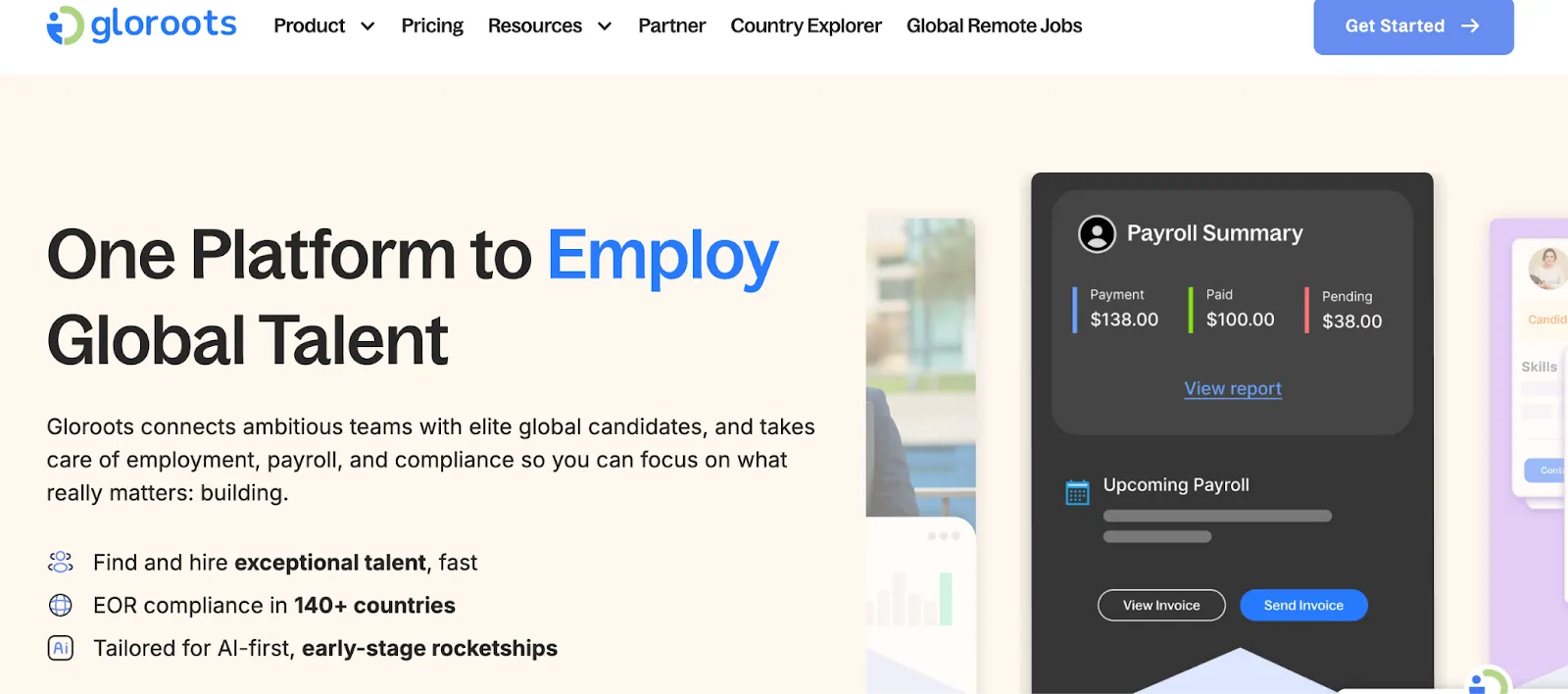
Gloroots streamlines the management of international teams by centralizing all workforce operations in a single platform.
Instead of coordinating multiple vendors, payroll systems, and compliance processes, everything from hiring and payroll to contracts and reporting is handled seamlessly in one place.
With Gloroots, companies can expand globally without delays from entity setup, reduce compliance risks, and minimize administrative overhead.
Here's how Gloroots helps:
- Hire globally without setting up entities
Employ people in 150+ countries using Gloroots’ local infrastructure. Skip the 6–12 month process of forming entities in each market. - Stay compliant automatically
Country-specific contracts, statutory benefits, and taxes are managed accurately from day one. Regulatory changes are tracked and updated for you. - Run accurate global payroll
Pay salaries, bonuses, and benefits in local currencies with automatic tax deductions and contributions. Payroll data integrates directly with your accounting systems. - Scale without extra admin work
Whether you’re hiring one person or fifty, the process stays simple and consistent. No new systems or additional overhead required. - Get full workforce visibility
View headcount, costs, and compliance status across all markets in one dashboard. Export reports for finance, audits, and strategic workforce planning.
Gloroots brings together structure, technology, and compliance so you can focus on growth instead of administration.
Book a demo with Gloroots to see how we help companies manage distributed teams across 100+ countries.
FAQ’s
1.What is global workforce management?
Global workforce management is the system for hiring, paying, and managing employees across multiple countries while maintaining compliance and operational control. It covers payroll, benefits, labor law adherence, and workforce planning.
2.What tools are needed for GWM?
Essential tools include global payroll software, compliance tracking systems, HRIS platforms, time tracking tools, and communication platforms. Many companies use EOR services to consolidate these functions.
3.How do companies stay compliant globally?
Companies stay compliant by using country-specific employment contracts, monitoring regulatory changes, classifying workers correctly, filing taxes accurately, and often partnering with EOR providers who assume legal employer responsibilities.
4.What is the best global workforce management solution?
The best solution depends on your hiring model, growth plans, and compliance capacity. Companies hiring international employees without local entities typically benefit most from EOR platforms that combine compliance, payroll, and workforce management.

Ready to take the first step?
Request a demo now and learn how you can focus on building, without worrying for compliance, ever!