











- Global mobility now blends remote work, short-term projects, and cross-border flexibility under one compliance-driven strategy.
- Leverage technology, automation, and EOR partnerships to simplify tax, immigration, and payroll management for mobile employees.
- Prioritize employee well-being with transparent communication, cultural support, and holistic relocation resources.
- Build agility through proactive compliance, data-driven visibility, and scalable mobility frameworks that align with business goals.
Remote work and distributed teams have changed how companies approach talent.
Employees don’t always need to relocate permanently, but they still move for projects, market launches, skill transfers, and leadership development.
This movement brings compliance and administrative challenges that often appear only when managing visas, payroll across multiple countries, or unexpected tax obligations. Most HR teams are unprepared for this complexity.
Only 23% of organizations handle global mobility strategically. The rest react to requests, treating it as administrative work rather than a growth enabler.
Platforms like Gloroots simplify international workforce management. From payroll and tax compliance to immigration support, it allows companies to move employees across borders efficiently while reducing risk and administrative burden.
What is Global Mobility?
Global mobility is the structured process of moving employees across international borders for work while managing immigration, tax, payroll, and compliance. It covers everything from short business trips to permanent relocations, ensuring employees can work legally without creating regulatory risk for the company.
The key difference between global and domestic mobility is jurisdiction. Domestic transfers involve one set of labor laws and tax rules, while global mobility introduces multiple legal systems, visa requirements, currency considerations, and potential permanent establishment exposure.
Modern global mobility also supports work-from-anywhere models. It provides frameworks for employees to contribute from different countries compliantly, enabling flexible work arrangements that align with business needs while maintaining legal and tax compliance.
Types of Global Mobility
Different mobility types have different requirements, costs, and compliance needs.
1.Business Travel
Short international trips for meetings, training, negotiations, or conferences. Business travel usually does not require work permits, but frequent or long trips can create tax implications that need careful tracking.
2.Workations and Digital Nomad Mobility
Employees working remotely from another country for personal or lifestyle reasons. Unlike company-assigned travel, workations depend on employee intent and duration. Clear policies on locations, maximum stay, and tax or immigration requirements are essential.
3.Short-Term Assignments
Assignments lasting three to twelve months for projects, skill transfers, or interim leadership roles. These usually require work permits, split payroll arrangements, and careful tax planning to avoid double taxation or permanent establishment exposure.
4.Long-Term and Permanent Assignments
Long-term assignments (one to three years) support market expansion, leadership development, or specialized projects. Permanent relocations involve local employment in the destination country and full repatriation planning. Both require comprehensive immigration, payroll, and compliance management.
Why Global Mobility Matters for Businesses?

Effective mobility supports growth, talent, and competitive advantage.
- Access to Global Talent
Companies can deploy expertise where it is needed most. Mobility enables critical projects in any market without permanent relocation costs.
- Talent Development and Retention
Employees value international opportunities as part of their career path. Companies with integrated global mobility strategies see up to 26% higher retention among international assignees compared to those treating mobility as transactional.
- Cultural Diversity and Innovation
Teams with cross-border experience bring fresh perspectives, challenge assumptions, and uncover new opportunities.
- Faster Market Entry
Deploying employees who understand your business accelerates expansion. Mobility allows testing new regions without immediate local hires or entity setup.
- Competitive Hiring Advantage
Top talent expects international growth opportunities. Offering mobility through tools like Gloroots demonstrates flexibility and global support.
What Is a Global Mobility Strategy?
A global mobility strategy is the comprehensive framework defining how your organization enables, manages, and governs employee movement across international borders to achieve business objectives.
It's not the same as a mobility program or policy; those are execution layers.
- Global Mobility Strategy
Sets the business case, defines eligible mobility types, identifies priority markets, and establishes governance for cross-border employee movement.
- Global Mobility Program
Implements the strategy through specific offerings like expatriate packages, short-term assignment terms, and workation policies.
- Global Mobility Policy
Documents the rules, eligibility criteria, approval processes, and employee responsibilities within each program.
- Strategic Alignment
The strategy aligns employee movement with business goals.
For example, if your strategy is entering APAC markets, your mobility programs should prioritize assignments to Singapore, India, and Australia with compensation and support packages that attract the right talent.
What are the Key Elements of a Global Mobility Strategy?
Understanding these elements ensures your international employee movement is compliant, cost-effective, and aligned with business goals.
1.Legal Structure and Permanent Establishment Risk
Understand your legal presence before moving employees.Sending someone to a country without an entity can trigger tax obligations and require entity setup.
Map where you have entities, where you use EOR services, and where mobility creates permanent establishment exposure.
2.Immigration and Work Authorization
Requirements vary widely by country.
Some markets grant work permits quickly, others take months and have restrictive quotas.
Your strategy needs clear visa pathways for each priority market to avoid non-compliant assignments.
3.Employment Law and Tax Compliance
Determines how employees are paid, benefits they receive, and who withholds taxes.
Countries define "employee" differently and enforce varied statutory benefits and termination protections.
Tax residence rules also vary some tax based on physical presence, others on contract location.
4.Global Payroll and Compensation Alignment
Addresses how employees are paid across borders.
Shadow payroll, split payroll, and home-country payroll all have tax implications.
Compensation must consider cost-of-living differences, exchange rate volatility, and any promised tax equalization.
5.Benefits and Cost-of-Living Adjustments
Standardize benefits while allowing local flexibility.
Decide on gross-ups for tax differences, housing allowances, and dependent education support.
These choices affect total mobility costs across multiple assignments.
Global Mobility Best Practices
- Align mobility strategy with long-term business goals: Don't approve assignments reactively. Connect mobility decisions to market expansion plans, leadership development pipelines, and strategic workforce planning.
- Centralize compliance ownership: Fragmented responsibility across HR, legal, and finance creates accountability gaps. Designate clear owners for immigration, tax, payroll, and policy administration.
- Standardize policies while allowing local flexibility: Core principles should be global. Implementation details can flex for local norms, cost structures, and regulatory requirements.
- Communicate mobility policies clearly to employees: Eligibility criteria, approval processes, compensation approaches, and career implications should be transparent. Unclear policies create unrealistic expectations and resentment.
- Track costs and ROI of mobility programs: International assignments cost several times more than home-country roles in mobility-intensive markets. Know what you're spending and whether assignments deliver expected business outcomes.
What are the Common Global Mobility Challenges?
- Immigration Delays and Visa Complexity
Visa processing times vary, documentation requirements change often, and approvals can be denied even for compliant applications.
These delays can disrupt project timelines and employee plans.
- Managing Multi-Country Payroll
Split payroll, currency conversions, and tax withholding across jurisdictions require careful coordination.
Without integrated systems, errors and delays are common.
- Tax and Social Security Compliance
Employees may owe taxes in both home and host countries and trigger multiple social security obligations.
Tax equalization calculations often change monthly with exchange rates.
- Permanent Establishment Risk
Employee presence in a country can create a corporate tax nexus unexpectedly.
Many companies only realize this risk after tax authorities demand back taxes.
- Compensation Parity Challenges
Differences in cost-of-living adjustments, housing allowances, and tax gross-ups can create perceived inequities across regions.
Compliance Considerations in Global Mobility
Ensuring compliance across immigration, payroll, and tax rules is critical to avoid fines, legal risk, and employee disruption.
Immigration & Work Permits
Every country has its own rules for who can work. Eligibility depends on nationality, role, salary, and employer type.Visa renewals often need planning, and some countries require leaving and re-entering.
Employers usually handle sponsorship, registration, and reporting obligations. Violations can lead to fines and future visa problems.
Employment Law & Taxes
Local labor laws affect contracts, working hours, leave, and termination rules.A worker classified as a contractor in one country may be considered an employee elsewhere.
Companies must also manage double taxation and may need to provide tax equalization to protect employees.
Payroll & Social Security
Payroll reporting varies monthly, quarterly, or annually depending on the country.Statutory deductions include taxes, social security, and sometimes local levies. Rates can change yearly.
Currency exchange can affect total assignment costs and employee take-home pay when compensation is paid in different currencies.
How to Build a Global Mobility Strategy (Step-by-Step)?
A structured approach helps your company move employees across countries safely, keeping costs and compliance under control.
Step 1: Define Business Objectives
Decide why employees need to move internationally. Are you expanding to new markets, developing future leaders, or filling skill gaps?
Understand which countries and roles are involved. Focus on locations where you already have operations, entities, or EOR partnerships. Map which employees are likely to move based on skills and project needs.
Step 2: Involve Key Stakeholders
Global mobility affects HR, legal, finance, and leadership. HR manages policies and employee support. Legal handles visas and compliance. Finance takes care of payroll, taxes, and costs. Leadership sets strategy and budgets.
Create a small cross-functional team to meet regularly, make decisions, and handle problems as they arise.
Step 3: Identify Eligible Employees & Mobility Types
Set clear rules for eligibility, like tenure, performance, and visa requirements.
Decide which types of mobility to offer: business travel, short-term assignments, long-term assignments, permanent relocations, or workations. Each type has different rules, costs, and paperwork.
Step 4: Assess Costs & Risks
Add up total costs, including salary, benefits, housing, relocation, immigration fees, and administration. International moves can cost 2–3 times more than local hires.
Look at tax risks for both the employee and company. Decide if you’ll handle tax equalization, dual filings, and permanent establishment issues.
Consider ongoing costs for legal help, payroll vendors, and immigration support.
Step 5: Create Policies & Processes
Document how employees request assignments, who approves them, and what rules apply. Clear processes prevent confusion and delays.
Set approval levels: senior leadership for long-term or new-market moves, department heads for short-term projects.
Define standards for visas, contracts, tax filings, and reporting. Standardization reduces errors and makes managing multiple assignments easier.
Global Mobility Programs vs Global Mobility Policies
Role of Technology in Global Mobility Management
Technology helps streamline global mobility and reduces errors while giving clear visibility into assignments.
- Mobility Management Platforms
Centralize assignment tracking, approval workflows, document storage, and reporting. These systems replace spreadsheets and provide visibility into active assignments, pending requests, and upcoming compliance deadlines.
- Immigration Tracking Tools
Monitor visa expiration dates, work permit renewals, and document requirements across countries. Automated alerts prevent missed deadlines that could disrupt assignments or violate regulations.
- Payroll and Compliance Systems
Handle multi-country payroll processing, tax calculations, and statutory reporting. Integrating payroll with mobility platforms reduces manual data entry and synchronization errors.
- Analytics and Reporting Dashboards
Show costs by country, assignment type, and business unit. Finance teams use this for budgeting and cost control, while HR teams track ROI and identify areas to optimize mobility programs.
Using an Employer of Record (EOR) for Global Mobility
An EOR lets companies hire employees internationally without setting up a legal entity in each country, simplifying compliance and payroll.
- Legal Employer Responsibility
The EOR becomes the official employer in countries where you don’t have entities. It manages employment contracts, payroll, benefits, taxes, and statutory obligations while your team oversees day-to-day work.
- Simplifies Relocation
EORs remove entity formation delays and provide local compliance expertise. Employees moving for assignments are employed locally, paid according to local law, and fully supported with regulatory filings.
- Flexibility for Assignments
Ideal for testing new markets with small teams or supporting short-to-medium-term assignments. Using an EOR reduces permanent establishment risk. For long-term presence with larger teams, entity setup may be better.
- Key Benefits
- Speed: Hire employees in days instead of months.
- Compliance Certainty: The EOR assumes legal employer liability.
- Cost Efficiency: Avoid entity setup and ongoing maintenance for small teams.
Measuring the Success of a Global Mobility Strategy
Track these key metrics to see if your mobility programs deliver business value and a positive employee experience.
- Employee Retention
High turnover after assignments can signal poor repatriation planning or unclear career paths for international employees.
- Time-to-Deploy Internationally
Measures how quickly assignments can start once approved. Long delays often point to bottlenecks in processes, immigration, or vendor coordination.
- Compliance Incident Reduction
Tracks issues like visa violations, tax filing errors, and payroll mistakes. Fewer incidents show effective processes, technology, and vendor management.
- Cost Predictability
Compare actual assignment costs to budgets. Large gaps indicate poor cost modeling, unclear policies, or weak expense control.
- Employee Satisfaction
Survey assignees to understand their experience. Low satisfaction highlights areas needing better support, communication, or program clarity.
Common Mistakes to Avoid in Global Mobility Strategy
Avoid these pitfalls to ensure your global mobility programs run smoothly and compliantly.
- Treating All Countries the Same
Different countries have unique immigration timelines, tax rules, employment laws, and cost structures. What works in Canada won’t necessarily work in India, Brazil, or the UAE.
- Ignoring Permanent Establishment Risk
Waiting until tax authorities intervene can be costly. Employee presence may trigger corporate tax obligations and retroactive entity formation.
- Poor Employee Communication
Lack of clarity about eligibility, processes, expectations, or career impact causes frustration and distrust. Transparency prevents disappointment.
- Underestimating Compliance Complexity
Trying DIY mobility without expert guidance leads to immigration errors, tax violations, and payroll mistakes, especially when scaling globally.
- Scaling Without a Structured Strategy
Ad-hoc assignment decisions create inconsistent policies, runaway costs, and compliance gaps, leading to operational chaos and higher risk.
The Future of Global Mobility
Global mobility is evolving as companies adapt to remote work, flexible assignments, and technology-driven compliance.
- Rise of Remote-First Mobility
Employees increasingly work from anywhere instead of relocating. Companies use technology and EOR models to stay compliant without relying on traditional expatriate packages.
- Short-Term and Flexible Assignments
Long three-year overseas assignments are declining. Employees prefer shorter rotations, such as six-month assignments, with clear return plans and structured outcomes.
- Automation and EOR Adoption
Manual mobility management doesn’t scale. Companies rely more on automation and Employer of Record solutions to streamline payroll, compliance, and entity setup for small or remote teams.
- Employee-Centric Programs
Mobility strategies focus on employee experience, not just cost. Flexible options, career development, and comprehensive support help attract and retain top talent globally.
Build Your Global Mobility Strategy With Gloroots
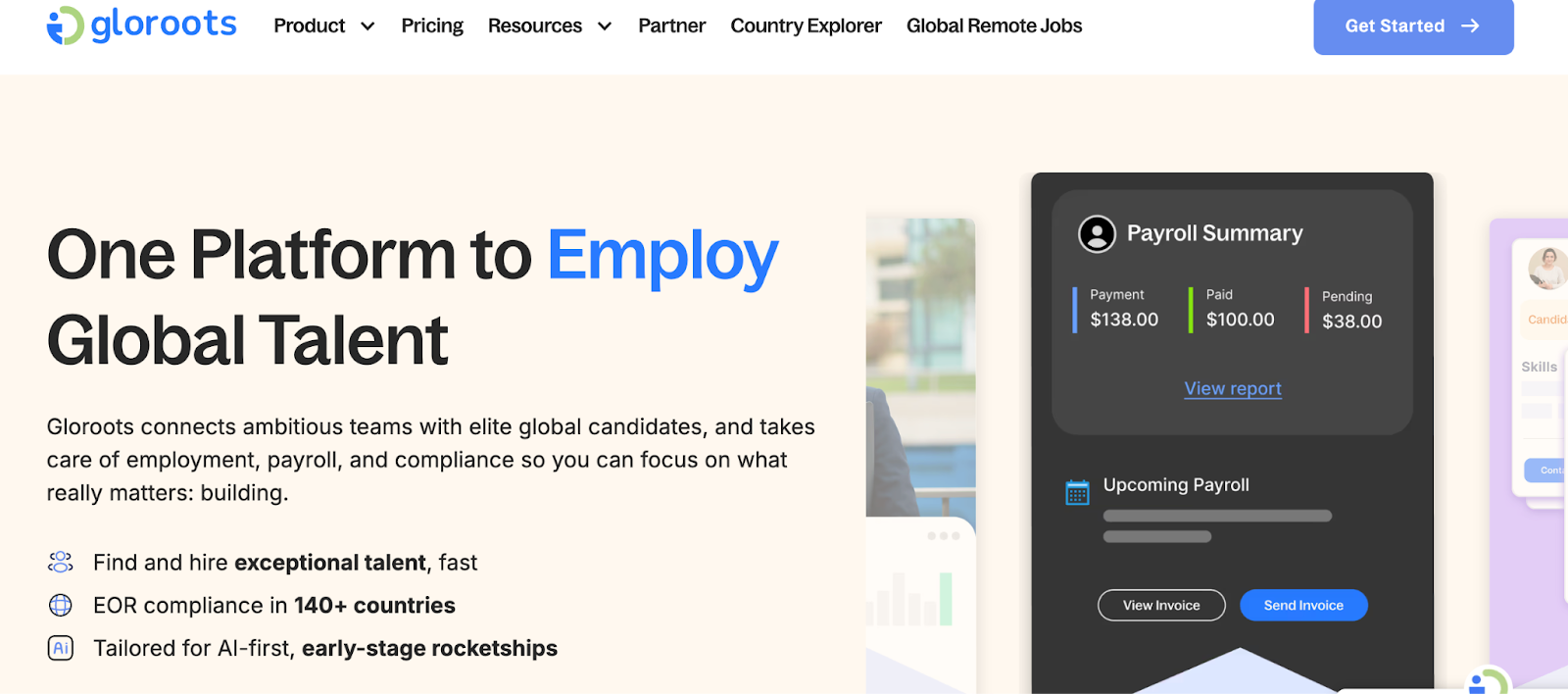
Managing international employee movement can be complex. Gloroots simplifies global mobility by acting as the legal employer in 100+ countries. We handle compliance, payroll, and administration, so you can focus on employee development and business goals.
Whether it’s a short-term project, relocating leadership, or enabling remote work across borders, Gloroots provides the infrastructure to move employees compliantly without entity setup delays.
Here's how Gloroots supports global mobility:
- Legal employer in 140+ countries: Employ assignees compliantly without forming entities or managing local compliance
- Multi-country payroll with tax accuracy: Process compensation, bonuses, and allowances in local currencies with automated statutory deductions
- Immigration and work permit support: Navigate visa applications, renewals, and sponsorship requirements with local expertise
- Assignment cost transparency: Line-item invoices with country breakdowns, GL mapping, and predictable pricing for accurate budgeting
- Contractor-to-employee conversions: Transition contractors to full employment when assignments require employee status
- Dedicated mobility support: Customer Success Managers who understand your markets and provide real-time guidance
Companies choose Gloroots to move employees globally without administrative headaches, compliance risk, or unpredictable costs.
Explore Gloroots' global mobility solutions or book a demo to discuss how we support your international team movement.
FAQ’s
1.What is global mobility?
Global mobility is the process of moving employees across international borders for work while managing immigration, tax, payroll, and compliance. It includes business travel, short-term assignments, relocations, and remote work.
2.What's the difference between global mobility strategy and policy?
A global mobility strategy defines why and how your organization enables cross-border movement to achieve business goals. Policies document the specific rules, eligibility criteria, and processes within mobility programs.
3.How do companies manage tax compliance in global mobility?
Companies manage tax through coordination between home and host country obligations, often providing tax equalization support. Many use specialized tax advisors or EOR providers who handle multi-jurisdiction tax compliance automatically.
4.When should companies use an EOR for global mobility?
Use an EOR when deploying employees to countries where you lack entities, testing markets with small teams, supporting short-to-medium-term assignments, or wanting to avoid permanent establishment risk from employee presence.
5.What are the biggest global mobility compliance risks?
Biggest risks include immigration violations from improper work authorization, tax exposure from permanent establishment, payroll errors across jurisdictions, and worker misclassification when employment status differs between countries.

Ready to take the first step?
Request a demo now and learn how you can focus on building, without worrying for compliance, ever!