



- South Korea mandates four statutory social insurance contributions: NPS, NHIS, Employment Insurance, and Workers' Compensation, with NPS employer contributions rising from 4.5% to 6.5% per party between 2026 and 2033, making accurate, forward-looking contribution rate management one of the most critical factors when selecting an EOR provider for South Korean operations.
- EOR pricing in South Korea ranges from $99 to $1,000 per employee per month, with Asanify starting at $99, RemoFirst at $199, Gloroots at $299, and premium providers including Deel, Remote, Atlas HXM, and Oyster HR charging $599–$699, with statutory employer contributions adding approximately 13–15% of salary on top of base EOR fees.
- South Korea requires severance equivalent to 30 days of average wage after one year of continuous employment, meaning companies must confirm their EOR accrues severance from day one and calculates obligations accurately, as errors compound over employee tenure and create financial liability that becomes material as South Korean headcount grows.
South Korea added 193,000 jobs in 2025, with shortages in AI, cybersecurity, and healthcare driving international hiring and pushing companies toward EOR for compliant, entity-free market entry.
This guide delivers an expert-backed comparison of the top EOR providers in South Korea, covering pricing, statutory compliance, and key strengths to help you choose the right partner.
How we evaluated these providers:
- Customer and buyer interviews
- Review site analysis (G2, Capterra ratings)
- Hands-on platform testing
Gloroots is included in this comparison. We are a provider in this space. This list reflects independent research. No paid placements or rankings influence the selection or ordering of providers in this guide.
What Is an EOR in South Korea?
An Employer of Record in South Korea is a third-party legal employer that manages compliance with the Labor Standards Act, payroll, taxes, and statutory benefits without the client establishing a local entity.
An EOR enables companies to hire in South Korea by assuming full employer responsibilities, including National Pension Service contributions, health insurance filings, employment insurance, and severance accruals from day one.
Core EOR responsibilities:
- Managing payroll
- Handling taxes
- Employment contracts
- Statutory benefits
- Compliance reporting
Startups, scaleups, and enterprises use EOR services in South Korea for market entry and tech talent acquisition in AI, cybersecurity, and IT sectors without the overhead of local entity setup.
Detailed Comparison of Best EOR Service Providers in South Korea [2026]
Who Are the Best EOR Service Providers in South Korea?
1. Gloroots
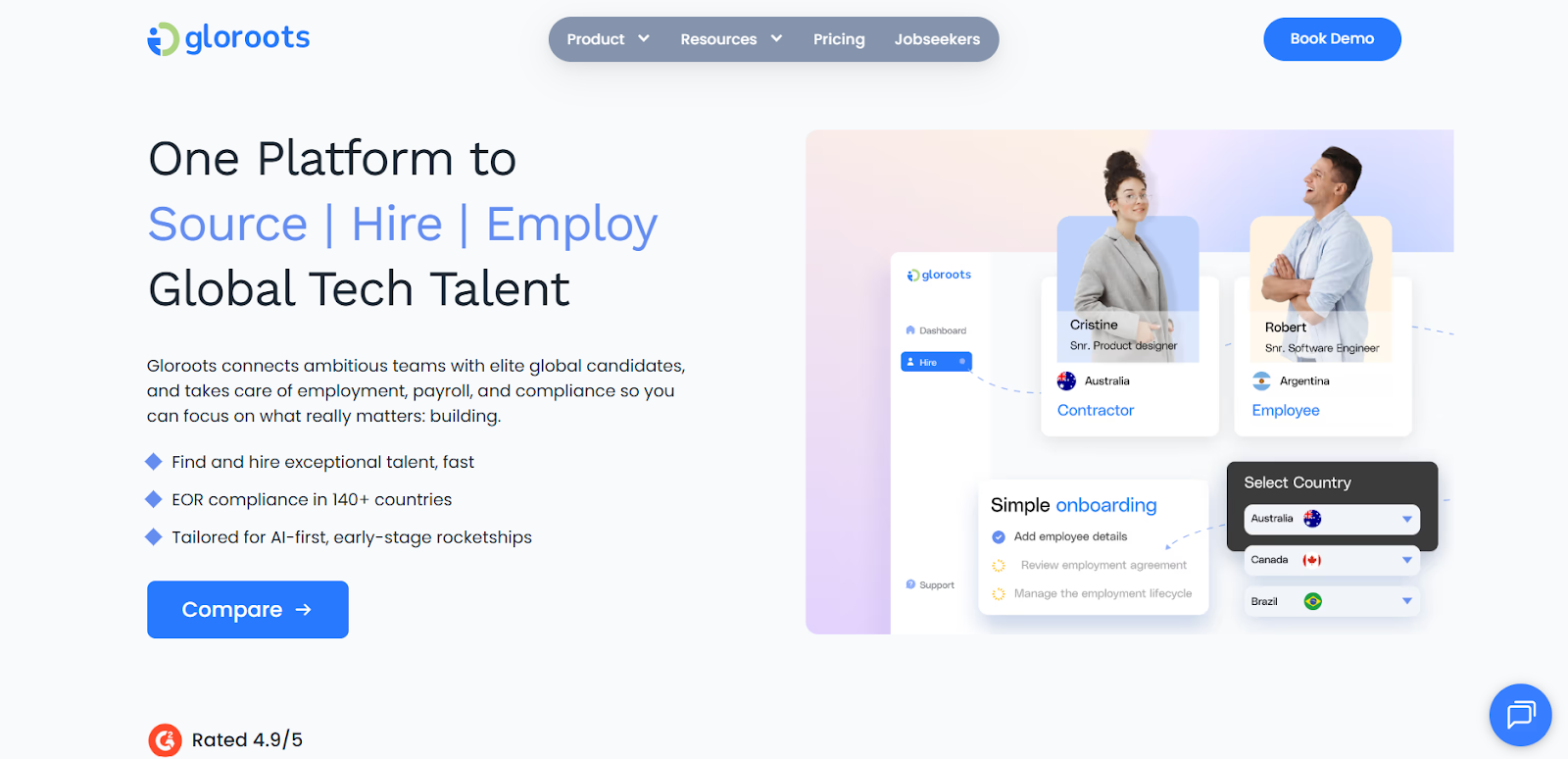
Gloroots is a global hiring and employment platform covering 140+ countries, suited for startups and scaleups entering the South Korean market for tech talent acquisition without local entity setup.
In South Korea, Gloroots enables companies to run compliant payroll in KRW, automate NPS, NHIS, and EI deductions, handle severance accruals from day one, and onboard hires in two to five days.
Gloroots differentiates through transparent fixed monthly pricing independent of employee salary, combined with localized contracts and cultural HR support for Korean employment operations.
Key Features:
- Automated NPS (4.5%), NHIS (approximately 4%), and EI deductions are managed end-to-end, ensuring accurate statutory contribution processing from the point of hire activation.
- Severance accrual management from day one handles South Korea's mandatory 30-day average wage severance obligation after one year of continuous employment.
- Localized employment contracts aligned to South Korea's Labor Standards Act reduce legal exposure for companies entering the market without in-house Korean compliance expertise.
- Predictable monthly invoicing with fixed fees independent of employee salary gives Finance teams reliable South Korea employment cost forecasting at scale.
- Cultural HR support for Korean employment norms gives HR teams operational context for managing Korean workforce relationships effectively over time.
Customer Review
Gloroots' platform is praised by existing users for compliance reliability, with detailed invoice breakdowns and payroll reports providing teams with full statutory assurance across global employment operations.
Pros:
- Fast two-to-five-day onboarding gives companies a rapid activation timeline for South Korea-based hires without extended compliance setup periods.
- Fixed monthly pricing independent of employee salary removes variable billing risk for companies managing South Korean hires across different compensation levels.
- Full statutory management covering NPS, NHIS, EI, and severance accruals reduces compliance gaps for companies without in-house Korean labor law expertise.
Cons:
- Pricing range of $299–$1,000 per employee per month varies by employment complexity, making exact cost forecasting for specific South Korean roles more difficult upfront.
- Limited publicly available South Korea-specific enterprise case studies reduce the ability to benchmark operational performance against larger established providers.
- No South Korea-specific G2 reviews were found in available research; buyer evaluation using general platform ratings is recommended before final selection.
Pricing
Gloroots charges a fixed monthly fee of $299–$1,000 per employee for South Korea EOR services, independent of employee salary level.
Mini Case Study:
A company evaluating local entity setup in South Korea faced significant time delays and compliance uncertainty as it attempted to activate tech talent hiring for its Asia-Pacific expansion.
Using an EOR model, the company achieved faster South Korea market entry with full statutory compliance, avoiding the overhead of entity establishment and accelerating time-to-productivity.
Hire in South Korea without opening a local entity
Access top South Korean talent with Gloroots EOR while we manage local labor laws, CBAs, social contributions, and benefits.
{{hiring-power="/components"}}
2. RemoFirst
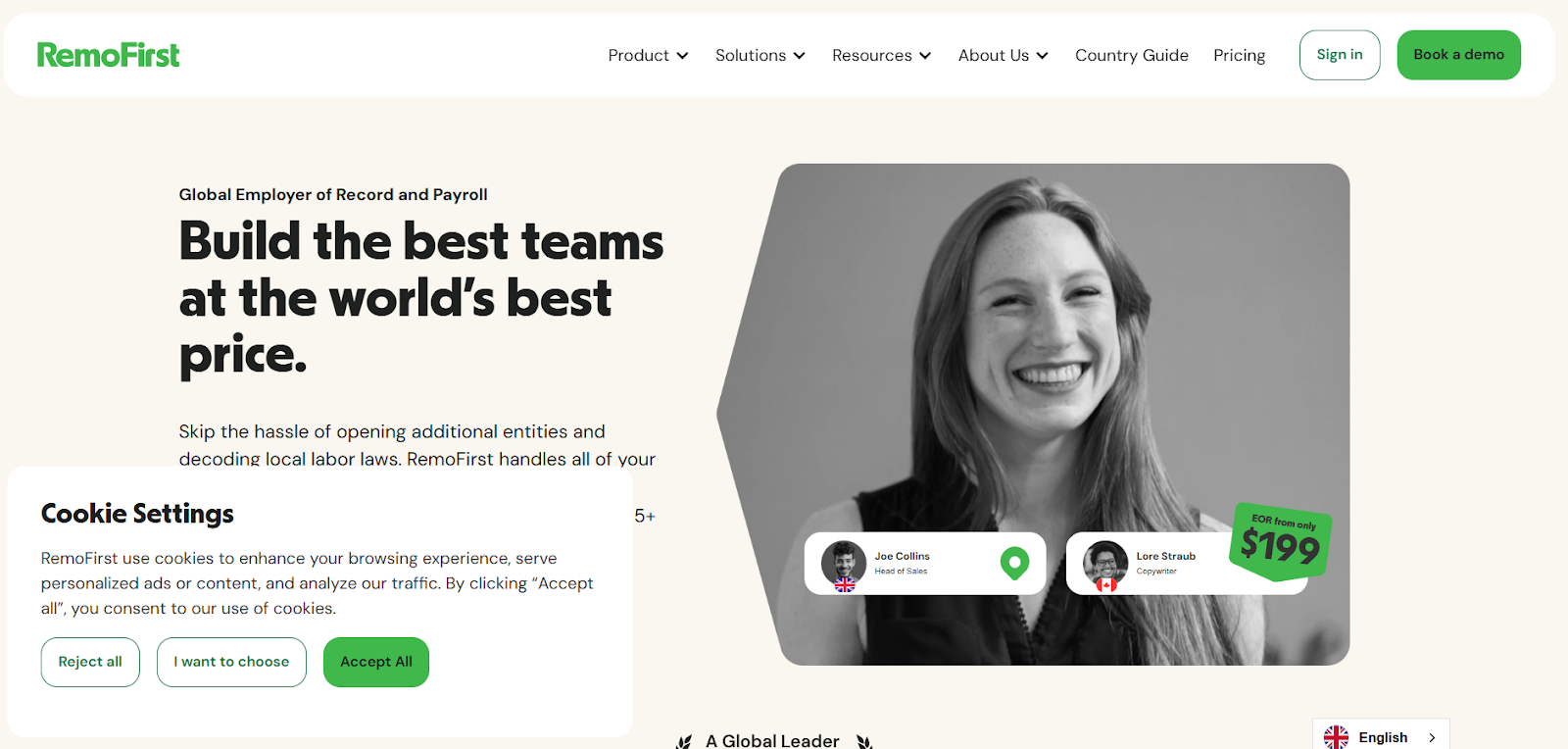
RemoFirst is a cost-focused EOR covering 185+ countries, including South Korea, suited for companies making their first international hires who need fast, low-cost employment activation.
In South Korea, RemoFirst enables companies to onboard employees within one week, managing payroll in KRW, statutory contributions, and compliance without requiring local entity setup.
RemoFirst differentiates through its $199 per month starting price, a self-service platform model, and a straightforward structure suited to budget-conscious companies entering South Korea for the first time.
Key Features:
- A one-week onboarding timeline gives companies fast activation for South Korea-based hires without extended implementation or compliance setup delays.
- Self-service platform gives HR teams direct control over employment contracts, onboarding workflows, and KRW payroll management without relying on dedicated account managers.
- Coverage across 185+ countries allows companies to manage South Korea employment within the same platform used for other international workforce operations.
- Low entry pricing at $199 per employee per month makes South Korean employment accessible for companies at the earliest stage of APAC market expansion.
- Statutory compliance management covers South Korea's four social insurance obligations within a centralized platform framework for employment operations.
Customer Review
RemoFirst holds high ratings on G2 from verified users, reflecting strong satisfaction with its low-cost, fast-activation model for international employment operations across multiple markets.
Pros:
- Low pricing at $199 per employee per month makes RemoFirst the most cost-accessible EOR option for companies making their first South Korea hire.
- One-week onboarding reduces time-to-productivity for South Korea hires compared to the months required to establish a local legal entity in the market.
- Coverage across 185+ countries allows South Korean employees to be managed within the same platform used for other international operations simultaneously.
Cons:
- Basic feature set may not accommodate the complexity of South Korea's four social insurance obligations, severance accruals, and LSA compliance for enterprise-scale operations.
- The self-service model provides limited dedicated support for companies unfamiliar with South Korea's statutory contribution structures and cultural employment norms.
- Less suited for enterprise organizations requiring complex compliance workflows, dedicated account management, or high-volume KRW payroll operations in South Korea.
Pricing
RemoFirst charges $199 per employee per month for EOR services in South Korea. This represents the lowest starting price in the South Korean EOR market.
3. Remote
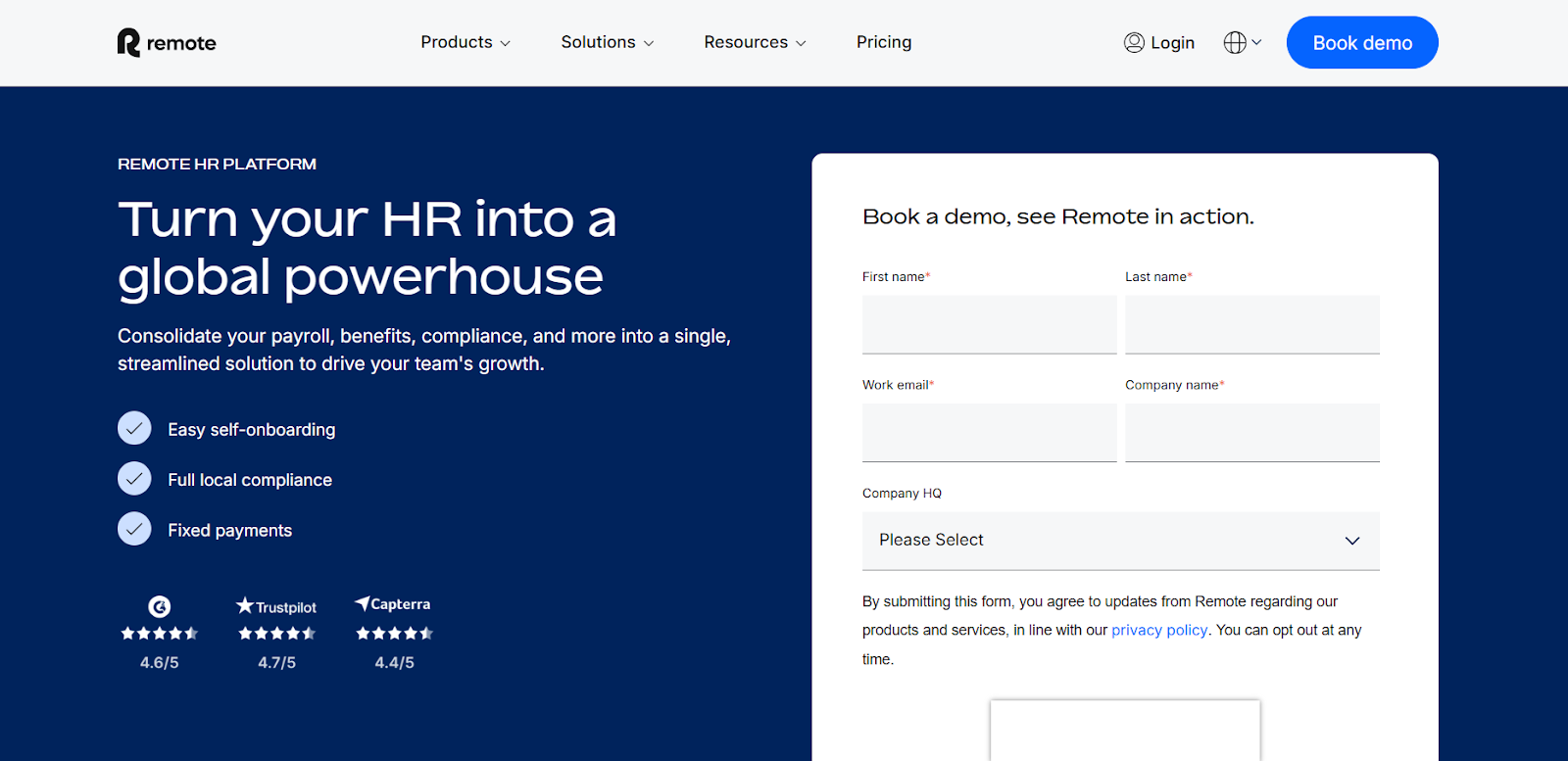
Remote is a compliance-focused EOR with owned entities covering 70+ countries for EOR, suited for organizations that prioritize employee experience, IP protection, and direct compliance accountability in South Korea.
In South Korea, Remote enables companies to hire through its owned entity infrastructure, managing KRW payroll, statutory contributions, employment contracts, and intellectual property protection for tech hires.
Remote differentiates through its IP Guard intellectual property protection feature, employee experience focus, and direct entity ownership that eliminates third-party partner network dependencies for Korean operations.
Key Features:
- An owned entity in South Korea provides direct compliance accountability for KRW payroll, statutory filings, and employment contracts without reliance on partner networks.
- The IP Guard feature protects intellectual property for companies hiring software engineers and AI specialists in South Korea under full-time employment contracts.
- Employee experience focus supports South Korean workforce expectations around pay consistency, benefits administration, and employment contract transparency.
- KRW payroll processing with accurate NPS, NHIS, and EI deductions ensures statutory compliance for South Korean employees without manual intervention from HR teams.
- Real-time compliance tracking monitors South Korean regulatory changes, including the phased NPS contribution rate increases running from 2026 through 2033.
Customer Review
Remote holds strong ratings across G2 and Trustpilot from its global user base, reflecting consistent satisfaction with its compliance infrastructure and employee experience capabilities.
Pros:
- An owned South Korea entity means Remote holds direct compliance responsibility, eliminating partner network inconsistencies for statutory filings and payroll execution.
- The IP Guard feature protects intellectual property for companies hiring technical talent in South Korea's AI, cybersecurity, and IT sectors.
- Employee experience focus aligns with South Korean workforce expectations around consistent payroll delivery and transparent employment contract management.
Cons:
- Pricing at $599–$645 per employee per month places Remote at the premium end of the South Korea EOR market for companies with budget constraints.
- EOR coverage limited to 70+ countries may restrict companies from simultaneously expanding to markets outside Remote's current owned entity footprint.
- No South Korea-specific customer reviews were found in available research; general platform ratings are recommended for satisfaction benchmarking before selection.
Pricing
Remote charges $599–$645 per employee per month for EOR services in South Korea. Flat-rate pricing applies without percentage-of-salary billing structures.
4. Deel
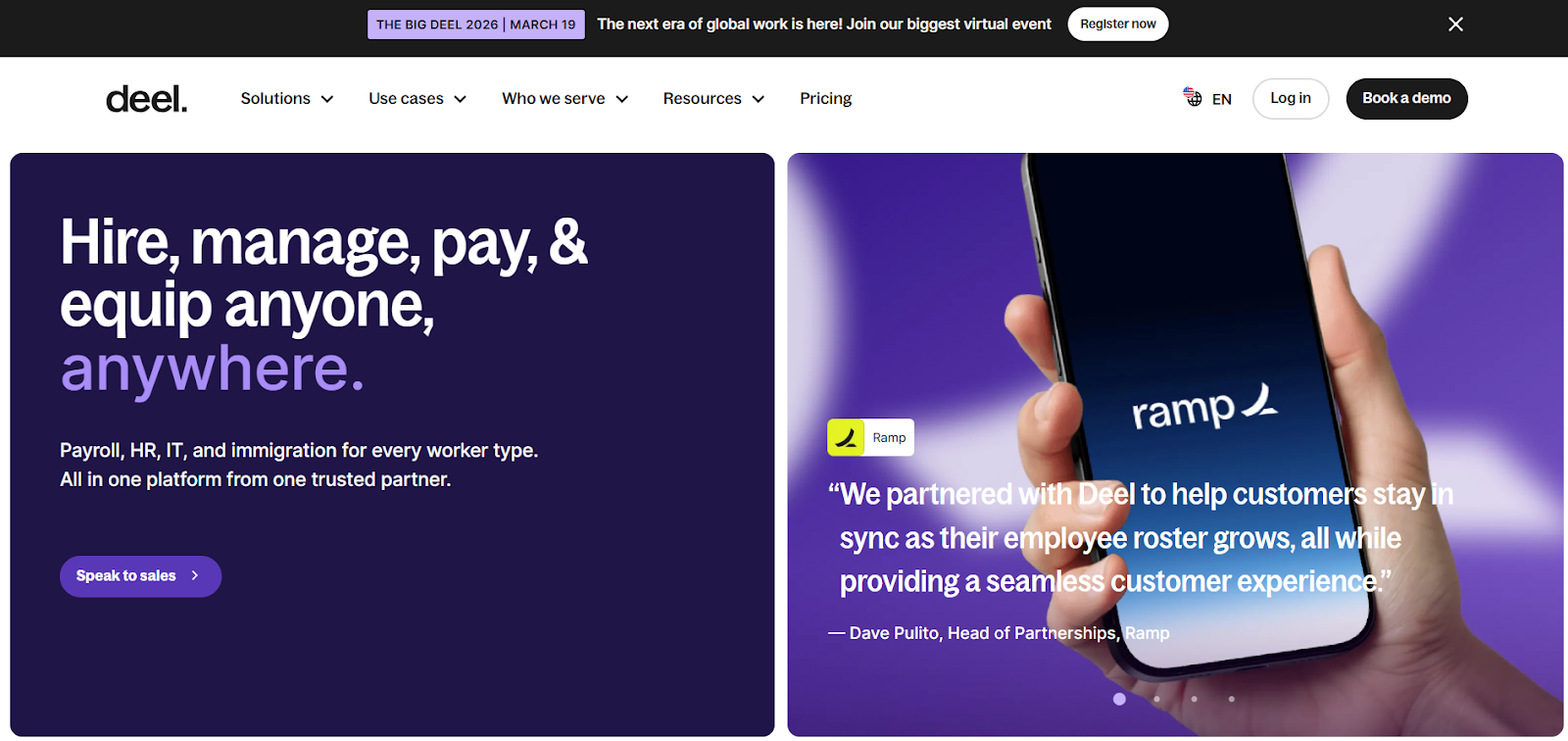
Deel is a platform-focused EOR covering 150+ countries, suited for tech companies and distributed teams that need contractor management, HRIS integrations, and full-time employment support in South Korea.
In South Korea, Deel enables companies to manage compliant employment and contractor arrangements through an integrated platform with broad connectivity to existing HR and finance tool ecosystems.
Deel differentiates through its integration ecosystem, contractor and employee management on a single platform, and a large verified user base reflecting consistent platform performance.
Key Features:
- Contractor and full-time employee management on one platform gives companies flexibility as their South Korea workforce structure evolves from project engagements to direct employment.
- Extensive HRIS integration ecosystem connects Deel with existing HR and finance tools, reducing manual data transfer for South Korean payroll and compliance operations.
- KRW payroll management with statutory deduction processing covers South Korea's four social insurance obligations within a centralized platform framework.
- Platform-wide reporting gives Finance and HR teams consolidated visibility into South Korea employment costs, payroll cycles, and compliance documentation.
- Coverage across 150+ countries allows companies to manage South Korea employment within the same system used for other international workforce operations.
Customer Review
Deel holds a 4.6 out of 5 rating on G2, reflecting strong user satisfaction with its platform capabilities, integration ecosystem, and contractor management features across global employment markets.
Pros:
- 4.6 G2 rating from a large verified user base provides strong evidence of consistent platform performance and user satisfaction across international employment markets.
- Contractor and employee management on one platform gives companies a unified system for South Korea workforce operations across different engagement types.
- Extensive integrations reduce operational overhead for companies managing South Korea employment alongside existing HR and finance tool ecosystems.
Cons:
- Premium pricing at $599 per employee per month places Deel at the higher end of the South Korea EOR market for growth-stage companies with limited budgets.
- No South Korea-specific customer reviews were found in available research, reducing the ability to assess local compliance depth before committing to the platform.
- Feature availability varies by pricing tier, meaning some South Korea-specific compliance or reporting tools may require plan upgrades to access.
Pricing
Deel charges $599 per employee per month for EOR services in South Korea. Pricing tiers apply, and feature availability varies by plan level.
5. Oyster HR
Oyster HR is a global EOR suited for companies that prioritize equity management and global benefits administration alongside compliant employment for South Korea-based hires in tech sectors.
In South Korea, Oyster HR enables companies to hire compliantly, manage statutory employment requirements, and administer equity and global benefit packages through a centralized platform.
Oyster HR differentiates through its equity management capabilities and global benefits focus, making it suited for companies offering stock compensation to South Korean tech and AI talent.
Key Features:
- Equity management support enables companies to administer stock options and equity grants for South Korea-based employees within the Oyster HR platform.
- Global benefits administration gives South Korea-based employees access to competitive benefit packages beyond statutory minimums, supporting talent retention in competitive tech sectors.
- South Korean statutory compliance covers NPS, NHIS, EI, and Workers' Compensation management within a centralized employment platform framework.
- KRW payroll processing with accurate statutory deductions ensures on-time, compliant pay cycles for South Korean employees across the employment lifecycle.
- Employment contract management aligned to South Korea's Labor Standards Act reduces legal exposure for companies entering the market without dedicated local compliance expertise.
Customer Review
No South Korea-specific Oyster HR customer reviews were found in the available research. General platform evaluation using Oyster HR's G2 profile is recommended before platform selection.
Pros:
- Equity management capabilities make Oyster HR suited for companies offering stock compensation to South Korean AI, cybersecurity, and IT talent.
- Global benefits administration supports talent retention for South Korean hires in competitive tech sectors where compensation beyond statutory minimums is expected.
- South Korean statutory compliance coverage reduces legal exposure for companies entering the market without in-house Korean labor law expertise.
Cons:
- Pricing at $599–$699 per employee per month places Oyster HR at the highest end of the South Korea EOR market across providers reviewed.
- No South Korea-specific coverage count was found in available research; direct engagement is recommended to confirm local operational depth before commitment.
- Limited South Korea-specific review data reduces the ability to benchmark local service quality against other providers during initial vendor evaluation.
Pricing
Oyster HR charges $599–$699 per employee per month for EOR services in South Korea, reflecting its equity management and global benefits platform positioning.
6. Papaya Global
Papaya Global is an enterprise-grade EOR suited for large organizations that require payroll automation, remittance management, and scalable employment infrastructure for South Korean operations.
In South Korea, Papaya Global enables enterprises to manage compliant KRW payroll, statutory contributions, and employment contracts through an automation-focused platform built for high-volume operations.
Papaya Global differentiates through its payroll automation depth and remittance management capabilities, which reduce manual processing overhead for enterprises managing large South Korean headcounts.
Key Features:
- Payroll automation reduces manual processing overhead for South Korean statutory deductions, including NPS, NHIS, EI, and Workers' Compensation contributions.
- Remittance management supports accurate, on-time KRW payment execution for South Korean employees within a centralized global payroll infrastructure.
- Enterprise-scale compliance infrastructure supports organizations operating in South Korea as part of large-scale, multi-country workforce expansion programs.
- Centralized reporting gives Finance and HR teams consolidated visibility across South Korean headcount, payroll costs, and compliance status within a single system.
- Employment contract management aligned to South Korea's Labor Standards Act reduces legal exposure for enterprise organizations managing complex Korean workforce operations.
Customer Review
No specific public ratings or South Korea-specific customer reviews for Papaya Global were found in the available research. Enterprise buyer evaluation is recommended before platform selection.
Pros:
- Payroll automation depth reduces manual processing overhead for enterprises managing South Korea's complex four social insurance statutory deduction requirements.
- Remittance management ensures accurate, on-time KRW payment execution for South Korean employees within a centralized global payroll infrastructure.
- Enterprise-scale infrastructure supports organizations scaling South Korean headcount rapidly as the AI and tech sector demand continues to grow.
Cons:
- No public pricing data was found for Papaya Global's South Korea EOR services, making cost comparison with other providers difficult at the evaluation stage.
- Enterprise positioning may create unnecessary complexity for growth-stage companies with straightforward South Korea hiring needs and limited compliance requirements.
- No South Korea-specific customer reviews were found; direct enterprise buyer evaluation is recommended to validate local compliance depth before commitment.
Pricing
No public starting price was found for Papaya Global's South Korea EOR services. Direct engagement with the provider is required for pricing and service scope details.
7. Asanify
Asanify is an Asia and MENA-focused EOR suited for companies that need fast, cost-competitive South Korea employment activation with regional compliance expertise across Asian markets.
In South Korea, Asanify enables companies to onboard employees in two to three days, managing KRW payroll, statutory contributions, and employment contracts within a regional compliance framework.
Asanify differentiates through its two-to-three-day onboarding timeline, competitive pricing starting at $99 per month, and Asia-specific compliance knowledge relevant to South Korean employment requirements.
Key Features:
- A two-to-three-day onboarding timeline gives companies one of the fastest South Korea employment activation paths available among reviewed EOR providers.
- Competitive pricing starting at $99 per employee per month provides the broadest cost range for South Korea employment, making it accessible across company stages.
- Asia and MENA regional focus gives companies compliance operations grounded in Korean statutory requirements without generic global EOR frameworks.
- South Korean statutory compliance management covers LSA requirements, social insurance contributions, and misclassification risk reduction for Korean workforce operations.
- Regional expertise across Asian markets supports companies managing South Korea employment as part of broader APAC workforce expansion strategies.
Customer Review
Asanify holds a 4.8 out of 5 rating on G2, reflecting strong user satisfaction with its Asia-focused platform capabilities and fast onboarding model across regional employment markets.
Pros:
- Two-to-three-day onboarding gives companies the fastest South Korea employment activation timeline among the reviewed EOR providers in this guide.
- Competitive pricing starting at $99 per month gives early-stage companies a highly accessible entry point for South Korea employment operations.
- Asia-specific compliance expertise reduces the risk of applying generic global EOR frameworks to South Korea's specific Labor Standards Act requirements.
Cons:
- Coverage limited to Asia and MENA markets restricts Asanify's suitability for companies simultaneously expanding to markets outside its regional operational footprint.
- The pricing range of $99–$399 per month without clear tier definitions makes exact cost forecasting for specific South Korean employment needs more difficult upfront.
- Limited public information on specific South Korean compliance depth beyond general LSA coverage; direct evaluation is recommended before platform selection.
Pricing
Asanify charges $99–$399 per employee per month for EOR services. Pricing reflects its Asia-focused regional positioning for South Korean employment operations.
8. Atlas HXM
Atlas HXM is an enterprise EOR with a local South Korean entity, suited for organizations that need direct compliance accountability and premium benefits administration for Korean workforce operations.
In South Korea, Atlas HXM enables companies to hire through its owned local entity, managing KRW payroll, statutory filings, and premium benefit packages with direct in-country compliance responsibility.
Atlas HXM differentiates through its owned South Korean entity, direct employment model without partner network dependencies, and premium benefits administration for Korean workforce requirements.
Key Features:
- An owned South Korean entity provides direct compliance accountability for KRW payroll, statutory contributions, and employment contracts without third-party partner dependencies.
- Premium benefits administration gives South Korean employees access to competitive benefit packages that meet local market expectations in tech and AI talent sectors.
- Local entity ownership ensures accurate management of South Korea's phased NPS contribution rate increases running from 2026 through 2033.
- Employment contract management aligned to South Korea's Labor Standards Act reduces legal exposure for enterprise organizations managing complex Korean employment operations.
- Direct employment model eliminates partner network inconsistencies that create payroll and compliance execution gaps as South Korean headcount grows.
Customer Review
No South Korea-specific Atlas HXM customer reviews were found in the available research. Enterprise buyer evaluation using Atlas HXM's general analyst recognition profile is recommended before selection.
Pros:
- An owned South Korean entity means Atlas HXM holds direct compliance responsibility, eliminating partner network risk for statutory filings and employment contract management.
- Premium benefits administration supports talent retention for South Korean hires in competitive AI, cybersecurity, and IT sectors, where beyond-statutory benefits are expected.
- Direct entity ownership ensures consistent compliance execution as South Korea's NPS contribution rates increase annually through the 2026–2033 phased schedule.
Cons:
- Pricing at $599 per employee per month reflects premium positioning and may not suit growth-stage companies with straightforward South Korea hiring requirements.
- No South Korea-specific customer reviews were found in available research, limiting pre-commitment satisfaction benchmarking against other providers in this guide.
- Enterprise orientation may create unnecessary procurement complexity for smaller companies making initial South Korea hires without complex statutory compliance requirements.
Pricing
Atlas HXM charges $599 per employee per month for South Korea EOR services. Pricing reflects its owned entity and premium benefits positioning for Korean operations.
9. Velocity Global

Velocity Global is a global EOR suited for organizations that need workforce flexibility and scalable South Korean employment coverage as part of a multi-country APAC expansion strategy.
In South Korea, Velocity Global enables companies to manage compliant employment, KRW payroll, and statutory contributions through a platform focused on flexibility and scalable workforce management.
Velocity Global differentiates through its workforce flexibility focus and broad country coverage, supporting companies that need adaptable employment models alongside South Korean statutory compliance management.
Key Features:
- Workforce flexibility model supports companies managing South Korean employment across different engagement structures as team size and contract types evolve.
- KRW payroll management covers South Korea's monthly payroll cycle with accurate statutory deductions for NPS, NHIS, EI, and Workers' Compensation contributions.
- Broad country coverage allows companies to manage South Korean employment within a platform built for multi-country APAC workforce expansion operations.
- Employment contract management aligned to South Korea's Labor Standards Act covers severance obligations, notice periods, and statutory employment norms from the point of hire.
- Compliance governance tools give HR and Legal teams visibility into South Korean statutory obligations and employment documentation across the active workforce.
Customer Review
No South Korea-specific Velocity Global customer reviews were found in the available research. General platform evaluation is recommended for satisfaction benchmarking before platform selection.
Pros:
- Workforce flexibility focus supports companies managing South Korean employment across different team structures as APAC expansion plans evolve.
- Broad country coverage provides consistent employment management for South Korea within a multi-country platform built for scalable APAC workforce operations.
- KRW payroll management with statutory deduction processing reduces compliance gaps for companies entering South Korea without in-house Korean HR expertise.
Cons:
- No public pricing data was found for Velocity Global's South Korea EOR services, making cost comparison with fixed-price competitors difficult at the evaluation stage.
- No South Korea-specific operational details were confirmed in available research; direct buyer evaluation is recommended to validate local compliance depth before commitment.
- Limited South Korea-specific review data reduces confidence when benchmarking Velocity Global's local service quality against other providers in this guide.
Pricing
No public starting price was found for Velocity Global's South Korea EOR services. Direct engagement with the provider is required for pricing and service scope confirmation.
10. Horizons
Horizons is a global EOR suited for companies that prioritize transparent pricing and no-hidden-fee structures for South Korea employment operations within a multi-country workforce strategy.
In South Korea, Horizons enables companies to manage compliant employment, KRW payroll, and statutory contributions through a platform with transparent pricing designed to eliminate unexpected billing complexity.
Horizons differentiates through its transparent pricing model and no-hidden-fees positioning, giving Finance teams reliable South Korean employment cost forecasting from the point of engagement.
Key Features:
- Transparent pricing model eliminates hidden fees and unexpected billing adjustments, giving Finance teams reliable South Korean employment cost forecasting at scale.
- No-hidden-fees structure gives companies complete cost visibility before committing, with all-in pricing disclosed upfront for South Korean employment operations.
- KRW payroll management covers South Korea's monthly payroll cycle with statutory deductions for NPS, NHIS, EI, and severance accrual management.
- Employment contract management aligned to South Korea's Labor Standards Act reduces legal exposure for companies entering the market for the first time.
- South Korean statutory compliance management covers the four social insurance obligations and severance requirements within a centralized employment framework.
Customer Review
No specific public ratings or South Korea-specific customer reviews for Horizons were found in the available research. Direct reference checks with existing clients are recommended before engagement.
Pros:
- Transparent pricing with no hidden fees provides Finance teams with reliable South Korean employment cost forecasting, without unexpected billing adjustments after contract signing.
- No-hidden-fees structure removes the billing uncertainty that commonly emerges with globally positioned EOR providers as South Korean headcount grows over time.
- South Korean statutory compliance coverage reduces legal exposure for companies entering the market without dedicated in-house Korean labor law expertise.
Cons:
- No public pricing data was found for Horizons' South Korea EOR services, which limits cost comparison with fixed-price competitors at the initial evaluation stage.
- No public ratings or South Korea-specific customer reviews were found; direct reference checks with existing Korean clients are recommended before platform selection.
- Limited publicly available feature documentation makes a thorough pre-engagement assessment more difficult for prospective South Korean clients evaluating EOR options.
Pricing
No public starting price was found for Horizons' South Korea EOR services. Direct engagement with the provider is required for pricing and service scope confirmation.
How to Choose the Best EOR Service Provider in South Korea?
1. Labor Standards Act Compliance and Severance Management
South Korea's Labor Standards Act mandates severance pay equivalent to 30 days of average wage after one year of continuous employment. Evaluate whether the EOR accrues severance from day one and manages these calculations accurately, as errors in accruals create cumulative financial liability that grows with employee tenure.
2. Four Social Insurance Contribution Management
South Korea requires employers to manage four statutory social insurances: NPS, NHIS, including long-term care, Employment Insurance, and Workers' Compensation. Contribution rates are evolving, with NPS rising from 4.5% to 6.5% per party by 2033, starting in 2026. Confirm the EOR tracks and apply these phased rate changes without requiring manual updates from your HR team.
3. Monthly KRW Payroll Accuracy and Tax Withholding
South Korean payroll must be processed monthly in KRW with progressive personal income tax withheld at rates from 6% to 45%. Evaluate whether the EOR handles accurate PIT withholding alongside social insurance deductions, as errors in either create employee trust risk and potential regulatory penalties from Korean tax authorities.
4. Employment Contract Alignment to Korean Labor Norms
South Korean employment law includes specific requirements for the standard 40-hour work week, overtime regulations, and full-time role classification. Evaluate whether the EOR issues locally compliant contracts that accurately reflect these norms from the point of hire, reducing misclassification risk that carries financial penalties under Korean labor law.
5. Support with South Korea-Specific Cultural and Compliance Context
South Korea's employment environment combines formal statutory compliance requirements with specific cultural HR norms around workplace relationships and compensation. Evaluate whether the EOR provides dedicated support with South Korea-specific compliance and cultural knowledge, not just generalist APAC HR assistance, as both dimensions affect workforce operations.
What Are the Factors Affecting EOR Pricing in South Korea?
1. Local Labor Law Complexity
South Korea's Labor Standards Act mandates severance accrual, four separate social insurance contributions, progressive PIT withholding from 6–45%, and misclassification penalties, all increasing compliance management overhead that directly affects EOR service pricing for Korean employment operations.
2. Statutory Benefits and Taxes
NPS contributions total 9% combined and are rising to 13% by 2033, NHIS totals approximately 8.135% combined, and EI ranges from 2% to 2.65% combined. These statutory obligations add significant administration costs to South Korea's EOR operations across all provider pricing tiers.
3. Payroll Frequency and Currency Handling
South Korean payroll is processed monthly in KRW. Multi-currency support requirements for companies managing South Korea alongside other international operations add processing overhead that contributes to overall EOR service costs for Korean employment.
4. Add-On Services and Support Level
Visa processing, relocation packages for foreign AI and cloud specialists, equipment provisioning, and premium dedicated account management increase EOR fees beyond base pricing, depending on the service tier and specific South Korean employment requirements selected.
Why Gloroots Is the Best EOR Provider in South Korea?
Gloroots is best suited for startups and scaleups entering South Korea's tech market, where shortages in AI, cybersecurity, and IT talent make fast, compliant employment without entity setup a strategic priority.
Gloroots combines fixed monthly pricing independent of employee salary, automated NPS, NHIS, and EI management, severance accruals from day one, and two-to-five-day onboarding for South Korean operations.
- Fixed monthly pricing at $299–$1,000 per employee removes variable billing risk for companies managing South Korean hires across different salary levels and seniority.
- Automated statutory deduction management for NPS, NHIS, and EI reduces compliance gaps as South Korea's phased contribution rate increases take effect from 2026.
- Severance accrual handling from day one ensures companies avoid cumulative financial liability that compounds over employee tenure under South Korean labor law.
- Two-to-five-day onboarding gives companies a rapid path to South Korean employment activation without the delays associated with local entity establishment.
Explore how Gloroots can run your South Korea employment.
Book a demo to see the platform in action.
Frequently Asked Questions About the Best EOR in South Korea
1. What is an Employer of Record in South Korea?
An Employer of Record in South Korea is a third-party organization that acts as the legal employer under the Labor Standards Act.
The EOR manages monthly KRW payroll, NPS contributions at 4.5% each (rising to 6.5% by 2033), NHIS contributions of approximately 4% each, Employment Insurance, Workers' Compensation, severance accruals after one year, and progressive PIT withholding, all without requiring you to establish a Korean legal entity.
2. How much does an EOR cost in South Korea?
EOR pricing in South Korea ranges from $99 to $1,000 per employee per month, with statutory employer contributions adding approximately 13–15% of salary on top of base fees.
Asanify starts at $99, RemoFirst at $199, Gloroots at $299, and premium providers, including Deel, Remote, Atlas HXM, and Oyster HR, charge $599–$699. Papaya Global, Velocity Global, and Horizons require direct engagement for pricing. Total employment cost includes all four statutory social insurance contributions.
3. Is using an EOR legal in South Korea?
Yes, using an Employer of Record is fully legal in South Korea and is a standard model for compliant employment of international and domestic talent.
EOR arrangements allow companies to engage employees in South Korea without establishing a local legal entity, while the EOR assumes responsibility for Labor Standards Act compliance, KRW payroll, NPS and NHIS contributions, Employment Insurance, Workers' Compensation, severance accruals, and progressive PIT withholding on behalf of the hiring company.
4. How does Gloroots compare to other EORs in South Korea?
Gloroots offers fixed monthly pricing at $299–$1,000 per employee, independent of salary, competitive with RemoFirst at $199 and below premium providers charging $599–$699.
Beyond pricing, Gloroots provides two-to-five-day onboarding, automated NPS, NHIS, and EI deduction management, severance accruals from day one, and localized Korean employment contracts. For startups and scaleups prioritizing transparent cost governance and fast South Korea market entry, Gloroots provides a strong combination of price, speed, and compliance depth.
5. Can an EOR manage payroll and benefits in South Korea?
Yes, a South Korean EOR manages the full payroll and statutory benefits function in compliance with Korean labor law and the Labor Standards Act.
This includes monthly KRW payroll processing, NPS contributions at 4.5% each party rising to 6.5% by 2033, NHIS contributions of approximately 4% each, Employment Insurance at 0.9% employee and 1.15–1.75% employer, Workers' Compensation at risk-rated employer rates, progressive PIT withholding, and mandatory severance accruals after one year of employment.

Ready to take the first step?
Request a demo now and learn how you can focus on building, without worrying for compliance, ever!