
How to hire employees in Italy
Learn how to hire employees in Italy compliantly. Understand hiring options, employment laws, payroll, taxes, contracts, and how EORs simplify hiring.
Begin your Journey with Gloroots
Schedule a call with our solution expert
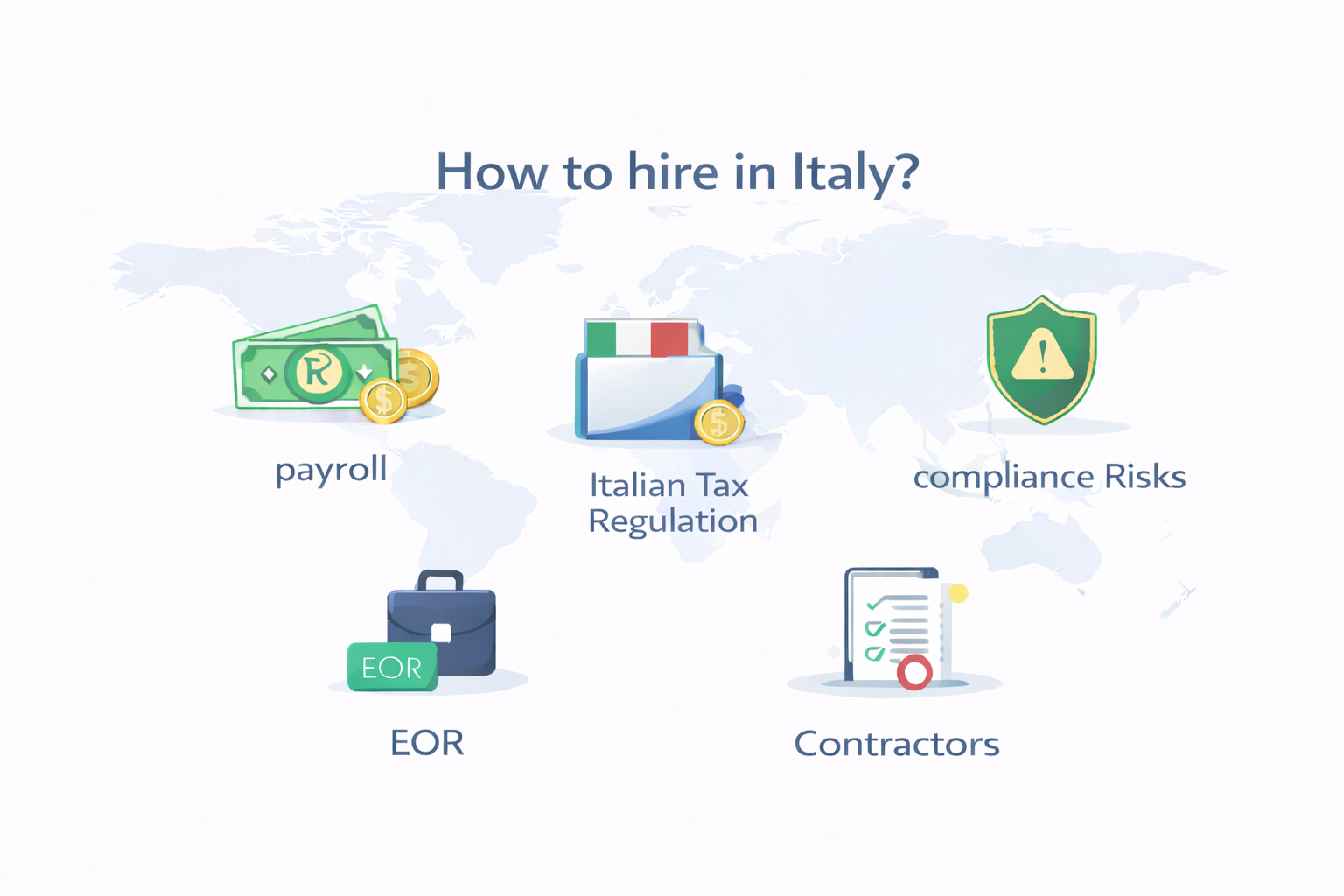
Italy offers foreign companies a compelling entry point into Southern Europe's largest economy. Skilled manufacturing workforce, strong luxury goods and design sectors, strategic Mediterranean location, and access to EU markets.
But cultural richness doesn't mean regulatory simplicity.
Italy enforces complex, multi-layered employment regulations with strict compliance expectations across national collective bargaining agreements, regional variations, and detailed social security requirements. Early missteps in contract structure, contribution calculations, or employee classification trigger costly disputes, regulatory penalties, and expansion delays that compound with every hire.
Hiring employees in Italy requires:
- Clarity on hiring models (entity vs. Employer of Record vs. contractor)
- Mandatory employer obligations under Italian labor legislation
- Payroll tax structures and social security contributions
- Termination protections and notice requirements
- Legal distinctions separating compliant employment from misclassification risk
This guide walks you through each step: choosing the right hiring model, onboarding your first employee, managing payroll, navigating termination rules, and avoiding compliance traps that catch unprepared employers off guard.
Core truth: Hiring employees in Italy requires the right hiring model and strict adherence to local labor laws. One hire done wrong costs more than doing ten right.
What Are Your Employment Options When Hiring in Italy?
Before posting a job or signing an offer letter, decide how you'll employ talent. Foreign companies typically choose between three models: establishing a local entity, partnering with an Employer of Record (EOR), or engaging contractors. Each has distinct implications for compliance risk, cost structure, and operational control.
Entity setup → means full legal presence. Register an Italian company (SRL or SpA), handle all employer obligations directly, and bear complete liability.
EOR hiring → outsources employment compliance to a third-party legal employer while you retain operational control.
Contractor engagement → treats individuals as independent service providers, not employees. But only when the relationship genuinely reflects independence.
The stakes are higher than they appear. Misclassifying an employee as a contractor triggers back taxes, social security penalties, and reclassification claims. Setting up a local entity in Italy for hiring costs €5,000–€12,000 total, including registration fees, notary services, legal counsel, accounting setup, and regulatory filings with the Chamber of Commerce and Revenue Agency.
Choosing the wrong model doesn't just slow hiring. It creates legal exposure that compounds with every additional hire.
1. Hiring Through a Local Entity
Establishing an Italian entity gives you direct control over employment, payroll, and benefits administration. You become the legal employer. Full responsibility for Italian labor law compliance, tax withholding, social security contributions, and statutory filings.
This model makes sense when:
- You're committing to long-term operations in Italy
- Hiring at scale (typically 10+ employees)
- You need to own intellectual property and operational infrastructure locally
The trade-off: entity formation takes 2-4 months, requires ongoing legal and accounting support, and locks you into administrative obligations even if hiring slows.
2. Hiring Through an Employer of Record (EOR)
An EOR becomes the legal employer in Italy while you direct the employee's day-to-day work. The EOR handles employment contracts, payroll processing, tax compliance, social security administration, and statutory filings.
You maintain operational control. They absorb legal liability.
EOR hiring suits:
- Companies testing the Italian market
- Scaling quickly (hires live in days, not months)
- Expanding into multiple countries without establishing entities everywhere
It's not a workaround. It's a legitimate employment model under Italian law, ideal when speed, compliance assurance, and low upfront cost matter more than direct entity ownership.
3. Hiring Independent Contractors
Contractors are appropriate for project-based work, specialized services, or genuinely independent engagements. Italian law distinguishes employees from contractors based on subordination, continuity, exclusivity, and the reality of the working relationship. Not what the contract says.
Misclassification happens when companies treat contractors like employees:
- Setting their hours and work schedules
- Providing equipment and workspace
- Directing how work is done
- Maintaining exclusive relationships
Local Entity Vs EOR Vs Independent Contractor: Side-by-Side Comparison
What Are The Legal Requirements for Hiring in Italy?
Italian employment law operates through national legislation supplemented by extensive national collective bargaining agreements (CCNL) that set industry-specific terms. Key laws include the Workers' Statute, Jobs Act reforms, and sector-specific CCNL provisions. Italy's regulatory framework emphasizes worker protection and collective bargaining.
Key employer obligations:
- Provide written employment contracts documenting essential terms
- Register employees with INPS (National Social Security Institute)
- Register with INAIL (Workers' Compensation Authority)
- Make monthly contributions to social security (pension, health, unemployment, family benefits)
- Withhold income tax and regional/municipal taxes
- Comply with the applicable national collective bargaining agreement (CCNL)
- Maintain accurate payroll records and the mandatory employment book
- Register with the Revenue Agency for tax purposes
- Provide mandatory severance fund contributions (TFR)
- Conduct health and safety risk assessments
Employment relationships are presumed indefinite unless a fixed-term contract meets specific legal criteria. Probationary periods vary by role and CCNL but typically range from 1-6 months.
Italy's enforcement environment is not theoretical. The Labor Inspectorate conducts regular audits. Employees can file claims through the Labor Courts. Non-compliance with payroll or contract standards results in financial penalties, back-payment orders, and reputational damage.
The presumption favors employee protection, not employer flexibility.
What Are the Employment Contract Rules in Italy?
Written, locally compliant employment contracts are not optional. They're legally required.
Oral agreements carry significant legal risk and create presumptions of indefinite employment with full protections. The contract must be in Italian, signed by both parties, and provided before the employee's first day of work.
Types of Employment Contracts
- Indefinite-term contracts are the default and most common form. They continue until lawfully terminated by either party with proper notice and include full entitlements under Italian law and applicable CCNL.
- Fixed-term contracts are permitted for specific objective reasons such as temporary replacement of absent employees, seasonal work, temporary increase in activity, or specific projects. Italian law limits fixed-term contracts: maximum 12 months duration initially (extendable to 24 months with specific justifications), maximum 4 renewals. Exceeding limits automatically converts contracts to indefinite-term status.
- Apprenticeship contracts combine work and training for youth (typically ages 15-29), with reduced social security contributions and specific training obligations.
- Part-time contracts specify regular working hours less than the standard full-time schedule (typically 40 hours per week) with pro-rata entitlements to benefits and leave.
Full-time employment typically follows a 40-hour workweek as established by most CCNL agreements, though the statutory maximum allows up to 48 hours, including overtime.
Probationary periods allow employers to assess new hires, with duration varying by role classification in CCNL (typically 1-6 months), with reduced notice requirements during this window.
What to Include in an Offer Letter?
Employment offers must specify the job title, duties, reporting structure, and work location.
Essential contract elements:
- Employer and employee identification details
- Start date and contract type (indefinite, fixed-term, apprenticeship, part-time)
- Job title, classification level per CCNL, and primary responsibilities
- Work location and any mobility requirements
- Gross monthly or annual salary (must meet CCNL minimums)
- Working hours and overtime compensation
- Vacation entitlement (varies by CCNL, typically 4+ weeks)
- Notice period requirements
- Applicable national collective bargaining agreement (CCNL)
- Probation period (if applicable)
- Supplementary health insurance details (if provided)
Clarity matters. Ambiguous job descriptions or vague compensation terms create disputes during performance reviews or terminations. Italian Labor Courts interpret contract ambiguities in favor of employees.
NDAs and Confidentiality Agreements
Confidentiality clauses are enforceable under Italian law, particularly when protecting trade secrets, client information, or proprietary processes. Intellectual property (IP) created during employment typically belongs to the employer for work-related inventions unless otherwise specified.
Post-employment non-compete clauses are valid but must meet strict requirements: reasonable duration (typically 3-5 years maximum for executives, shorter for others), limited geographic scope, adequate compensation during restriction period, and apply only to employees with access to significant confidential information or strategic roles. Non-competes must be individually negotiated and agreed in writing.
Overly broad non-competes risk being struck down as unenforceable.
How Payroll Costs and Taxes Work in Italy?
Italy's labor costs are moderate within Western Europe. But only if you understand the full employer burden.
Italy has no statutory national minimum wage. Wages are set through national collective bargaining agreements (CCNL), which establish sector-specific minimums. As of 2026, sector agreements set averages of €1,650-€2,200 monthly gross (post-inflation estimates). Typical total employer costs for mid-level hires range from €3,000 to €6,000 per month, including gross salary and mandatory contributions.
1. Payroll and Salary Structure in Italy
Salaries are quoted and paid in euros (€). Compensation typically includes base salary, 13th-month bonus (mandatory in most CCNL), 14th-month bonus (common in many sectors), performance bonuses, and mandatory benefits.
Employers must meet CCNL minimum wage thresholds, which vary significantly by sector and job classification.
2. Employer Payroll Obligations
Employers face substantial mandatory social security contributions averaging 30-35% of gross salary:
- INPS (pension and social security): ~23-24% of gross salary
- INAIL (work accident insurance): 0.5-6% depending on industry risk classification
- Unemployment insurance: Included in INPS contributions
- Family benefits: Included in INPS contributions
- TFR (severance fund): ~6.91% accrued annually (not paid monthly but reserved)
- Supplementary health funds: Variable by CCNL if applicable
Total employer burden for social security typically ranges 30-35% above gross salary, plus TFR accrual obligations.
These contributions sit on top of the employee's gross salary. Not embedded within it.
3. Employee Tax Contributions
Employees face significant deductions withheld at source:
- Social security contributions (INPS): ~9-10% of gross salary
- Income tax (IRPEF): Progressive rates (23-43%)
- Regional tax: 1.23-3.33% depending on region
- Municipal tax: Up to 0.8% depending on municipality
Income tax brackets (2026):
- €0 – €28,000: 23%
- €28,001 – €50,000: 35%
- €50,001 – €100,000: 43%
- Above €100,000: 43%
Tax deductions and allowances apply based on employment type, family situation, and income level. Total employee deductions range from 30-45% of gross salary, depending on income level and regional/municipal rates.
4. Social Security Contributions
Both employer and employee contribute to Italy's social security system, managed by INPS, funding pensions, healthcare, unemployment benefits, and family allowances. Employer rates substantially exceed employee rates, creating a significant employer burden.
5. Minimum Wage and Statutory Pay Requirements
No statutory national minimum wage exists in Italy. Instead, national collective bargaining agreements (CCNL) set sector-specific minimums averaging €1,600-€2,200 gross monthly for full-time work (2026 estimates).
Employers must also pay:
- 13th-month bonus (mandatory under most CCNL, paid in December)
- 14th-month bonus (common in many CCNL, typically paid in summer)
- Overtime premiums (typically 15-30% for weekday overtime, 30-50% for Saturday, 50-60% for Sunday)
- Night shift differentials as per CCNL
- Holiday work premiums as per CCNL
- Meal vouchers or allowances (common in many CCNL)
In practical terms, employers should budget 30-40% above gross salary for statutory obligations plus mandatory bonuses. For professional roles, this puts the true monthly cost of hiring in Italy between €3,000 and €6,000, depending on seniority, role, and applicable CCNL.
How Employers Pay Employees in Italy?
1. Payment Methods
Salaries are paid via bank transfer to the employee's Italian bank account. Bank payment is legally mandatory for amounts above certain thresholds.
Cash payments are restricted and create significant compliance risks.
Payslips must contain:
- Employer and employee identification details
- Pay period
- Gross salary and all components (base, bonuses, allowances)
- All deductions (social security, income tax, regional/municipal taxes)
- Employer and employee contribution amounts
- Net salary
- TFR accrual amount
- Vacation and leave balances
Payslips must be provided monthly, typically electronically or in print.
2. Salary Payment Frequency
Payroll runs monthly, with salaries typically paid at the end of the month or beginning of the following month for work performed.
Payment delays beyond the agreed date breach labor law and give employees grounds for lodging complaints or claiming immediate contract termination with full severance entitlements.
How To Onboard Employees in Italy?
1. New Hire Onboarding Checklist
Register the employee with INPS and INAIL before their first working day. Provide signed employment contracts, company policies, role-specific training materials, and access to payroll/benefits systems.
Onboarding essentials:
- Register the employee with INPS for social security
- Register with INAIL for work accident insurance
- Register with the Revenue Agency for tax purposes
- Send mandatory pre-hire notification to the Labor Inspectorate
- Open the mandatory employment book
- Sign and provide an employment contract
- Provide workplace health and safety training
- Conduct mandatory occupational health medical examination
- Set up payroll system access
- Assign a direct manager and clarify expectations
- Provide the company handbook and data protection information
Schedule orientation sessions covering workplace health and safety (mandatory under Legislative Decree 81/2008), data privacy policies under GDPR, and reporting structures. Ensure the employee understands leave policies, overtime rules, and performance review timelines.
2. Required Employee Documentation
Italian employment and tax regulations require employers to collect specific employee documents at the time of onboarding. These records support payroll processing, social security registration, and statutory compliance.
Documents you need from new hires:
- National ID card (Carta d'Identità) or passport
- Tax identification code (Codice Fiscale)
- Social security number
- Bank account details (IBAN)
- Educational certificates and professional qualifications relevant to the role
- Work permit and residence permit (for non-EU nationals)
- Proof of address
- Health card
- Prior employment documentation (if claiming certain benefits)
Maintain signed copies of the employment contract, confidentiality agreements, health and safety training records, and acknowledgment of company policies in the employee's personnel file. These documents become critical during audits or disputes.
What Are The Best Practices Of Interviewing and Hiring in Italy?
Italian employment law prohibits discrimination based on gender, age, disability, race, ethnicity, religion, sexual orientation, political opinions, or union membership. Interview questions must focus strictly on job-related qualifications and competencies.
- Avoid questions about family planning, marital status, religious beliefs, political affiliations, pregnancy intentions, or health conditions unless directly relevant to essential job requirements and legally justified.
- Data privacy matters. Under GDPR (enforced in Italy with strict interpretation), candidate information must be collected with consent, stored securely, and used only for recruitment purposes. Candidates have extensive rights to access, correct, and request deletion of their information.
- Document retention and processing justifications carefully.
- Italian candidates value job security, clear organizational hierarchy, and respect for work-life balance.
- Communicate hiring timelines, provide prompt feedback, and set realistic expectations about compensation and role responsibilities.
A sluggish or opaque hiring process signals organizational dysfunction.
Work Permits and Right to Work in Italy
1. Italian, EU/EEA, and Swiss nationals have unrestricted work rights in Italy and require no permits.
2. Non-EU/EEA nationals require valid work permits and residence permits issued by Italian authorities before starting employment. Common work authorization types include:
- Subordinate work permit: For standard employment contracts, subject to the annual quota system (Decreto Flussi)
- Highly qualified worker permit (EU Blue Card): For highly qualified professionals with recognized qualifications and salary thresholds
- Intra-corporate transfer permit: For transfers within multinational companies
- Self-employment permit: For independent contractors and entrepreneurs
- Seasonal work permit: For temporary seasonal employment
Key considerations for non-EU/EEA hires:
- Processing times: expect 2 to 6 months, depending on permit type and quota availability
- The annual quota system limits permits for most non-EU workers
- Employers must apply during quota opening periods (typically announced annually)
- Highly qualified worker permits exempt from quotas with salary thresholds
- Work permits tied to specific employers and roles
- Residence permit required alongside work authorization
Hiring non-EU/EEA nationals without valid work authorization exposes employers to fines from €5,000-€25,000 per employee, potential criminal liability, and business activity suspension.
How Does Employment Termination Work in Italy?
1. Lawful Grounds for Termination
- Employers can terminate for just cause (immediate dismissal for serious misconduct), justified subjective reason (employee-related issues after warnings), or justified objective reason (business/operational needs).
- Termination requires documented justification and adherence to strict procedures. Employers must provide written notice with specific grounds, respect notice periods, calculate severance (TFR), and follow procedural requirements, including conciliation attempts.
- Employees enjoy extremely strong protections against unfair dismissal. Italian Labor Courts scrutinize termination justifications closely and may order reinstatement or substantial damages for improper dismissals, particularly in companies with more than 15 employees.
2. Notice Periods
Notice periods depend on employment duration, job classification, and applicable CCNL:
Typical CCNL-based notice periods:
- Up to 5 years service: 1-2 months notice
- 5-10 years service: 2-3 months notice
- 10+ years service: 3-4 months notice
Executive and managerial roles typically have longer notice periods (3-6 months).
During probation, notice is typically 1-7 days, depending on probation duration and CCNL provisions.
Specific notice periods vary significantly by CCNL and job classification. Both parties must provide written notice.
3. Severance Requirements
Severance in Italy includes mandatory TFR plus potential additional indemnity:
TFR:
- Mandatory severance fund accrued throughout employment
- Calculated as gross annual salary divided by 13.5, accumulated yearly with indexation
- Paid for all terminations regardless of reason (except gross misconduct in some cases)
Additional termination indemnity:
- For individual dismissals: Varies by CCNL (typically 0-6 months' salary depending on tenure and reason)
- For collective dismissals: Subject to union negotiation, typically higher than individual dismissals
- Companies with 15+ employees: Higher protections and potential reinstatement for unfair dismissal
Typical total severance calculations:
- TFR: Approximately one month gross salary per year of service (accumulated with indexation)
- Plus CCNL indemnity: 0-6 months' salary depending on circumstances
- Plus notice pay if not worked
Termination for just cause (gross misconduct) may eliminate additional indemnity but TFR typically still applies. Courts rarely uphold just cause terminations without overwhelming evidence of severe violations.
Employee vs Contractor Classification in Italy
Italian authorities assess classification based on subordination (hetero-direction), continuity, coordination, and personal execution of work. Labor Courts and INPS presume employment relationships when work is performed continuously under employer direction. Contracts labeled "independent contractor" mean nothing if the working relationship resembles employment.
Misclassification consequences include:
- Retroactive reclassification as an employee from day one
- Back payment of all INPS and INAIL contributions (~35-40% total employer/employee)
- Back payment of all employment benefits (13th/14th month, vacation pay, TFR)
- Income tax adjustments and penalties
- Fines from €1,000-€5,000 per misclassified worker
- Additional sanctions of up to €50,000 for serious violations
- Labor Court damages for unfair treatment
- Automatic indefinite employment contract status from the start date
The "one contractor won't attract attention" myth dies fast when Labor Inspectorate audits or employee claims begin. Italian courts heavily favor employees in classification disputes, and penalties compound with duration.
What Compliance Risks Should Employers Know When Hiring in Italy?
- Payroll non-compliance (incorrect INPS/INAIL contributions, missed tax withholding, failure to register employees properly, or inaccurate TFR calculations) results in financial penalties, back-payments with interest, and potential criminal liability for serious violations.
- Contract violations (missing written contracts, failure to comply with CCNL terms, unclear employment conditions, or improper use of fixed-term contracts) create unenforceable terms and heavily favor employees in disputes. Labor Courts presume indefinite employment status when documentation is deficient or fixed-term justifications are inadequate.
- Termination disputes arise when employers bypass mandatory procedures, fail to provide adequate written justification, miscalculate TFR or notice, or terminate protected categories without proper grounds. Italian Labor Courts strongly tilt toward employee protection. Weak documentation guarantees costly settlements, often including reinstatement orders (companies with 15+ employees) or damages equivalent to 12-24 months' salary.
Compliance failures don't just cost money. They damage the employer brand in a market where labor rights awareness is high and legal recourse through unions and labor courts is readily accessible.
How an Employer of Record (EOR) Helps You Hire in Italy?
An EOR eliminates entity formation delays, absorbs compliance risk, and handles payroll, tax, INPS/INAIL contributions, and benefits administration.
What you gain with an EOR:
- Speed: Hires go live in days instead of months
- Certainty: Italian labor law adherence, CCNL compliance, accurate INPS/INAIL, and tax remittance
- Control: Employee reports to you, performs work under your direction
- Risk mitigation: EOR handles complex CCNL navigation, TFR calculations, and changing regulations
EORs don't replace strategic workforce planning. They enable it.
- Testing the Italian market without committing to entity setup costs? An Employer of Record (EOR) model makes sense.
- Scaling from 2 to 20 employees within six months? An EOR enables rapid, compliant growth.
- Hiring across multiple European countries without setting up local subsidiaries? An EOR keeps expansion flexible and manageable.
The model works because it's legally recognized: the EOR is the statutory employer, you're the operational employer, and the employee receives full Italian labor law protections and CCNL benefits.
How Gloroots Simplifies Hiring in Italy?
When hiring in Italy through Gloroots, the entire process is managed for you end-to-end. You do not need to coordinate vendors, navigate local regulations, or manage administrative steps.
Gloroots runs the complete hiring workflow:
- Candidate sourcing, shortlisting, and background verification
- Initial screening to assess skills, experience, and role fit
- Interview coordination for final selection
- Offer issuance and compliant employment setup
- Statutory registrations (INPS, INAIL, Revenue Agency), payroll setup, and benefits administration
- Employee onboarding aligned with Italian labor regulations
This model removes operational overhead entirely, allowing you to focus on building and managing your team while Gloroots handles hiring execution, compliance, and onboarding from start to finish.
Gloroots provides end-to-end EOR services in Italy, handling employment contracts, payroll processing, tax compliance, INPS/INAIL administration, TFR calculations, and statutory filings. Local compliance expertise ensures your hiring aligns with Italian labor law requirements and applicable CCNL agreements, from contract drafting to termination procedures.
The platform combines self-service functionality (contract management, onboarding workflows, payroll visibility) with dedicated customer success support.
With Gloroots, you get:
- Audit-ready reporting
- Transparent cost breakdowns
- Finance-team-friendly invoicing with country-level detail
- GL mapping
Gloroots scales with you: whether hiring your first Italian employee or expanding a distributed team across 140+ countries, the infrastructure supports growth without the complexity of multi-entity management.
It's not a vendor relationship. It's workforce infrastructure that adapts to your expansion strategy.
[Include Gloroots CTA Banner - Here]
FAQs
1. Can a foreign company hire employees in Italy without setting up a local entity?
Yes. Foreign companies can hire through an Employer of Record (EOR) without establishing an Italian entity. The EOR becomes the legal employer, handling compliance, payroll, tax, and INPS/INAIL obligations while you direct the employee's work.
2. What are the legal requirements for hiring employees in Italy?
Employers must provide written contracts before work begins, register with INPS and INAIL, make monthly social security contributions (30-35% of salary), withhold income tax and regional/municipal taxes, comply with applicable CCNL agreements, maintain employment books, and calculate TFR severance according to Italian labor law.
3. What taxes and social security contributions do employers pay in Italy?
Employers contribute 30-35% of gross salary toward social security (INPS pension, INAIL accident insurance, and unemployment). Plus ~6.91% TFR accrual annually. Employees pay ~9-10% social security plus progressive income tax (23-43%) and regional/municipal taxes. For professional roles earning €3,000-6,000 monthly, the total employer cost, including contributions, ranges from €3,900 to €8,100.
4. How long does it take to hire and onboard an employee in Italy?
Through an EOR, hiring and onboarding can occur within 5 to 10 business days. Establishing a local entity first adds 2 to 4 months for registration and regulatory approvals.
5. What is the easiest way to hire employees in Italy compliantly?
Partnering with an EOR is the fastest, lowest-risk path. The EOR handles contracts, payroll, tax, INPS/INAIL compliance, TFR calculations, and benefits while you maintain operational control, eliminating entity formation costs and enabling hiring within days.

Ready to take the first step?
Request a demo now and learn how you can focus on building, without worrying for compliance, ever!

Get the Free hiring guide