

.avif)

- G-P's true cost exceeds the advertised rate: The $699/month baseline doesn't include benefits markups, FX fees, and country-specific add-ons that push actual costs to $950+ per employee.
- Invoice opacity frustrates finance teams: Bundled charges without line-item breakdowns create reconciliation headaches, with benefits and FX fees varying 15-20% month-to-month.
- Specialized alternatives often outperform G-P: Gloroots costs 20-30% less for India hiring, Deel offers flat $599/month pricing, and Multiplier provides 35-40% savings in APAC markets.
- Owned entity infrastructure matters: Providers with direct legal entities in your target markets deliver faster payroll processing and cleaner statutory compliance than partner-dependent models.
- Entity setup becomes economical at scale: If you're planning 50+ employees in one market within 18 months, calculate the break-even point where forming your own entity costs less than continued EOR fees.
Globalization Partners built its reputation on compliance-first global employment. But that reputation comes with a price tag most HR leaders don't see until after the first invoice arrives. The sticker shock isn't just about the monthly fee. It's the benefits premiums, FX markups, onboarding charges, and country-specific add-ons that turn a $699 quote into a $950 reality per employee.
This guide breaks down G-P's actual costs, compares them against alternatives that deliver similar compliance strength, and helps you decide whether premium pricing aligns with your expansion strategy.
Our evaluation drew from:
- Direct pricing data from G-P sales calls and customer contracts
- Cost analyses from ins-globalconsulting, remotepeople, and anywherer
- Conversations with HR leaders managing 50+ distributed employees across Asia, EMEA, and LATAM
- Hands-on testing of G-P's platform, contractor tools, and Gia AI features
Gloroots is included in this comparison. We specialize in India-first EOR services with transparent pricing and GCC enablement. Our goal is to help you choose the right provider, even if that's not us.
This guide covers how to choose the right EOR provider for your expansion goals, whether that's G-P, a specialized alternative, or a hybrid approach, so you can avoid costly mistakes in markets where missteps quickly become compliance issues.
What Is Globalization Partners?
Globalization Partners (G-P) is an Employer of Record platform that enables companies to hire employees in 180+ countries without establishing local legal entities. The platform handles employment contracts, payroll processing, benefits administration, and statutory compliance across jurisdictions.
G-P primarily serves mid-market and enterprise companies expanding internationally. HR leaders, global mobility teams, and finance operations use the platform to manage distributed workforces.
In practice, companies use G-P when opening new markets rapidly, testing regional demand before committing to entity setup, or managing cross-border teams during M&A transitions. The platform consolidates employment administration across multiple countries into a single vendor relationship.
Key Features of Globalization Partners
- Global entity infrastructure in 180+ countries: G-P operates through owned entities and partner networks, though entity ownership structure varies significantly by region and affects liability transfer clarity.
- Gia AI compliance assistant: AI-powered tool answers country-specific employment questions and drafts compliant contracts. The Pro tier costs $299/month and includes 200 queries plus 10 expert task requests.
- Managed benefits administration: Coordinates statutory and supplementary benefits across markets, with standardization trade-offs that sometimes miss local market competitiveness expectations.
- Dedicated country specialists: Each market includes in-country HR and legal advisors who handle employee issues, terminations, disputes, and audits rather than relying solely on self-service workflows.
- Enterprise-grade compliance documentation: Audit trails, policy libraries, and country playbooks designed for companies operating in highly regulated industries like finance, healthcare, and government contracting.
- Contractor management: Handles contractors at $39/person/month across 180 countries, though classification complexity occasionally surfaces during contractor-to-employee conversions.
When to Consider a Globalization Partners Alternative
Teams outgrow or move away from G-P when their expansion strategy demands deeper regional expertise, tighter cost control, or more flexible engagement models than a broad-coverage EOR can provide.
Pricing at scale becomes unsustainable:
- G-P's EOR Core starts at $699/employee/month on a 12-month minimum contract
- The per-employee model works for exploratory hires but creates budget pressure when managing 50+ employees
- Pricing often represents 10-20% of employee salary, significantly higher than competitors like Deel's $599 flat fee
- No volume discounts as you scale
Flexibility constraints surface:
- Enterprise teams hit limits when they need hybrid models combining EOR with owned entities
- Contractor management at scale or white-label solutions aren't supported
- Customization for complex internal workflows becomes difficult
Support quality degrades:
- Early customers report strong CS engagement
- Teams managing larger footprints often experience slower ticket resolution
- Generic guidance doesn't account for market-specific nuances
Invoice opacity frustrates finance teams:
- G-P's processes optimize for simplicity, not customization
- Bundled charges without line-item breakdowns make variance analysis difficult
- Benefits and FX fees can vary by 15-20% month to month
"We started with G-P for our APAC expansion. Great for the first 10 hires. By hiring 40, we were paying premium rates for commodity service and couldn't get the India-specific payroll support we needed."
(G2 review, VP of Global Operations)
Top 10 Globalization Partners Alternatives to Consider in 2026
1. Gloroots
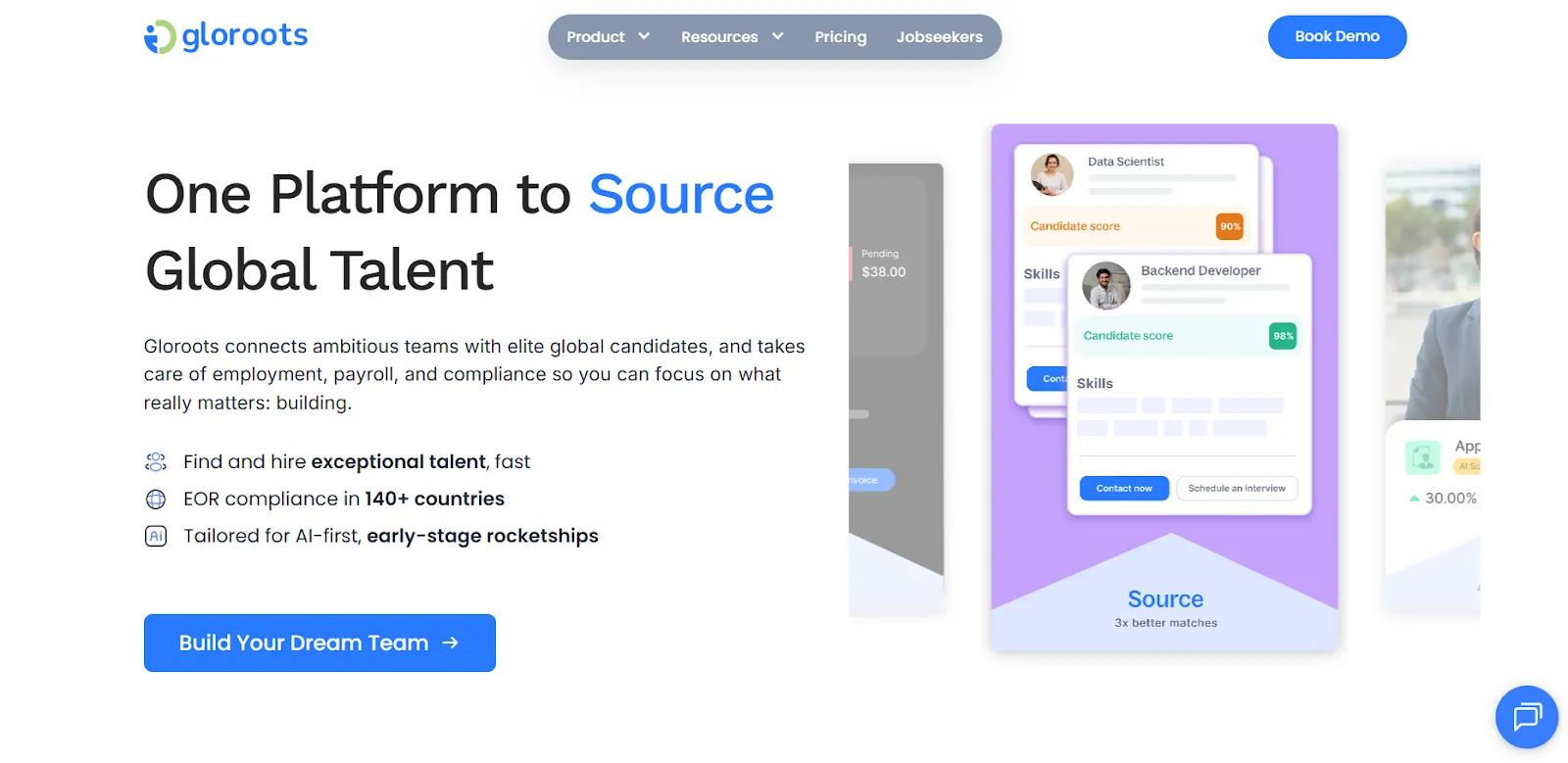
Gloroots is a global EOR platform purpose-built for companies expanding into India and establishing Global Capability Centers. It combines owned legal infrastructure with specialized GCC enablement services that accelerate time-to-productivity in high-growth markets.
The platform serves mid-market and enterprise companies hiring technical, operations, and business support teams in India while managing distributed employees across 100+ countries. Teams choose Gloroots over G-P when India represents a strategic expansion priority rather than a single-market test.
Key Features
- GCC acceleration infrastructure: Manages interim hiring while entities form, then transitions employees seamlessly, eliminating the 6-9 month hiring freeze most companies face during India incorporation.
- Owned India entity operations: Direct legal employer status ensures faster statutory filings, accurate PF/ESIC contributions, and cleaner audit trails compared to partner-dependent models.
- Contractor-to-employee conversion workflows: Purpose-built process handles Indian tax implications, gratuity calculations, and benefit transitions that often create compliance gaps with generic platforms.
- Transparent finance visibility: Line-item invoicing with country breakdowns, GL mapping, and FX transparency eliminates the "black box" invoicing that frustrates finance teams with other EOR providers.
Customer Review
"Gloroots handled our Bangalore GCC setup while we navigated entity registration. We hired 47 engineers in 4 months without the typical compliance anxiety. Support team actually understands Indian labor law, not just generic EOR processes."
Pros
- India-specific expertise reduces misclassification risk and statutory compliance errors that create expensive rectification projects with other EOR providers
- Managed service model combines self-service platform efficiency with hands-on CS support, avoiding the "figure it out yourself" approach common with scaled EOR platforms
- Pricing scales with volume and complexity, not just headcount, making India expansion economically viable compared to fixed per-employee models
Cons
- Smaller global footprint than mega-EOR providers means companies hiring across 50+ countries may need supplementary vendors for niche markets
- India specialization creates a perception of limited global capability, though 100+ country coverage handles most distributed team scenarios effectively
- Platform feature depth prioritizes compliance and finance over candidate experience features like onboarding, gamification or employee self-service portals
Why Choose Gloroots Over Globalization Partners?
- India infrastructure advantage: Owned entities deliver statutory compliance accuracy and faster payroll processing than G-P's partner-dependent APAC model
- GCC enablement: Provides interim hiring capability during entity formation, eliminating the "wait 9 months or hire compliantly" dilemma that stalls most India expansions
- Finance transparency: Audit-ready documentation and transparent cost breakdowns address the invoicing opacity and reconciliation challenges G-P customers frequently report
Pricing
Gloroots uses volume-based pricing that scales with headcount and market complexity. India hires receive preferential rates reflecting owned infrastructure economics. No setup fees for standard implementations.
2. Deel
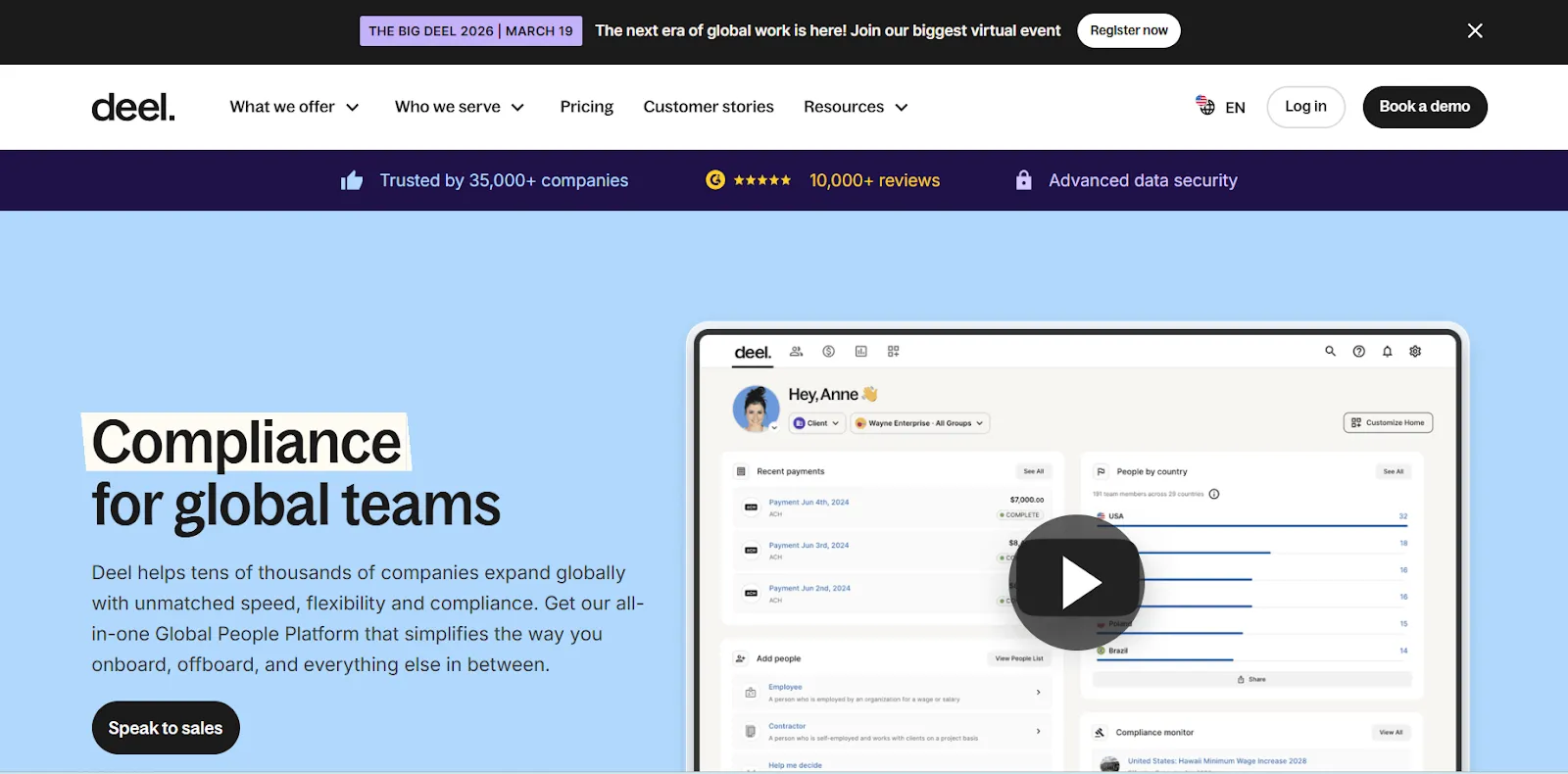
Deel is a unified global hiring platform combining EOR services, contractor management, and direct entity payroll in a single system. The platform handles employment administration across 150+ countries with a product-led approach emphasizing self-service efficiency.
Mid-market tech companies and startups use Deel to manage mixed workforce models. Teams choose Deel over G-P when they need integrated contractor and employee management without switching platforms or want to avoid G-P's variable pricing structure.
Key Features
- Flat-rate EOR pricing: $599 per employee per month across all countries, eliminating cost variance and FX markup unpredictability that G-P builds into every invoice.
- Contractor + EOR hybrid platform: Manages contractors and employees from the same dashboard, solving fragmentation when using separate tools for each workforce type.
- Self-service onboarding workflows: Employees complete document uploads, contract signing, and benefits enrollment without HR intervention, reducing onboarding from 5-7 days to under 48 hours.
- API-first architecture: Robust developer tools allow HRIS integration and custom workflow automation that standardized EOR platforms treat as professional services engagements.
Customer Review
"Deel consolidated our contractor chaos and made international hiring feel like domestic onboarding. Dashboard is intuitive. Compliance updates are proactive. Support is solid for Tier 1 markets but gets generic in APAC." (Capterra review)
Pros
- A single platform for contractors and employees eliminates vendor fragmentation and reduces administrative overhead when managing mixed workforce models across regions
- Self-service platform prioritizes speed and autonomy, making it ideal for product teams that resist heavyweight HR processes or lengthy implementation cycles
- Transparent pricing with published rates builds trust and simplifies budgeting compared to quote-based models that obscure true cost until contracts are finalized
Cons
- Compliance depth varies significantly between established and emerging markets, with generic guidance that sometimes misses jurisdiction-specific nuances
- Support quality degrades at scale, with larger customers reporting ticket backlogs and less responsive account management than during initial onboarding
- Benefits competitiveness lags local market expectations in APAC, where statutory minimums meet legal requirements but fail talent retention benchmarks
Why Choose Deel Over Globalization Partners?
- Flat-rate pricing saves 15-20% on total employment costs compared to G-P's variable model, particularly for teams hiring in high-cost countries
- Unified workforce management eliminates platform switching when teams include mixed employment types across markets
- Developer-friendly integration enables custom workflows that G-P treats as enterprise-tier customizations requiring professional services
Pricing
Deel EOR pricing starts at $599 per employee per month with transparent rate cards published by the market. Contractor management begins at the lower tiers. Volume discounts available for teams exceeding 50 employees.
3. Remote
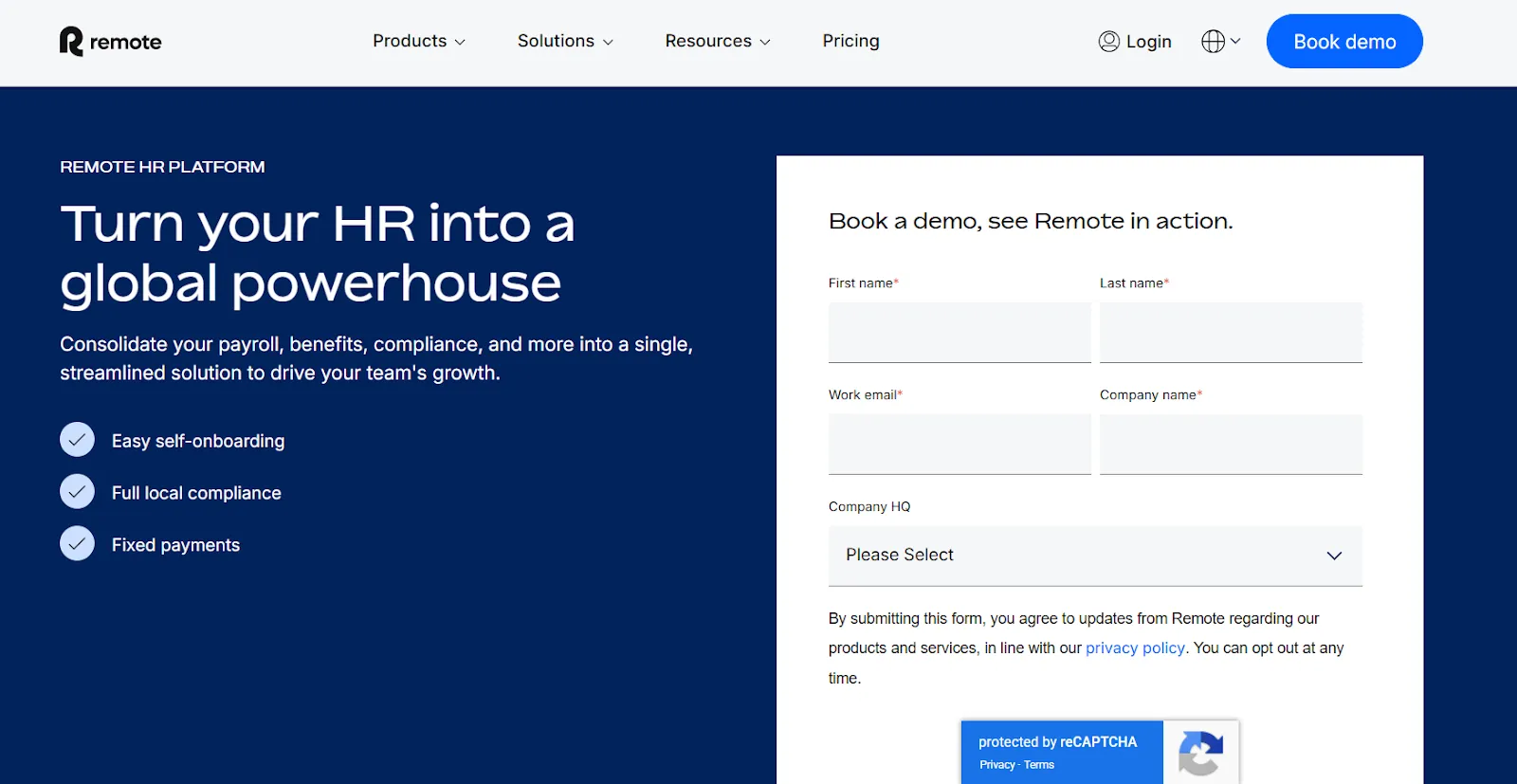
Remote is a compliance-first EOR platform emphasizing legal risk mitigation, data privacy, and intellectual property protection for distributed teams. The platform covers 80+ countries with owned entities and operates with a "compliance-over-convenience" philosophy.
Enterprise companies in regulated industries (finance, healthcare, legal services) and European teams prioritizing GDPR compliance use Remote for employment administration. Teams choose Remote over G-P when regulatory risk outweighs operational speed or when G-P's broader coverage isn't needed.
Key Features
- GDPR-native architecture: Purpose-built data handling and employee privacy controls meet European regulatory standards without retrofitting, addressing cross-border data transfer complexities.
- IP protection templates: Standardized intellectual property assignment agreements protect company ownership across jurisdictions, closing gaps that generic employment contracts often miss.
- Compliance liability insurance: Platform includes professional liability coverage for employment-related claims, transferring risk more completely than standard EOR indemnification clauses.
- Tax optimization modeling: Provides permanent establishment risk analysis and tax exposure forecasting before hiring, preventing expensive restructuring after expansion begins.
Customer Review
"Remote's compliance rigor gave our legal team confidence to approve European expansion. Documentation is audit-ready out of the box. Support understands regulatory nuance, not just payroll mechanics."
Pros
- Compliance infrastructure prioritizes legal risk mitigation over operational convenience, making it ideal for regulated industries where employment errors create material liability
- GDPR and data privacy controls meet European regulatory expectations without customization, addressing concerns that make generic EOR providers unacceptable for sensitive data handling
- Transparent entity ownership structure clarifies legal employer responsibility and simplifies liability assessment compared to partner-dependent models that obscure accountability
Cons
- A compliance-first approach sometimes creates operational friction, with approval workflows and documentation requirements that slow hiring velocity compared to product-led competitors
- Smaller country coverage than broad-footprint providers limits options for companies expanding into emerging markets or niche jurisdictions
- Premium pricing reflects compliance depth and legal infrastructure, making Remote more expensive than platforms that optimize for volume and operational efficiency
Why Choose Remote Over Globalization Partners?
- Legal protection depth: Compliance liability insurance and risk mitigation tools provide protection that G-P's standard indemnification clauses don't match
- European compliance: GDPR-native architecture meets data privacy requirements without retrofitting or workarounds
- IP safeguards: Protection templates and data processing agreements come standard rather than requiring custom legal work
Pricing
Remote EOR pricing is $599 per employee per month with annual billing. Setup fees apply for new market activations. Enterprise plans include compliance advisory and dedicated legal support.
4. Oyster HR
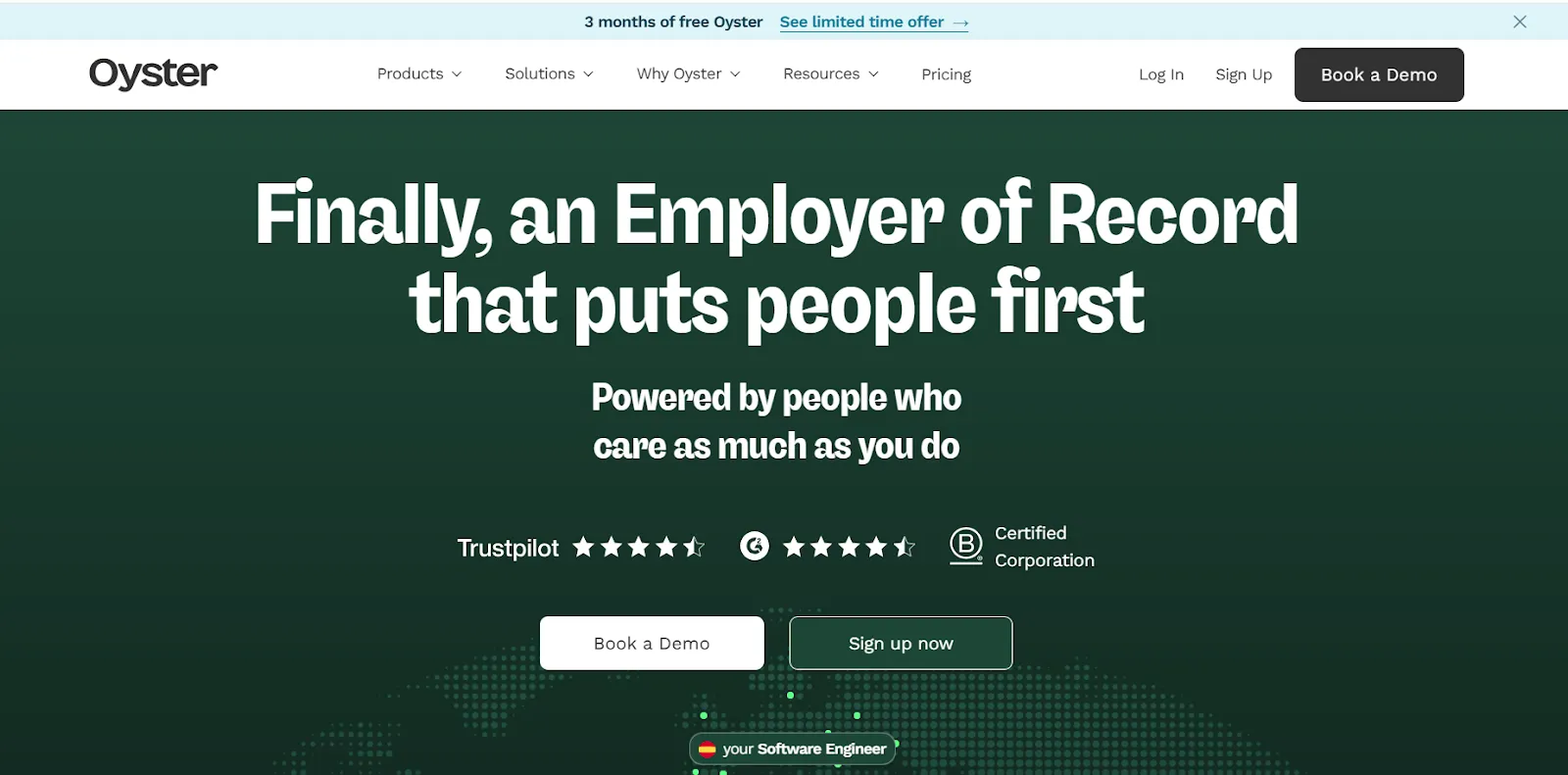
Oyster HR is a remote-first EOR platform combining employment administration with distributed team enablement tools. The platform covers 180+ countries and emphasizes employee experience features alongside compliance fundamentals.
Fully remote companies and distributed-first startups use Oyster for EOR services. Teams choose Oyster over G-P when employee experience and distributed team enablement matter as much as employment compliance, or when G-P's $699/month baseline exceeds budget.
Key Features
- Fair pricing philosophy: $499/employee/month across all countries with no FX markups or hidden fees, undercutting G-P's baseline by 29%.
- 48-hour onboarding: Activates employees in under 2 days compared to G-P's 5-7 day average, critical for startups competing in fast-moving hiring markets.
- Location-agnostic compensation: Benchmarking tools that normalize pay across geographies based on role and experience, not just local market rates, supporting remote-first compensation philosophies.
- Distributed team playbooks: Templates and workflows for async collaboration, timezone management, and remote onboarding that help distributed teams operate effectively.
Customer Review
"Oyster felt purpose-built for remote companies, not retrofitted EOR with bolted-on features. Compensation tools aligned with our location-agnostic philosophy. Employee onboarding was smooth across 12 countries." (Capterra review)
Pros
- $499/month flat pricing makes Oyster the most cost-effective EOR for SMBs hiring in expensive markets where G-P's premiums exceed $850/employee/month
- Remote-first design philosophy creates employee experience that matches distributed team expectations, improving satisfaction and reducing HR friction
- Location-agnostic compensation tools support progressive pay philosophies that generic EOR platforms don't accommodate, addressing cultural fit for remote-native companies
Cons
- Broader feature scope sometimes dilutes core EOR functionality, with compliance depth occasionally lagging specialized competitors in complex jurisdictions
- Smaller scale affects pricing leverage and platform stability compared to mega-platforms, with occasional performance issues during high-volume payroll processing
- Remote-first positioning creates a perception mismatch for hybrid and office-first companies, even though EOR functionality works regardless of work model
Why Choose Oyster Over Globalization Partners?
- 29% lower pricing ($499 vs $699/month) makes international hiring financially viable for startups that can't absorb G-P's premium costs
- Employee experience: Distributed team features improve satisfaction and reduce People Ops administrative burden
- 48-hour onboarding reduces time-to-productivity and helps teams close candidates faster in competitive markets
Pricing
Oyster pricing starts at $499 per employee per month for EOR services. Contractor management is available at lower tiers. Platform features are included at all levels without premium tier gating.
5. Papaya Global
Papaya Global is an enterprise-focused EOR and global payroll platform emphasizing finance integration, multi-entity consolidation, and audit-ready reporting. The platform serves Fortune 500 companies and publicly traded enterprises managing complex employment structures.
Enterprise finance teams, global mobility directors, and corporate controllers use Papaya for employment administration. Teams choose Papaya over G-P when financial visibility and multi-entity management outweigh cost or implementation speed.
Key Features
- Automated GL mapping: Direct integration with major ERP systems (SAP, Oracle, NetSuite) eliminates manual journal entries and reduces month-end close complexity for multi-country operations.
- Multi-entity consolidation: Aggregates data across owned entities and EOR relationships into unified dashboards, providing CFO-level visibility that fragmented vendor relationships obscure.
- Audit-ready documentation: Maintains complete employment history, payroll records, and statutory filing evidence with timestamp trails meeting SOX and external audit requirements.
- Currency risk management: Provides FX hedging tools and predictive budgeting that protect P&L from currency fluctuations affecting global payroll expense.
Customer Review
"Papaya transformed our global payroll from a finance nightmare to an automated close process. Multi-entity reporting finally works. Audit trails are clean. Implementation required serious change management, but operational ROI justified the effort." (G2 review)
Pros
- Finance-first architecture provides GL automation and audit documentation that generic EOR platforms ignore, significantly reducing manual reconciliation work
- Multi-entity consolidation delivers CFO-level visibility across hybrid structures combining owned entities and EOR relationships
- Enterprise support model includes dedicated implementation teams and ongoing advisory, matching the complexity expectations of publicly traded companies
Cons
- Enterprise-only focus creates high implementation barriers and pricing floors that exclude mid-market companies
- Complex implementation timelines (3-6 months typical) delay time-to-value and require significant change management
- Platform complexity demands dedicated internal resources for ongoing administration, making it overkill for companies without full-time global mobility teams
Why Choose Papaya Over Globalization Partners?
- Finance automation: GL mapping and multi-entity consolidation that G-P leaves as manual finance team responsibilities
- Audit compliance: Documentation meets SOX and external audit standards out of the box
- Enterprise support: Dedicated implementation and ongoing advisory that matches Fortune 500 expectations
Pricing
Papaya Global uses custom enterprise pricing based on employee count, entity complexity, and integration requirements. Minimum commitments apply. Pricing typically exceeds $100K annually for baseline implementations.
6. Velocity Global

Velocity Global is an EOR and workforce management platform specializing in enterprise compliance, regulated industries, and M&A workforce integration. Velocity owns legal entities in 185+ countries and provides dedicated legal, HR, and payroll teams for each market.
Enterprise companies (500+ employees) in finance, healthcare, government contracting, and defense use Velocity for employment administration. Teams choose Velocity over G-P when they need white-glove service for complex terminations, works council negotiations, and regulatory audits.
Key Features
- Enterprise-grade compliance infrastructure: Provides dedicated legal counsel in every country, audit-ready documentation, and policy libraries designed for heavily regulated industries.
- M&A workforce integration: Handles employee transitions during acquisitions, including contract harmonization, benefits migration, and compliance risk assessments across legacy entities.
- Works council management: Navigates European works council requirements, collective bargaining agreements, and employee representative consultations.
- Equity administration support: Manages RSUs, stock options, and equity vesting schedules across global teams.
Customer Review
"Velocity handled our Germany works council negotiation flawlessly. G-P couldn't offer that level of legal support."
- Enterprise compliance depth exceeds G-P in heavily regulated markets like Germany, France, and the UAE
- M&A integration expertise helps acquirers consolidate international teams without compliance gaps
- The white-glove service model provides dedicated account teams, legal counsel, and HR advisors
Cons
- Premium pricing often exceeds G-P by 10-15%, making Velocity cost-prohibitive for startups and SMBs
- Minimum contract size (typically 50+ employees) excludes smaller teams exploring international expansion
- Platform user experience lags behind modern EOR tools like Deel and Remote
Why Choose Velocity Over Globalization Partners?
- Deeper compliance expertise in regulated industries like finance, healthcare, and defense
- M&A workforce integration capabilities that G-P doesn't offer
- White-glove service provides dedicated legal and HR counsel vs G-P's tiered support structure
Pricing
Velocity uses custom enterprise pricing based on headcount, country mix, and service complexity. Typical costs range from $750-$950/employee/month, exceeding G-P in most markets but justified for companies prioritizing compliance depth.
7. Multiplier
Multiplier is an APAC-focused EOR platform with deep coverage in Southeast Asian and South Asian markets. The platform emphasizes localized benefits administration and regional compliance expertise over broad global footprints.
Growth-stage companies expanding into Singapore, India, the Philippines, Vietnam, and Indonesia use Multiplier for employment administration. Teams choose Multiplier over G-P when APAC represents a core expansion strategy, and G-P's global pricing doesn't reflect regional economics.
Key Features
- APAC pricing advantage: Charges $400-$450/employee/month in APAC compared to G-P's $699+ baseline, reducing employment costs by 35-40%.
- Localized benefits benchmarking: Provides market-competitive benefits packages based on local talent expectations, not just statutory minimums that hurt retention.
- Regional payroll calendars: Handles market-specific payroll cycles, public holiday variations, and payment timing nuances that generic global platforms often mishandle.
- Multi-language support: Platform and CS support available in regional languages, including Mandarin, Bahasa Indonesia, and Tagalog.
Customer Review
"Multiplier understood our Singapore and Philippines expansion better than global platforms, treating APAC as an afterthought. Benefits were locally competitive. Payroll never missed a cycle. The support team knows regional labor law." (G2 review)
Pros
- 35-40% lower pricing in APAC makes Multiplier the most cost-effective option for teams hiring heavily in India, the Philippines, and Vietnam
- APAC specialization provides compliance depth and local market expertise that broad-footprint EOR providers treat as commoditized coverage
- Regional focus enables faster implementation and more responsive support compared to global platforms, spreading resources across 150+ countries
Cons
- Limited coverage outside APAC creates vendor fragmentation for companies hiring globally
- Smaller scale than mega-platforms affects pricing leverage and feature development velocity
- Platform maturity lags market leaders in areas like API capabilities and HRIS integrations
Why Choose Multiplier Over Globalization Partners?
- 35-40% cost savings in APAC markets make Multiplier the clear choice for startups building regional teams
- Regional depth: APAC-first approach provides compliance expertise and benefits competitiveness that G-P's broad coverage sacrifices
- Owned APAC infrastructure: Ensures faster payroll processing and cleaner statutory compliance than partner-dependent models
Pricing
Multiplier charges $400-$450/employee/month in APAC markets and $550-$650/month in EMEA/Americas. Contractor management costs $25/month per contractor. Volume discounts available for teams exceeding 50 employees.
8. Remofirst
Remofirst is a budget-friendly EOR platform targeting startups and small teams hiring their first 5-20 international employees. Remofirst covers 180+ countries through third-party partnerships and focuses on basic compliance, fast onboarding, and low-cost pricing.
Early-stage startups (pre-Series A) with limited budgets use Remofirst for employment administration. Teams choose Remofirst over G-P when cost is the primary constraint and G-P's $699+ pricing is prohibitive.
Key Features
- $199/employee/month pricing: The lowest-cost EOR on the market, making international hiring financially viable for bootstrapped startups that can't absorb G-P's premium.
- Fast onboarding (24-48 hours): Activates employees faster than any competitor, critical for startups moving quickly in competitive talent markets.
- Self-service platform: Minimalist dashboard for contract signing, payroll processing, and document management.
- Basic contractor management: Handles contractor payments at $19/month per contractor.
Customer Review
"First, let us hire internationally on a startup budget. We couldn't have afforded G-P." (Capterra review, Founder at pre-seed startup with 8 employees)
Pros
- $199/month pricing is 72% cheaper than G-P, making international hiring accessible for bootstrapped startups testing new markets
- 24-48 hour onboarding is the fastest in the industry
- Self-service simplicity reduces onboarding friction for founders and small teams without dedicated HR staff
Cons
- Compliance support is basic and reactive rather than proactive, creating risk in complex markets
- Benefits packages are statutory minimums only
- No dedicated account management or white-glove support
Why Choose Remofirst Over Globalization Partners?
- 72% cost savings ($199 vs $699/month) make international hiring financially viable for bootstrapped startups
- Fastest onboarding (24-48 hours) helps startups close candidates quickly in competitive markets
- Self-service simplicity matches early-stage operational maturity better than G-P's enterprise processes
Pricing
Remofirst charges $199/employee/month (all countries) and $19/contractor/month. No setup fees, no hidden costs, but minimal support beyond basic compliance.
9. Atlas HXM
Atlas HXM is a direct EOR provider with owned entities in 160+ countries. The platform emphasizes legal entity clarity and risk mitigation for enterprise companies managing complex global operations.
Large enterprises and publicly traded companies use Atlas for employment administration. Teams choose Atlas over G-P when legal entity transparency and risk transfer completeness outweigh platform innovation or cost efficiency.
Key Features
- Direct entity ownership: Owned legal entities in 160+ countries eliminate partner dependencies and clarify employer responsibility for liability and compliance obligations.
- Risk mitigation focus: Comprehensive liability insurance and legal indemnification provide protection depth that standard EOR contracts don't match.
- Regulatory monitoring: Proactive tracking of employment law changes with impact analysis and compliance adjustment recommendations.
- Audit trail documentation: Complete employment records with timestamp trails and approval workflows meet SOX and external audit requirements.
Customer Review
"Atlas provided the legal entity clarity and liability protection our general counsel demanded. Documentation met audit standards. Not the most user-friendly platform, but risk mitigation justified complexity." (G2 review)
Pros
- Direct entity ownership clarifies legal employer responsibility and eliminates partner dependencies that create liability ambiguity
- Comprehensive liability protection and risk mitigation tools provide coverage depth that matches enterprise risk management expectations
- Regulatory monitoring and proactive compliance guidance reduce exposure to employment law changes
Cons
- Enterprise focus and pricing create accessibility barriers for mid-market companies
- Platform user experience lags consumer-grade competitors, with workflows prioritizing documentation completeness over operational efficiency
- A conservative risk posture sometimes creates operational friction with approval processes that slow hiring velocity
Why Choose Atlas Over Globalization Partners?
- Entity clarity: Direct ownership eliminates partner dependencies and provides legal employer transparency
- Risk protection: Comprehensive liability insurance and mitigation tools deliver protection depth beyond standard indemnification
- Proactive compliance: Regulatory monitoring and guidance reduce exposure to employment law changes
Pricing
Atlas uses custom enterprise pricing based on employee count, entity complexity, and risk profile. Pricing typically ranges from $900 to $1,400 per employee per month. Set up fees and minimum commitments standard.
10. Horizons (formerly Globalpeo)
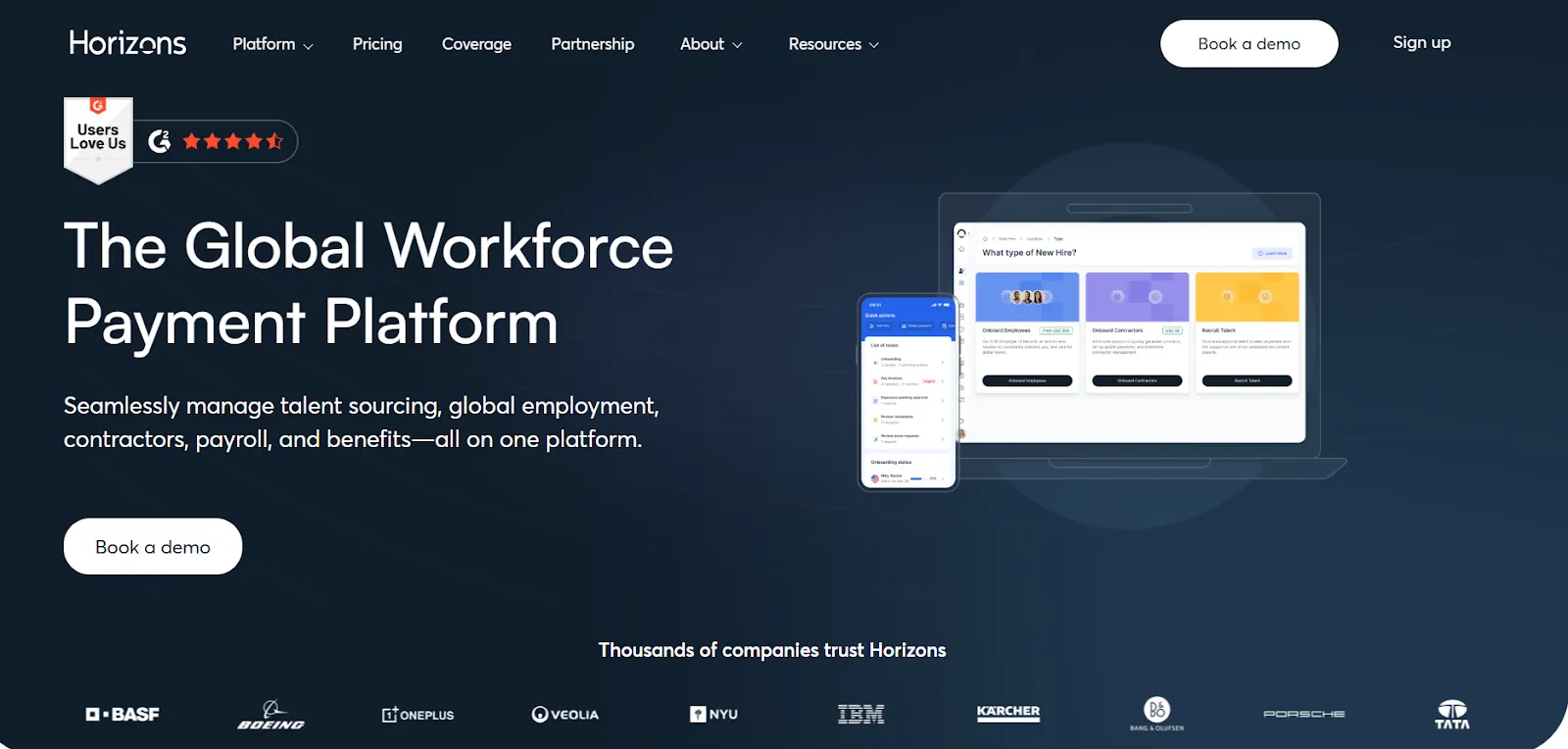
Horizons is a recruitment-focused EOR provider combining employment administration with talent sourcing services. The platform covers 180+ countries and emphasizes end-to-end hiring support.
Companies entering new markets without existing recruiting infrastructure use Horizons for employment administration. Teams choose Horizons over G-P when they need recruiting support alongside EOR services.
Key Features
- Integrated talent sourcing: In-house recruiting team provides candidate pipelines and screening support, eliminating separate recruiting agency relationships.
- Local market salary data: Compensation benchmarking based on real hiring data improves offer competitiveness and reduces talent acquisition cycle time.
- Candidate screening: Pre-vetted candidate shortlists reduce hiring manager burden and accelerate time-to-hire in unfamiliar markets.
- Onboarding coordination: End-to-end support from offer acceptance through first day reduces hiring manager administrative load.
Customer Review
"Horizons' recruiting support transformed our Latin America expansion. Candidate quality was strong. Salary guidance prevented overpricing. EOR administration was solid, though not the most feature-rich platform."
Pros
- Integrated recruiting eliminates separate talent sourcing relationships and reduces vendor fragmentation when entering new markets
- Local market expertise improves candidate quality and salary competitiveness compared to hiring blindly in unfamiliar markets
- End-to-end support from sourcing through onboarding reduces the hiring manager's administrative burden
Cons
- Recruiting focus sometimes dilutes core EOR functionality, with platform features occasionally lagging specialized competitors
- Bundled recruiting and EOR services create pricing opacity and make cost comparison difficult
- Smaller scale affects platform stability and feature development velocity
Why Choose Horizons Over Globalization Partners?
- Recruiting integration: Eliminates separate talent sourcing relationships when entering markets without existing hiring infrastructure
- Market intelligence: Local salary data and candidate screening improve hiring quality and speed
- End-to-end coordination: Reduces hiring manager burden from sourcing through onboarding
Pricing
Horizons uses custom pricing based on employee count and recruiting support level. EOR-only pricing starts around $650 per employee per month. Recruiting services add incremental fees based on headcount and sourcing complexity.
How Do You Choose the Right EOR Provider for Your Expansion Strategy?
Choosing an EOR isn't about finding the "best" provider. It's about matching capabilities to your expansion priorities, risk tolerance, and operational maturity.
1. What Markets Are You Actually Hiring In?
Country count doesn't matter if the provider lacks a strong infrastructure where you're expanding. A provider with owned entities in your top 3 markets outperforms one with 185 countries through partner networks.
Key considerations:
- Check entity ownership structure (owned vs partner) in your target markets
- Verify local payroll processing speed and statutory filing accuracy
- Ask about regional support coverage and language capabilities
- Understand compliance incident history and resolution timelines in your priority markets
2. How Much Compliance Risk Can You Actually Absorb?
Risk transfer completeness varies dramatically between providers. Some EOR contracts include professional liability insurance and comprehensive indemnification. Others limit liability to fee refunds and leave misclassification exposure with you.
Evaluation checklist:
- Review indemnification clauses and insurance coverage details
- Understand what happens when classification errors or statutory violations occur
- Ask about historical compliance incidents and resolution timelines
- Verify who owns legal liability if labor ministry audits happen
3. What Does Your Finance Team Need for Month-End Close?
Generic invoicing creates reconciliation nightmares. Your EOR invoice should integrate with your close process, not add manual work.
Finance requirements:
- Line-item cost breakdowns by country, employee, and expense type
- Automated GL mapping and accounting system integration
- Transparent FX rates with clear markup disclosure
- Audit-ready documentation with complete payment trails
4. Are You Building a Temporary Presence or Long-Term Operations?
EOR makes sense for market testing, pre-entity hiring, and managing small distributed teams. It becomes expensive at scale and creates friction when transitioning to owned entities.
Decision framework:
- If planning 50+ employees in a market within 18 months, model entity formation costs and timelines
- Calculate the break-even point where the owned entity becomes more economical
- Understand employee transition complexity when moving from EOR to an owned entity
- Consider hybrid models for phased expansion strategies
5. What Happens When Something Breaks at 2 a.m. local time?
Support quality matters more than dashboards when payroll fails or compliance issues surface. Generic ticket queues don't work when facing labor ministry audits or employee disputes requiring immediate local expertise.
Support evaluation:
- Test CS responsiveness during vendor evaluation (submit real questions)
- Ask for escalation procedures and SLA commitments
- Verify regional support coverage and language capabilities
- Request references from customers in your target markets
Why Gloroots Works Better Than Globalization Partners for India Expansion
Gloroots was purpose-built for companies treating India as a strategic expansion priority, not just another EOR market. While G-P offers broad global coverage, Gloroots delivers specialized India infrastructure and GCC acceleration expertise that generic global EOR providers simply can't match.
Gloroots vs Globalization Partners: India Expansion Features
Here's what makes Gloroots different:
1. Owned Indian infrastructure means better compliance:
Gloroots operates through its own legal entities in India, not partner networks. This means accurate statutory compliance handling for PF, ESIC, gratuity, and professional tax. Payroll processes faster and audit trails stay cleaner compared to G-P's partner-dependent APAC model, which often creates filing delays and reconciliation headaches.
2. GCC acceleration solves the expansion timeline problem:
Most companies face a painful choice: wait 9 months for entity formation or skip India hiring entirely. Gloroots eliminates this dilemma. You can hire immediately under Gloroots' entity while your own India entity forms in the background. Once your entity is ready, employees transition seamlessly with zero payroll disruption.
3. Local expertise that understands India, not just global templates:
Gloroots provides India-specific labor law guidance, compensation benchmarking for tech talent, and recruiting support. The CS team understands Indian employment nuances like notice periods, gratuity calculations, and contractor-to-employee conversions. You're not getting generic global templates applied to India.
4. Finance visibility that actually helps your team:
Get line-item invoicing with country-level cost breakdowns, transparent FX rates, GL mapping support, and audit-ready documentation. No more "black box" invoicing that finance teams struggle to reconcile at month-end, a complaint that shows up frequently in G-P customer reviews.
Gloroots is the right fit if you're:
- Hiring 10+ employees in India within the next 12 months
- Establishing a Global Capability Center and needs immediate hiring while your entity forms
- Looking for a hybrid model that combines EOR flexibility with owned entity economics as you scale
- Prioritizing cost predictability and transparent invoicing over broad global coverage
Ready to explore how Gloroots handles India expansion and GCC setup?
Talk to our team about your specific hiring timeline, compliance requirements, and entity transition strategy.
Frequently Asked Questions About Globalization Partners Pricing & Alternatives
1. What are the top Globalization Partners alternatives for global hiring?
Gloroots for India expansion, Deel for contractor-employee management, Remote for European compliance, Multiplier for APAC, and Papaya Global for enterprise finance. Choice depends on your target markets and priorities.
2. Is Globalization Partners suitable for large-scale international expansion?
G-P covers 180+ countries but struggles at scale with declining support quality, rising costs beyond 50 employees (no volume discounts), and limited flexibility for hybrid models combining EOR with owned entities. Specialized alternatives often perform better when the geographic focus is clear.
3. How does Gloroots compare to Globalization Partners for India hiring?
Gloroots owns India infrastructure for faster payroll (2-3 days vs 5-7 days) and accurate compliance. GCC acceleration eliminates 6-9 month entity formation delays. Local expertise and finance transparency (line-item invoicing) exceed G-P's generic APAC treatment. G-P offers broader global coverage (180+ vs 100+ countries).
4. What is the best free alternative to Globalization Partners?
No legitimate free EOR exists due to compliance infrastructure costs and legal liability. Remofirst ($199/month) is the lowest-cost option for basic compliance. Deel and Oyster offer more robust features at $599 and $499/month, respectively, balancing cost and compliance depth.

Ready to take the first step?
Request a demo now and learn how you can focus on building, without worrying for compliance, ever!